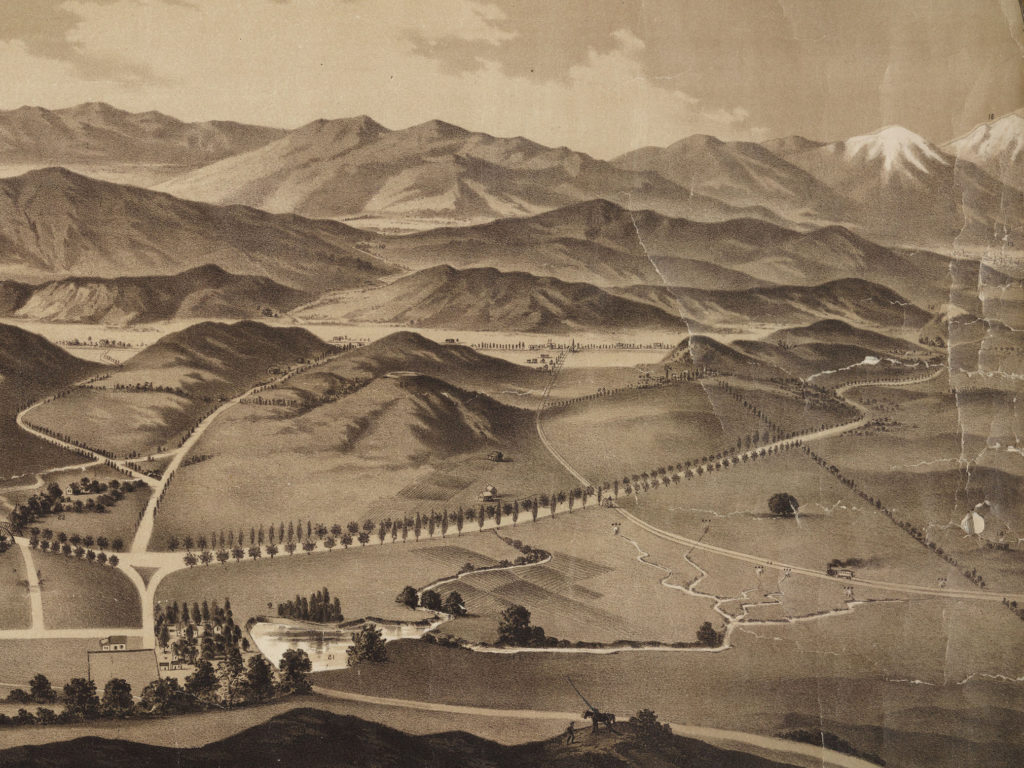
The proposed Garvanza–Eagle Rock Railway, complete with a mountain pass toward Pasadena that does not exist. Southern California real-estate promotion at its most geographically imaginative. Vintage advertisement, late 1880s, The Huntington Library, via Eagle Rock Valley Historical Society.
Optional Listening: Pete Yorn, Life on a Chain (2001). A little Southern California radio energy for the amazing drive along York Boulevard in Los Angeles.
Andrew J Lewis
For nearly twenty-five years, I assumed Eagle Rock, California, was named for a rock. Presumably one resembling an eagle. This seemed reasonable, although I never saw either. In fact, I barely remember seeing a hill.
Eagle Rock, as I encountered it in 2000 and 2001, seemed remarkably flat. Houses, storefronts, churches, and streets occupied nearly every available square foot. The San Gabriel Mountains were nearby, but Southern California had a way of filling its valleys with so much civilization that the underlying geography became difficult to discern.
Only recently did I discover that Eagle Rock is named for a geological formation whose shadow, under the right conditions, resembles an eagle in flight. The eagle, in other words, is an optical effect. As something of birder, this is information I would have appreciated considerably earlier.
I was living at 266 Thorne Street in Garvanza, finishing my dissertation while working at the Huntington Library. A bit over two miles away, just off York Boulevard near Occidental College, two very good friends were living in a modest rented house.
One was a young assistant professor at Occidental. The other was finishing a dissertation. They were a couple, and had somehow assembled what struck me as a nearly perfect domestic arrangement.
But first, York Boulevard.
The drive between our homes was almost entirely along York, a bit over two miles that could seem either interminable or distressingly brief.
When I was tired, hungry, and operating on a graduate student’s budget, it was much too long. My friends had food. They were generous with it. I wanted to get there. At other times, I wanted the drive to last forever.
York Boulevard offered an extraordinary assortment of human activity. Storefronts selling things I couldn’t identify. Little parks. A staggering number of piñatas and more restaurants than I could count. It had churches representing apparently every denomination of Christianity, conducting services in every language ever spoken, as well as a Jewish temple and storefront operations for other faith traditions. Plus, it had men standing on corners, engaged in the ancient and universal practice of standing on corners.
Unfortunately, other motorists regarded York Boulevard primarily as a means of getting somewhere. They were forever attempting to make me drive faster.
Once, I stopped at Galco’s Soda Pop Stop to investigate its extraordinary collection of obscure and nearly extinct soft drinks. I was unprepared for how frightening I found all of these carbonated zombie solutions, some of which I suspected might be radioactive. I left after three minutes without buying anything and have no intention of ever returning.
Most days, however, I continued toward Eagle Rock.
The house was modest, with a comfortable interior, a small backyard, and a little patch of lawn. Two exceptionally intelligent people lived there, cooking meals, reading books, writing and enjoying themselves.
Apparently, this was possible. You could be a dork, find another dork who was attractive and intelligent, rent a little house in Southern California, and establish a perfectly satisfactory civilization. Amazing.
And then there was the artichoke. Growing in their front garden, entirely without invitation, was an actual artichoke plant. A weed, apparently, which had taken it upon itself to produce an artichoke. I knew artichokes from grocery stores and dinner plates, but here was the living organism, producing its extraordinary edible flower bud in an ordinary residential garden.
As a historian of early American natural history, I examined this suburban marvel with something approaching the excitement of an eighteenth-century explorer encountering an unfamiliar species. California has the most remarkable weeds!
Inside, meanwhile, we had established a republic of dorks. We talked constantly. History, politics, books, academic gossip, the future of civilization, and anything else that came to mind. No subject was too important to discuss seriously, and none too ridiculous to occupy an entire evening.
I contributed occasional predictions of spectacular stupidity. I once expressed grave doubts about the commercial prospects of something called the iPod. My friends rolled their eyes. They had considerable practice. Eventually, we all moved on.
I finished my dissertation and moved to Washington DC. My friends married that fall, choosing, without consulting me, to hold their wedding on my birthday. This became a running joke, and an exceptionally convenient way to remember one another’s anniversaries.
Eventually, I left academia, and for years I wanted little to do with the life I’d once imagined spending there.
But the friendships continued. Sometimes a birthday greeting was also an anniversary greeting. Sometimes a conversation resumed after months or years, with remarkably little need to explain where we’d left off.
Back in Garvanza, at 266 Thorne Street, I was completing a dissertation and beginning to experience physical changes I couldn’t yet explain. That was one part of my California dream.
A bit over two miles away, just off York Boulevard, there was another. A little house. A patch of lawn. An artichoke growing where nobody had planted it. Dinner, conversation, and friends.
I traveled between those two places throughout the year, generally without any sense that the journeys were especially consequential. I was usually hungry, distracted by storefronts, or annoyed by drivers who wanted me to hurry along. And all that time, somewhere above the houses and streets of Eagle Rock, a shadow was occasionally taking the shape of a bird.
I never saw it.
I was having too good a time.
Optional Listening: Nick Drake, Pink Moon (1972). Rediscovered by way of a Volkswagen commercial, and adopted by one republic of dorks.