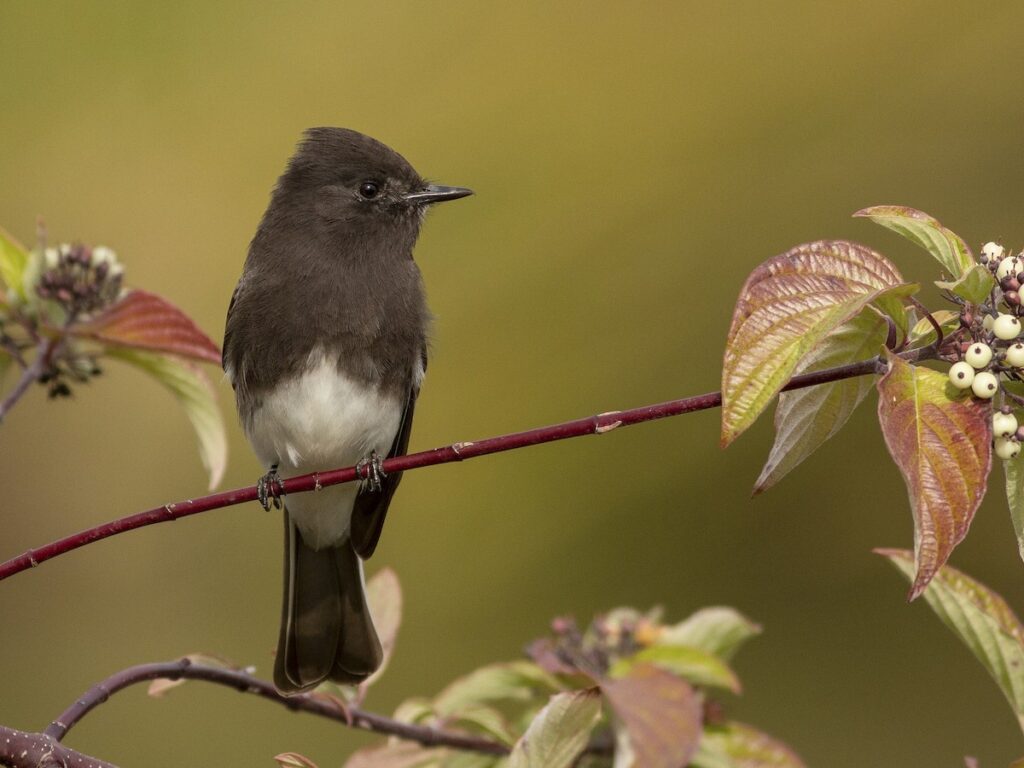
Black Phoebe. (Sayornis nigricans.)
Photograph © Paul Fenwick. Courtesy Macaulay Library, Cornell Lab of Ornithology.
Andrew J Lewis
One of the great pleasures of working at the Huntington Library in San Marino, California as a graduate student was lunch.
There were, obviously, other pleasures. The San Gabriel Mountains rose behind the place. The gardens were extraordinary. Southern California offered sunshine and fresh air in quantities that seemed indecent to someone accustomed to spending his days inside libraries in Northfield or New Haven. There were also the collections themselves: I had somehow been given permission to spend my days reading old things and thinking about early America in one of the most beautiful research institutions in the world.
And there was a heavily discounted lunch.
This mattered. I was a graduate student. Food was a budgetary and caloric daily riddle. For an amount of money I could plausibly spend, the Huntington would feed me something containing protein and actual vegetables. (My mother was elated when she learned about this feature of my fellowship. Still is.)
The library also closed for some period around lunchtime—for at least 60 minutes, I recall—and forced us nerds out into all that Southern California. So, each day I would emerge from whatever seventeenth- to nineteenth-century problem had occupied the morning, walk through the grounds to eat, chit-chat, then walk back.
Somewhere along that route lived Black Phoebes. I remember them in particular working from a low, spreading oak. This memory may be completely wrong. The tree might have been a massive eucalyptus. Twenty-five years have passed, and apparently my memory has preserved the bird while allowing the botany to reorganize itself.
Black Phoebes are flycatchers. More specifically, they belong to the genus Sayornis, named for the early American entomologist Thomas Say. I knew Thomas Say. He was one of those early American naturalists I encountered while spending my days reading about early American naturalists inside the Huntington Library.
Which makes it slightly ridiculous, in retrospect, that I’d be forced to leave the library for lunch and encounter him again outside. Not Thomas Say himself, obviously. He’s been dead since 1834. But Sayornis.
There are three phoebes in the genus Sayornis: Eastern, Black, and Say’s. The Black Phoebe is Sayornis nigricans. One can descend toward it taxonomically: Bird. Passerine. Tyrant flycatcher. Phoebe. Sayornis. Black Phoebe. I knew almost none of that then.
What I knew was what the bird did.
Sit. Flick-bob tail.
Watch. Sally out after an insect. Succeed or fail. Return to branch. Eat, perhaps. Chirp. Sometimes poop. Repeat.
After enough lunches I began assigning meaning to the chirps. Now, I should emphasize that I have no scientific basis whatsoever for the translations that follow. But spend enough time watching an animal work and eventually you begin inventing dialogue. Plus, my Black Phoebes seemed remarkably wholesome.
Sit. Watch. Sally. Miss. Return. Shoot! Almost had that one. Flick-bob.
Sit. Watch. Sally. Miss. Return. Fiddlesticks! Flick-bob.
Sit. Watch. Sally. Success! Return. Eat. Oh yeah, that’s the good stuff. Flick-bob.
They reminded me of the perpetually delighted bat kid who cannot quite believe somebody lets him or her stand this close to Major League Baseball. Success was exciting. Failure was also exciting, because failure meant another chance at success.
Only once do I remember hearing anything I would categorize as genuine profanity. It was raining. The day was dreadful. The bugs, I assume, had enough sense to be somewhere else. Damnit, missed! Fair enough. Even the luckiest Sayornis on Earth is allowed a bad day.
In hindsight, I suspect memory has made this rosier than it was. I was conducting a badly biased observational study. I generally encountered these birds on pleasant Southern California days when a graduate student wanted to walk through the gardens. I wasn’t monitoring Black Phoebe morale through five straight days of rain, an insect shortage, territorial disputes, predators, failed nests, or whatever constitutes a dreadful week for Sayornis nigricans.
Perhaps I mistook persistence for happiness. Still, I remember them as happy.
I was a Minnesotan historian-in-training by way of Connecticut working at the Huntington Library from January to May. Someone had given me money to spend my days reading old things and thinking about early America. At lunchtime they made me leave the library and walk through extraordinary gardens, where I could eat discounted protein and vegetables before returning to the archives.
This was work? And this was where I worked? My goodness. I was the luckiest historian on Earth.
Memory has probably improved that too. Graduate school was not an uninterrupted succession of beautiful libraries, affordable vegetables, and intellectual discovery. There were rainy days of various kinds. Some lasted years. But memory is allowed to preserve what mattered.
And what mine preserved from those Huntington lunches was a little black-and-white bird returning over and again to a branch.
Twenty-five years later, I can locate it more precisely. Aves. Passeriformes. Tyrannidae. Sayornis. Sayornis nigricans. Black Phoebe.
But taxonomy can only take you so far. Eventually the categories give way to particulars. That one. On that branch. Sit. Watch. Sally. Miss. Return. Dang. Almost had that one. Flick.
Go get ’em, Phoebe!