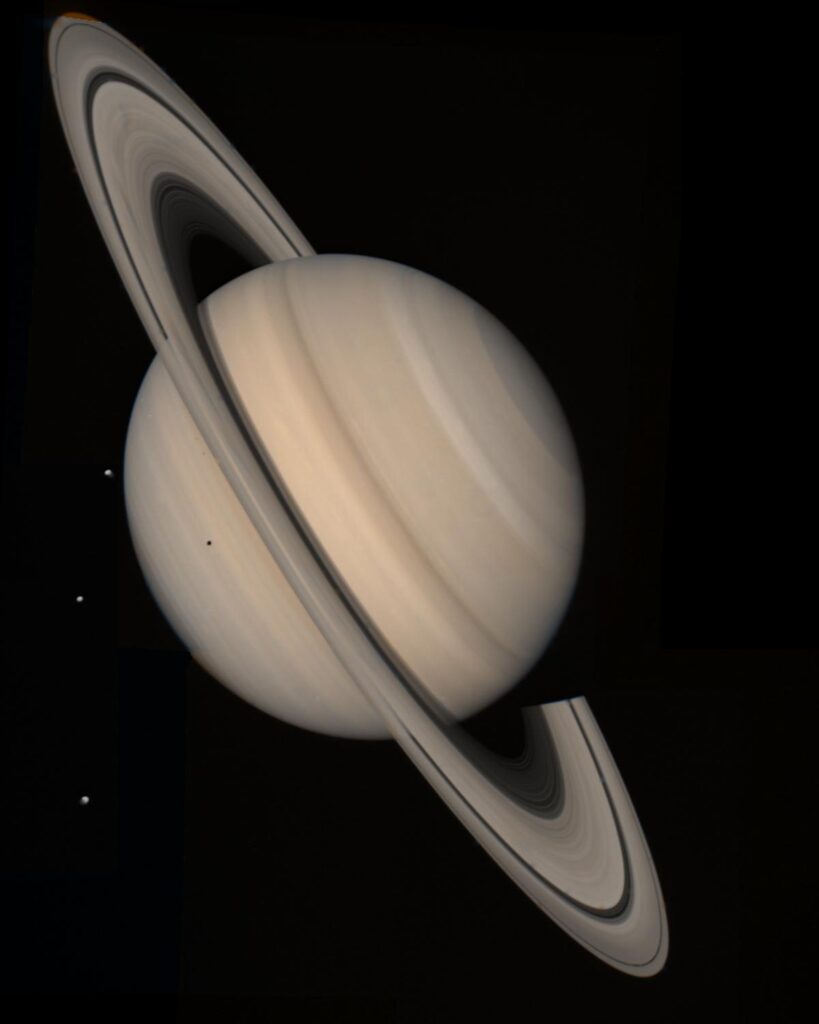
Saturn, magnificent and unbothered, roughly a billion miles from Los Angeles and the Grammys. Photographed by NASA’s Voyager 2 spacecraft on August 4, 1981. Image credit: NASA/JPL.
Andrew J Lewis
Los Angeles looks considerably better when you can see it.
In the winter of 2000, I was living in South Pasadena, researching early American natural history at the Huntington Library and discovering that nearly everything I’d imagined about California from Minnesota was true. Palm trees, mountains, sunshine, oranges growing in the backyard. Even winter rain seemed a reasonable price for sixty-five-degree afternoons and green hills.
The oranges were particularly persuasive. In Minnesota, acquiring fresh fruit in February generally required entering a heated building and exchanging money. In South Pasadena, apparently, you just go outside.
The San Gabriel Mountains rose behind the city, the Huntington’s gardens were embarrassingly beautiful, and I was in love with California. All of it. Possibly infatuated with a young woman as well, although the details of that particular enthusiasm are less important to my wife, my most important reader.
Meanwhile, Mike Davis was explaining why the entire place was a terrible idea.
His Ecology of Fear, published in 1998, examined Southern California’s vulnerabilities to fire, flood, earthquake, and the consequences of building a metropolis in such a complicated landscape. As a historian, I appreciated his point. As a Minnesotan by way of Connecticut enjoying February in Pasadena, I found it poorly timed.
Mr. Davis might well have been right. But could I please have my full twenty-eight days for treatment?
I’d been driving around Los Angeles for a few weeks, trying to understand the place. Echo Park, Hollywood, downtown, the beaches (do not care much for sand), the freeways—everything seemed connected by roads that went on forever without producing anything resembling a comprehensible city.
I could generally find my way from one place to another. But I couldn’t quite understand where I was.
Los Angeles seemed less a city than an accumulation of destinations. I’d drive through one neighborhood, enter a freeway, emerge somewhere else, and discover that the distance between the two had somehow consumed forty-five minutes of my life. (And then there were SigAlerts, which sounded very bad so I avoided them.)
On February 23, Grammy night, I went to Griffith Observatory for the first time, accompanied by the aforementioned young woman.
The winter rains had washed much of the particulate matter from the atmosphere. The hills were verdant green, and from the observatory the Los Angeles basin stretched out below.
And there was Los Angeles.
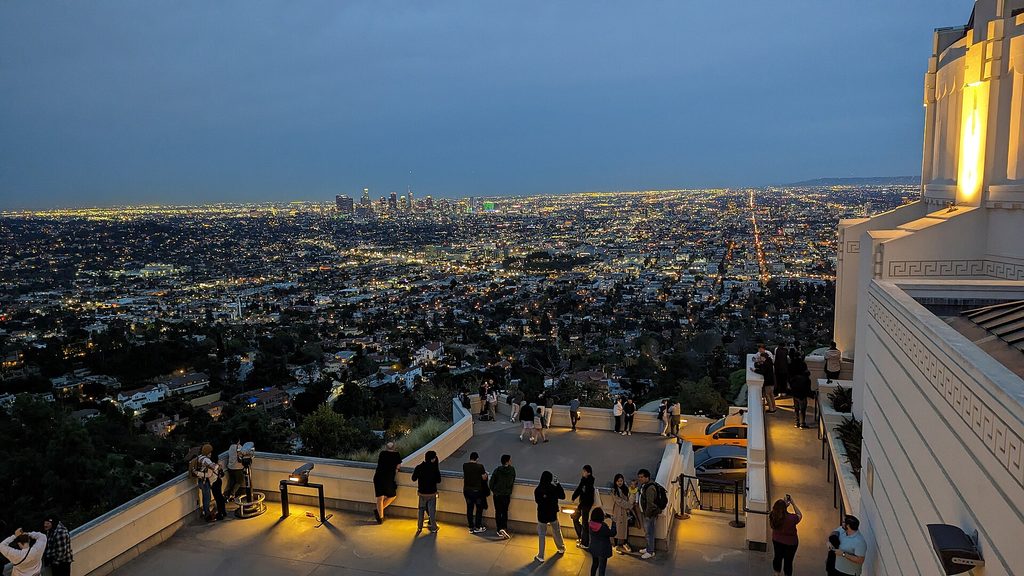
Los Angeles, spreading out beneath Griffith Observatory. A city that makes considerably more sense from up here. Photograph by Rachel L. Umstead, 2023. CC BY-SA 4.0.

The mountains, the enormous illuminated grid of streets and neighborhoods, the distant darkness of the Pacific. Freeways that had seemed bewildering from the driver’s seat now traced intelligible paths through the landscape. Pasadena belonged somewhere. Downtown belonged somewhere else.
It was magnificent. I’d come to California with a child’s idea of paradise, acquired through televised football games and Midwestern winter weather reports.
The actual place was better.
People were pointing toward downtown, where the Grammy Awards were taking place at the Staples Center. I listened as they identified the venue and discussed the spectacle below.
From Griffith Observatory, the music industry’s grand annual celebration occupied a remarkably small portion of Los Angeles. A concentrated orb of blinding light.
The rest of the city was getting on with its evening. Restaurants were serving dinner, families were going home, and someone was undoubtedly stuck on the 405. I liked that.
There were hundreds of people at Griffith Observatory that evening, perhaps thousands. People talked, pointed toward the city, and shared the view. It was a crowded place, and yet I remember the evening as almost perfectly quiet.
I didn’t want to leave.
I began returning to Griffith Observatory with some regularity. On one of those evenings, the observatory telescope was open and pointed toward Saturn.
Saturn is one of the few astronomical objects that looks exactly as advertised. The Moon is impressive but familiar. Mars has enjoyed centuries of publicity despite being, to the casual observer, a small reddish object.
Saturn delivers.
After waiting about ten minutes, I looked through the telescope and there it was: a little yellowish planet with unmistakable rings, looking remarkably like the NASA illustrations of my childhood.
It was almost suspiciously cooperative. The rings were where they were supposed to be. The planet occupied the middle. Nothing had been rearranged to accommodate changing tastes in planetary presentation.
Saturn, apparently, had retained its identity. An object roughly a billion miles away had somehow contrived to resemble its own picture.
I kept returning to Griffith Observatory. I loved the view, the crowds, the improbable pleasure of standing above Los Angeles on a February evening.
I never quite wanted to leave.
Above us, Saturn looked exactly like Saturn.
And below us, the City of Angels.
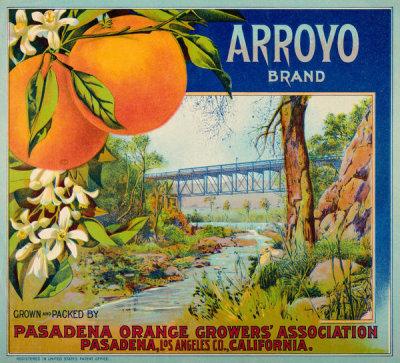
Arroyo Brand oranges, packed by the Pasadena Orange Growers Association, c. 1910–1920. From the Jay T. Last Collection, The Huntington Library.