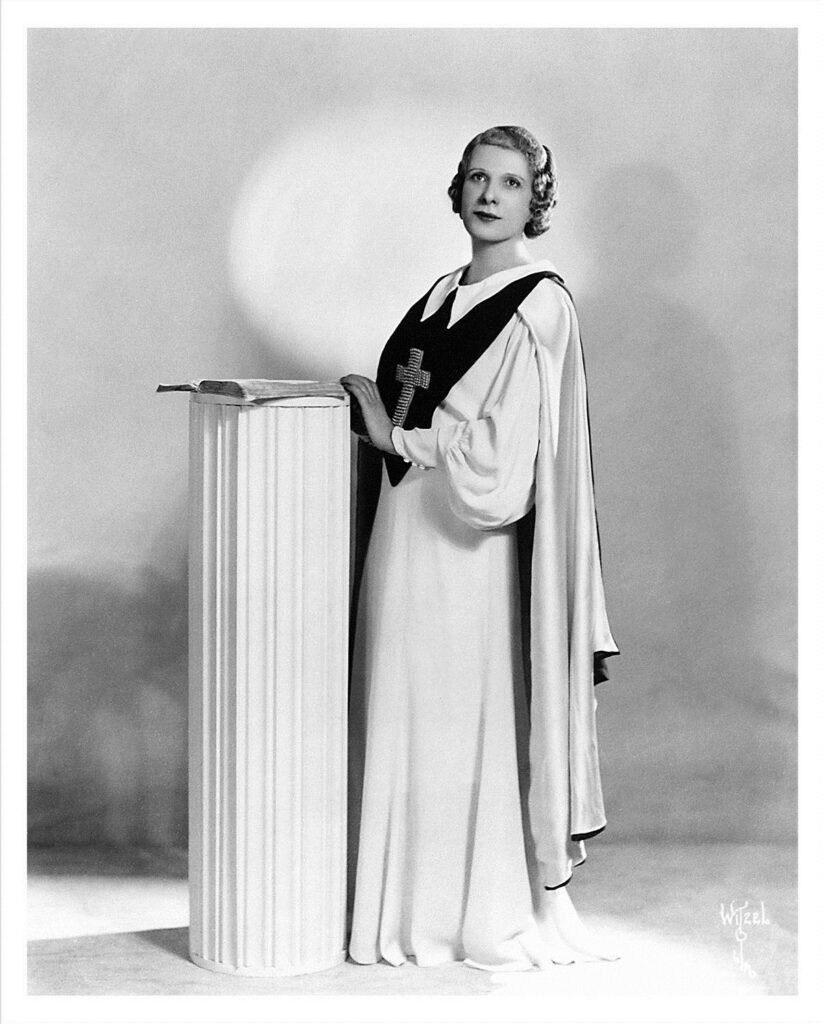
AIMEE SEMPLE McPHERSON, c. 1922. The Pentecostal evangelist built Angelus Temple beside Echo Park and became an early master of radio broadcasting and modern religious media. Photograph by Albert Witzel.
Andrew J Lewis
I first learned of Aimee Semple McPherson as a TA at Yale, in a survey course on American religious history. She lived in Los Angeles, built a massive temple, and used radio in ways that feel modern even now. It was fascinating, and I filed it away as part of a larger map I was assembling at the time.
About twenty months later, I was driving in Los Angeles and passed a domed building by a lake. I wasn’t looking for it. I wasn’t thinking about her. And then, a half-beat later, I realized what it was: Angelus Temple, sitting there as if it had always been obvious.
That winter and spring I was living in a Pasadena woman’s converted garage apartment, with several ancient, improbably generous orange trees as companions—as if they had taken on responsibility for the missing grove.
A college friend from Minnesota, Jon, was visiting. A serious baseball fan, with Rose Bowl–tinted glasses, he was ready to live the entire California dream in a five-day weekend. We went to an Angels game with a scholar of English religious history from Wales. The next day we drove up and down Ventura Highway in a rented convertible, wishing we’d had America as a soundtrack but finding only Moby. On his final full day, we planned a Dodgers game with a friend I’d met at the Huntington Library, Natalia Molina.
We picked Natalia up, along with her husband, and before heading to the game made a quick stop for dinner supplies—one of those small detours that makes it Los Angeles. She jumped out of the car into a storefront, her husband offering a quick explanation, and jogged back with a bag of marinated beef and a few other things I don’t remember. Jon looked at me like this was the strangest thing—late morning, pre-baseball, quick stop, and now we’re crossing jurisdictions with raw meat.
It didn’t strike me as odd. Our families were in hospitality, and Natalia and I were training as historians. It felt, if anything, like a continuation of the same logic.
We drove to Dodger Stadium. Chamber-of-Commerce spring weather—cool in the shade, ideal in the sun, warming gently through the afternoon. Ken Griffey Jr. was on the field, newly with the Reds, unmistakably himself but not quite the player he had been in Seattle. The game was good. The seats were better than expected. I think the Dodgers lost, but I wasn’t keeping score.
Jon always does.
The stadium worked as a container for the afternoon—something structured and predictable, holding the day in place.
Afterward we went back to Natalia’s place. The meat went on the grill. The evening settled into itself in a way I didn’t yet have language for.
Something like: Is it possible to live a life like this?
The food was extraordinary—simple, direct, uncommonly delicious in its clarity and confidence. Conversation moved easily: religion, media, what Hollywood does versus what people imagine it does—not conspiratorial, just a system that shapes perception at scale.
It wasn’t a party. No one was performing.
It was just an evening that held together.
This spring, two friends’ daughters decided on USC. I ordered Natalia’s book as a gift, thinking they should take her classes if they could—learn from her directly. That day came back to me, not all at once, but in pieces.
What has stayed with me isn’t the temple or the game or even the conversation, exactly.
It’s the way the pieces sat next to each other without strain.
That day has always felt like one of my great Los Angeles days, one of my LA Stories. It reads a little differently now.
The domed church by the lake wasn’t just a building; it was a transmitter. The stadium wasn’t just a game; it held an afternoon together and gave thousands of strangers something to share. And then there was a house, a grill, some marinated beef, and a conversation that continued long after I stopped remembering exactly what anyone said.
Echo Park sits close enough to everything in Los Angeles to gather it and just far enough off-center to remake it. It holds and reshapes without announcing that it’s doing so.
A preacher builds a temple and learns to speak in signals. A ballpark turns an afternoon into a shared language. A neighborhood sends its people outward—into classrooms, books, and conversations that travel well beyond it.
And, sometimes, back again.