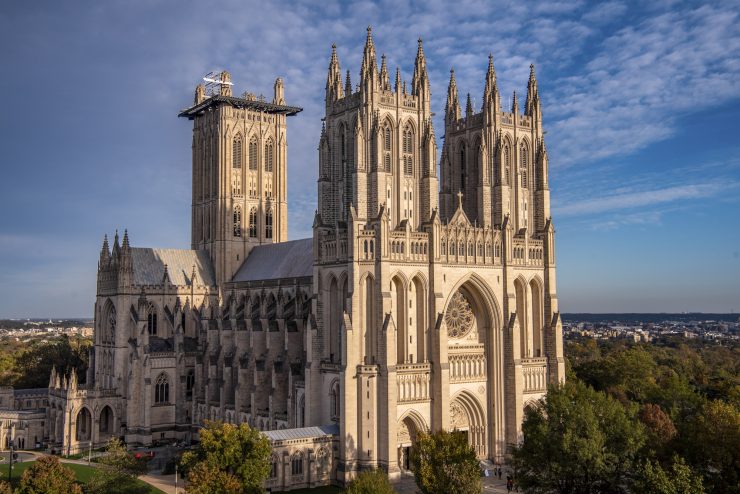
Washington National Cathedral. A monument to faith, architecture, and human aspiration. To a peregrine falcon, an exceptionally well-appointed cliff, complete with gargoyles. A DC dining hotspot. Photograph courtesy of Washington National Cathedral.
Suggested listening:
Entirely optional listening. Noah Floersch & Em Beihold, The Bird Song, 2024. This lovely song offers another perspective on birds, collisions, and the sometimes complicated business of being ourselves.
Andrew J Lewis
The summer of 2000, I spent a considerable amount of time watching peregrine falcons at Riverside Church in New York City.
I was working at Columbia University, although I can no longer remember precisely what I was doing there. Something academic, presumably. I was still at Yale, working toward a doctorate in American Studies, and spent my summers engaged in various activities intended to advance my professional development.
Whatever they were, I’ve forgotten them. I remember the falcons.
Riverside Church stands near the Hudson River in Morningside Heights, its enormous Gothic tower rising above the surrounding neighborhood. The architecture is intended to direct human attention upward, toward God, eternity, and other matters of considerable theological importance.
The peregrines had a somewhat different understanding of the building.
To them, the tower was a cliff.
Peregrine Falcons (Falco peregrinus) traditionally nest on high ledges overlooking open hunting territory. They don’t build elaborate nests. A shallow scrape on a suitable ledge will do. Skyscrapers, bridges, and church towers provide excellent substitutes for natural cliffs, particularly when the surrounding city supplies an abundant population of pigeons.
New York had thoughtfully provided both.
There’s something remarkable about the fact that I could watch these birds at all. By the 1960s, peregrines had effectively disappeared as breeding birds from the eastern United States. DDT and related pesticides had accumulated through food chains, interfering with reproduction and devastating their populations.
Their return required scientific research, pesticide restrictions, captive breeding, and reintroduction programs. Cornell ornithologist Tom Cade helped lead the recovery effort and establish The Peregrine Fund. In 1999, the peregrine was removed from the federal endangered species list.
A year later, I was watching them raise a youngster above Manhattan.
One afternoon, I witnessed what appeared to be a family lesson. Two adult peregrines and a youngster were flying between the church tower and the airspace toward the Hudson. One bird would accelerate into a dive, recover, and return toward the church. The others followed, and the sequence began again.
Down toward the river. Pull up. Circle back. Return to the tower.
And again.
For perhaps thirty minutes, I watched these extraordinary birds repeating the maneuver. The youngster seemed to be learning how to manage its speed, recover from a dive, and return to the starting point. Over the following weeks, I witnessed other episodes of aerial activity that appeared to involve the same family.
I don’t know precisely what the adults intended. Young peregrines develop their flying and hunting abilities after leaving the nest, and much of their early independence involves practice, pursuit, and occasionally unsuccessful attempts at catching dinner.
But whatever the biological explanation, it was magnificent to watch.
Peregrines are extraordinary fliers. Their long, pointed wings allow powerful flight, while their compact bodies and remarkable eyesight make them formidable aerial hunters. During a hunting dive, known as a stoop, a peregrine folds its wings and accelerates toward prey at speeds that can exceed 200 miles per hour.
The Cornell Lab of Ornithology describes peregrines hunting from high perches or soaring positions, sometimes beginning their dives thousands of feet above their prey. They may strike a bird hard enough to stun or kill it, or seize it directly in flight.
But before the spectacular dive comes an enormous amount of watching.
That afternoon at Riverside, I was watching the watchers.
Then summer ended, and I returned to Yale briefly. Then off to Garvanza and the Huntington Library and Gardens in San Marino, California.
The Cathedral
One year later, I lived on the seventh floor of an apartment building, The Etheridge, directly across from Washington National Cathedral.
Another monumental church. Another Gothic tower. Another collection of ledges and gargoyles originally installed for purposes that had absolutely nothing to do with falcons.
And another peregrine.
One afternoon, looking toward the cathedral, I witnessed something I have never forgotten.
A pigeon was flying perhaps thirty feet above the ground when a peregrine appeared, seemingly from nowhere, and struck it.
The pigeon essentially exploded.
There was an astonishing cloud of feathers, followed by the considerably less aerodynamic remainder of the pigeon descending toward the earth.
The falcon circled back, dropped to the ground, and attended to its prey. I couldn’t see precisely what happened next, but before long it had carried the pigeon up to a perch near one of the cathedral’s gargoyles.
And began lunch.
For the next hour, perhaps ninety minutes, I watched this magnificent predator dismantle its meal high above the National Cathedral grounds.
Below, tourists were taking photographs. This was unfortunate for the tourists.
As the peregrine worked, bloody clusters of feathers drifted down from the heights, occasionally landing among people who had come to admire one of America’s great religious monuments.
They were horrified.
I laughed on and off the whole time. I’m giggling as I write.
There is something wonderfully clarifying about watching a peregrine eat a pigeon above a cathedral. The tourists had come to contemplate sacred architecture, religious history, and perhaps the possibility of transcendence.
The peregrine had come to eat a pigeon.
Everyone was having a different experience of the same building.
Washington Hebrew
Which brings me, somewhat improbably, to Washington Hebrew Congregation.
I’ve spent much of the past year studying religion again, this time not simply as a historian examining American religious institutions, but as a participant trying to understand what these traditions might teach me.
The WHC rabbis, cantors, staff and congregation have been remarkably patient. This is particularly impressive because I occasionally approach religious education as though I’m defending a feats-of-strength dissertation, complete with objections, supporting documentation, and an alarming willingness to pursue an argument long after everyone else has decided the matter is settled.
We’ve recently developed a three-comment-per-hour arrangement, with the additional understanding that the faculty may ignore two of those comments as though they never occurred. Like two trees whisper-falling in a cloud forest, and an elegant pedagogical innovation.
I’ve also noticed a certain resemblance between my intellectual habits and those of the peregrines.
I can identify an institutional inconsistency from considerable distance, establish an angle of attack, and descend upon it at extraordinary speed, often armed with several centuries of American history, a bibliography, and more recently, a three-part growth and marketing plan.
Sometimes this is useful. Sometimes an institution absolutely deserves a peregrine. Hoo-boy. But occasionally, I’ve discovered, the person on the receiving end might have responded rather well to an invitation to tea first.
This possibility has not previously received sufficient attention in my methodology.
What I remember about Riverside, though, is how much time the birds spent circling, returning, waiting, and practicing. A peregrine spends considerably more of its life observing the world than hurtling toward it at two hundred miles per hour. The spectacular dive is only one part of the repertoire.
I’m building a company now, which requires conversations with people who know things I don’t. I’ve also returned to classrooms, where the teachers are quite reasonably interested in occasionally completing a sentence. Both enterprises seem to benefit from a certain amount of restraint.
The falcons, of course, don’t need to secure stakeholder alignment before eating a pigeon. I operate in a somewhat different environment.
Peregrination means wandering or traveling, often over considerable distances. It shares its linguistic ancestry with peregrine, the wandering falcon. That seems a reasonable description of much of my life: moving among places, institutions, disciplines, and traditions, watching what happens and occasionally discovering something worth pursuing.
I still admire the stoop. I have no intention of abandoning it entirely. But next time I identify an especially promising pigeon, perhaps I’ll begin by inviting it to tea.
We’ll see how that goes.
No guarantees.