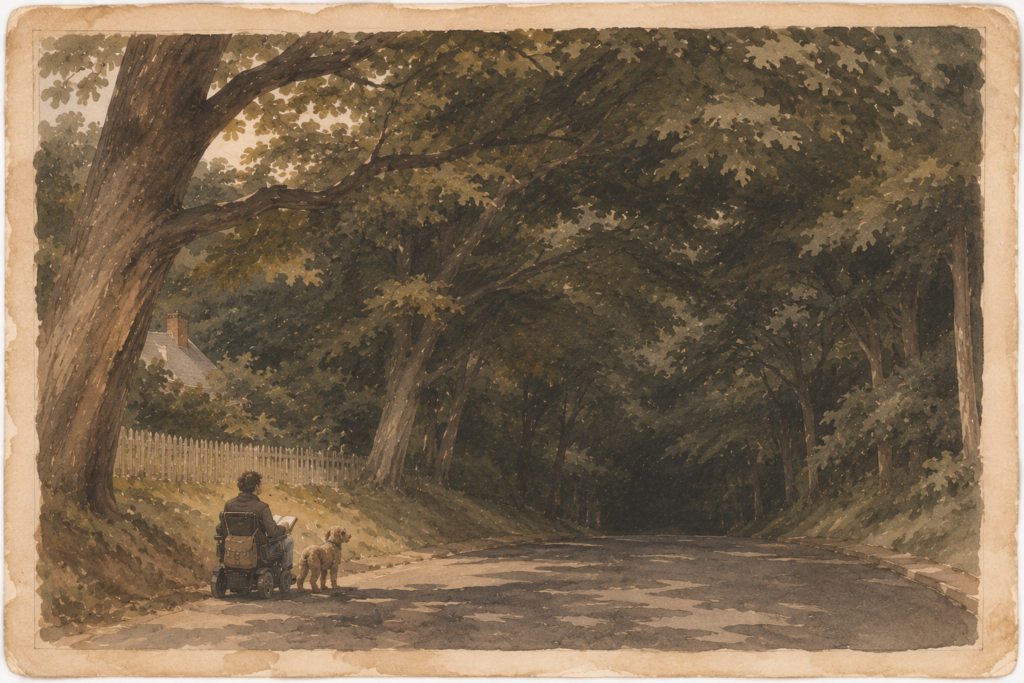
The missionary and his faithful expeditionary hound contemplate the forbidding descent into Lower Cumberland, the Town of Somerset, Maryland. Civilization remains a distant prospect. A modern rendering vaguely in the tradition of early-national expeditionary art, by AJL and SGPT, November 2026.
Optional listening: R.E.M., “(Don’t Go Back To) Rockville” (1984). One narrator begs his beloved not to return to Rockville, Maryland. Another begs Rockville to send reinforcements. The distance is negligible; the desperation mutual.
Andrew J Lewis
A Dispatch to the Society for the Propagation of Modern Civilization, Rockville, Maryland
I. The wilderness of Lower Cumberland
In 1890, five men of science established an experimental settlement in the Maryland countryside, beyond the northern frontier of the American capital. Their undertaking, subsequently incorporated as the Town of Somerset in 1906, represented an ambitious proposition: that a community organized by educated citizens, possessed of modern scientific knowledge and the instruments of self-government, might be trusted to administer its own affairs.
One hundred and thirty-six years later, the experiment continues. To the best of my knowledge, no comprehensive evaluation of its results has been undertaken by the authorities in Rockville.[1]
The inhabitants have nevertheless made remarkable progress. They have mastered medicine, law, finance, international affairs, ornamental horticulture, and the maintenance of a municipal swimming pool that houses the 2026 Montgomery County Swim League Division ‘I’ Champion Somerset Dolphins.
They possess a Town Council, a Mayor, a journal of public affairs, and written declarations of their devotion to Inclusion and Sustainability. Their intellectual attainments are formidable. Their gardens are magnificent.
As an earlier investigation of the settlement’s history established, preservation is among their most developed civic arts.
Their pedestrian ecology remains a subject of active theological disagreement.
Within this experimental municipality lies a territory of still greater mystery: Lower Cumberland, a wooded district descending toward the Little Falls watershed and its Willet Branch, administered by M-NCPPC, based in the aptly named locale, Riverdale.
Among residents of greater Somerset, the Lower Cumberland region enjoys something of a frontier reputation. Accounts persist of citizens who ventured downhill and failed to return, usually by sled in winter. I have found no documentary evidence of permanent disappearance and suspect that some simply continued sliding toward the enchanting, rumored settlement known as Bethesda.
Lower Cumberland is exceptionally beautiful. Great trees form a vast canopy above its narrow roadway, shading gardens, flowering shrubs, and houses whose inhabitants have spent decades cultivating the peculiar pleasures of suburban woodland life. The absence of sidewalks contributes materially to the district’s tranquility. It also requires pedestrians to share the roadway with automobiles, delivery trucks, construction equipment, and other manifestations of civilization.
These propositions are not contradictory.
The inhabitants are generous, intelligent, and deeply attached to their surroundings. Visitors from the upper settlements are generally received with courtesy, although their intentions may require explanation. A stranger arriving to discuss sidewalks may reasonably expect to be examined with the curiosity ordinarily reserved for unusual migratory birds.
I have explored the territory extensively with my faithful expeditionary hound, Ivy, a miniature labradoodle of twenty-three pounds. She squirrels. I watch for potholes and cars.
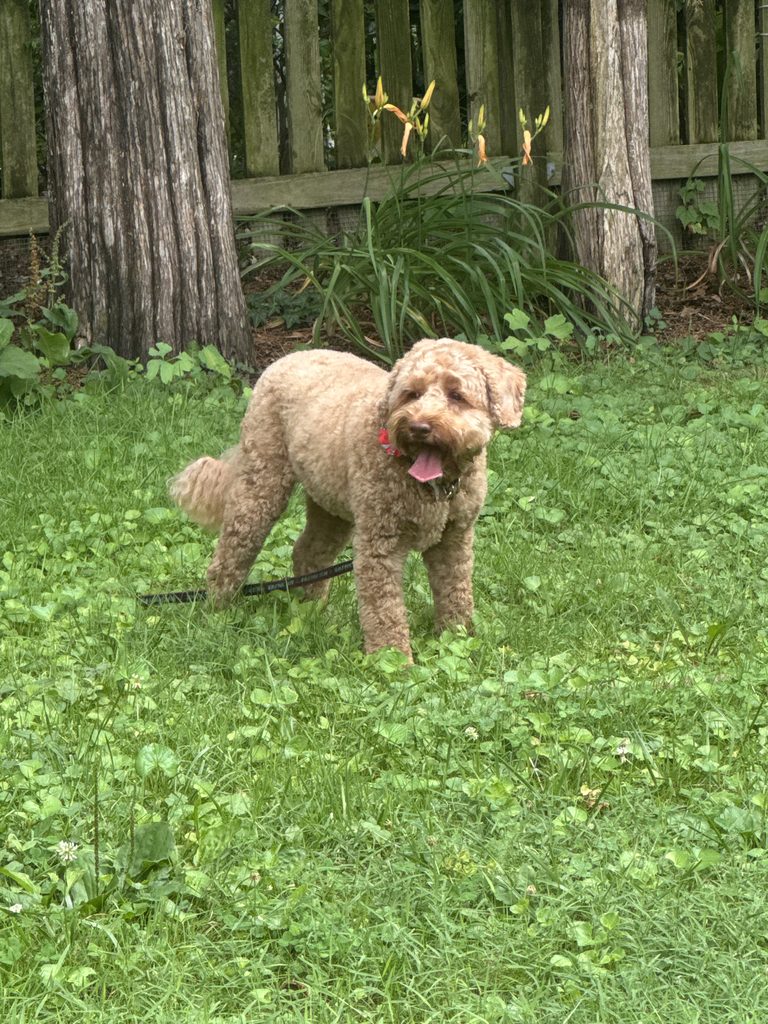
Ivy, the expeditionary hound, pauses to consult the missionary regarding the route ahead. The missionary’s progress remains considerably slower than hers. Photograph by AJL, 2026.
We both love Lower Cumberland. The hound is particularly devoted to its botanical diversity, although her investigative techniques are not those ordinarily employed by professional historians. The difficulty, as I was shortly to discover, was not that the Cumberlandians lacked civilization.
It was that they had developed several competing interpretations of its obligations.
II. The calling and the commission
My missionary vocation began, as many such undertakings do, with an involuntary domestic appointment. On July 4, 2025–Independence Day, fittingly–my wife determined that my evangelical energies had exceeded the household’s capacity for peaceful absorption. She therefore arranged for their redirection into municipal service under the supervision of Somerset’s Public Safety Committee.
I accepted this calling with humility, enthusiasm, and what subsequent events suggest may have been an insufficient appreciation of its scope.
By September 2025, I had published the first articles of my emerging faith in the settlement’s official Town Journal, describing myself as a “pro-growth vegetation conservative with a liberal need for personal safety and accessibility.” I invited the inhabitants to engage me in sidewalk conversations about their plants, believing horticultural enthusiasm might be reconciled with modern pedestrian civilization.[2] The invitation was public, printed, and extended more than a year before this report.
My first encounter with competing religious practices occurred at the Heritage Azaleas on October 28, 2025, along the route by which the young of Somerset travel toward their education at Somerset Elementary and eventual initiation into the aquatic mysteries of the residents-only Somerset Dolphins. At the Heritage Azaleas, I discovered that citizens and its leaders did not necessarily agree upon what civilization required of them. My earlier experiments in historianishing had not adequately prepared me for this botanical application of civilization’s rules. Those must await another dispatch.
Because there came alarming reports from Lower Cumberland.
The Town, a professed adherent of the Tree City tradition, was considering a sidewalk intervention requiring the possible sacrifice of numerous mature trees, seventeen in fact. The offering was intended to advance another municipal article of faith: pedestrian accessibility.
Unfortunately, the topography and preliminary engineering raised questions about whether the resulting infrastructure would adequately serve people using power wheelchairs. As pro-growth conservative myself, I found this troubling. Trees, once felled, are notoriously difficult to restore to their previous condition. An inaccessible sidewalk, by contrast, can remain inaccessible for generations with remarkably little additional expenditure.
The historical record revealed that the demand for improvements had originated among the inhabitants themselves.
On February 21, 2024, six households petitioned the Mayor and Council for a sidewalk along Lower Cumberland, citing the absence of a safe pedestrian route to the elementary school. They acknowledged possible consequences for trees and landscaping and endorsed a prior Public Safety Committee recommendation.[3]
On December 1, 2025, the authorities assembled the inhabitants and professional engineers to consider three proposed routes toward modern civilization. The engineers arrived bearing drawings, measurements, and an impressive inventory of obstacles involving trees, retaining walls, drainage, driveways, and gravity. Their preliminary estimate was $283,645, before the considerable additional expense of stormwater management.[4]
The inhabitants were not uniformly persuaded. One asked:
“If there’s been no accident, why are we doing this? It sounds drastic and expensive.”
Another offered a more promising question:
“We need to first define the problem. Is it child safety? Aging-in-place? Stormwater? We should decide what we’re solving for before choosing options.”
I found myself in agreement. The engineers had arrived with three proposed solutions before the inhabitants had agreed upon the question.
A Councilmember clarified the proceedings:
“Tonight is not the debate. Tonight is to hear the options. The debate will occur with the Council.”
The Society will appreciate the subtle distinction. The inhabitants had assembled to examine three routes toward pedestrianized modernity. Whether civilization was desirable would be considered at a subsequent gathering amongst a smaller group of the elected.
I began to suspect that the difficulty was neither a shortage of professional expertise nor an absence of legitimate concerns. The inhabitants understood their gardens, trees, drainage, and daily routines. The engineers understood grades, rights-of-way, accessibility standards, and construction.
What neither group yet possessed was a common language in which to consider what the public street ought to accomplish for everyone.
During December 2025 and January 2026, I sought and received the Town’s approval to assume some responsibility for exploring Lower Cumberland’s pedestrian conditions and possible improvements. The precise terms of that approval deserve reconstruction; it was not a formal appointment to represent the Mayor or Council.[5] Rather, armed with a notebook, an elementary understanding of gravity, and a dog whose qualifications remained unquestioned, I set forth to bring the Cumberlandians into closer acquaintance with the civilization they already professed.
I began, naturally, with their gardens.
III. The ministry of Sidewalk Botany
In the early spring of 2026, accompanied by my expeditionary hound, I commenced the systematic evangelization of Lower Cumberland. My methods were unconventional but, I submit, defensible.
Rather than arrive bearing commandments concerning sidewalks, parking, or mature trees, I invited the inhabitants to walk with me. We would observe the landscape, discuss its peculiarities, and perhaps discover something about the relationship between human beings and the physical environment they had inherited.
I also asked about their plants. This proved exceptionally effective.
The Cumberlandians are accomplished horticulturalists. An inquiry about a hydrangea might produce a household history, an explanation of drainage patterns, an account of a neighbor long departed, and occasionally refreshments.
A question about sidewalk construction, by contrast, generally produced a position. I commend this distinction to the Society: physical plants first, then the physical plant.
Over approximately six weeks, more than thirty-five neighbors joined one or more expeditions: organized walks, spontaneous encounters, and conversations along the street. Not thirty-five individual walks, not thirty-five simultaneous solo pilgrims, nor thirty-five statistically representative respondents.[6] I mention this because the distinction subsequently acquired considerable theological significance.
To assist our investigations, I established a modest geographical nomenclature. We began at Bolten Crest, the Town of Somerset’s geological apex, where the land announces its intention to descend toward one of two Little Falls branch-stream valleys. We proceeded through Blunden Junction and Quan Crossing, where pedestrians demonstrate a preference for routes selected by their own eyes rather than the municipal imagination.
We examined stormwater archaeology at Brown’s Bloomin’ Burden, contemplated the Devon Dilemma, and arrived eventually at The Sidewalk of Accepting Less, where the Somerset pedestrian ecology terminates.[7] The names were playful. The geography was not.
Gravity remained operative throughout. Water continued downhill regardless of municipal preference. Large vehicles required measurable space in which to turn. Trees possessed roots. Sidewalks, when absent, could not be employed. (Ivy contributed observations concerning squirrels, which I have retained in a separate classification.)
The inhabitants did not share a single doctrine. Some favored sidewalks. Others preferred one-way traffic, altered parking, painted pedestrian space, or no physical changes whatsoever. Many were concerned about trees, stormwater, construction vehicles, and the character of their neighborhood.
These were not imaginary concerns. The purpose of the ministry was not to determine which inhabitant possessed the correct opinion before breakfast. It was to establish what could be learned by looking together.
Accordingly, I introduced the Pledge of Community Gravity, under which participants agreed to observe carefully, respect their neighbors, listen before responding, and refrain from treating every disagreement as an occasion for burn-the-boats conquest.[8]
The results were encouraging. We did not agree about the solutions, or share the same definition of ‘problem.’ We achieved neither consensus nor agreement much beyond the day being, in fact, ‘nice.‘
We did, however, acquire a vocabulary for discussing the same landscape and a conversation amongst neighbors about shared challenges.
A tree became more than an obstacle to construction. A sidewalk gap became more than personal preference. A street became a system through which water, vehicles, children, dogs, and people with different physical capacities moved according to different requirements.
By June 4, 2026, reports of the pressures of modern civilization had arrived from neighboring Devon Lane.
Three inhabitants petitioned the Mayor and Council for restrictions on oversized vehicles and speeding, reporting damage to trees, fences, stone walls, and other property. Their historic passage, they explained, was “simply not built for the vehicles now using it.” They attributed worsening conditions partly to construction and infrastructure activity on Cumberland Avenue.[9]
The difficulties of Lower Cumberland, it appeared, were not confined to Lower Cumberland. I began to believe the inhabitants were prepared for a more demanding stage of instruction.
The Mayor evidently believed the time had come for a public gathering.
IV. The great council of the Cumberlandians
On July 27, 2026, the Mayor convened the Cumberlandians by Zoom, an instrument sufficiently advanced to permit an entire settlement to disagree without leaving home.[10]
Professional traffic engineers (from The Traffic Group!) had been invited to discuss possible improvements, including painted pedestrian space and changes to circulation. No final proposal was before the Council or the inhabitants, just discussion.
The Cumberlandians arrived prepared. One longtime inhabitant opened with a question:
“Whenever people talk about pedestrian safety on Cumberland, I honestly wonder what problem they’re describing.”
He continued:
“In all that time, I haven’t seen anyone injured on Cumberland except children sledding years ago, and that issue has already been addressed.”
I was delighted to learn that the settlement had addressed the dangers of sledding.
The testimony established that this inhabitant had not personally witnessed a pedestrian injury during his decades of residence. It did not establish that hazards were absent, that injuries had never occurred, or that people using mobility devices could safely negotiate the roadway.[11] These are different propositions.
Another inhabitant, invoking the authority of his fellow doubting Cumberlandian, whom I shall call Brother Certain-of-Himself, offered this assessment:
“I’m not convinced we’re solving a problem that actually exists.”
I was struck by the efficiency of this theological method. One inhabitant doubted the existence of a problem. Another endorsed his doubt. The Society will appreciate that two expressions of uncertainty do not constitute independent evidence, however reassuring their agreement in doubt may be.[12]
Inconveniently for the doubters, six households had petitioned the Town in February 2024, two and a half years prior, identifying the absence of a safe pedestrian route as a problem. The existing sidewalk demonstrably ended before the route to the school did. Nevertheless, the existence of the problem remained under consideration.
The Mayor, meanwhile, attempted to establish a foundational principle:[13]
“Different residents genuinely experience Cumberland differently.
Some people—including me—do not feel that sharing the roadway between pedestrians and vehicles is sufficiently safe.”
He continued:
“But I don’t believe we should wait until there is an accident before deciding there’s a safety issue worth examining.”
The Society will recognize both propositions as elementary. Apparently, their application required further instruction.[14]
Another inhabitant explained that her family enjoyed the street as it was. She raised legitimate concerns about children, bicycles, parking, and a proposed pedestrian lane. Then came a particularly instructive observation:
“But if someone who doesn’t live on Cumberland feels uncomfortable walking there, one response might simply be to choose a different route.”
This was an ingenious solution to inaccessible public space. The person encountering the barrier could go somewhere else.
I considered whether the Society might incorporate this principle into its broader program. Hospitals could redirect patients unable to enter their buildings. Schools could suggest alternative institutions to children unable to negotiate their entrances. The administrative savings might be considerable.[15]
The Mayor declined to embrace the doctrine. He appealed instead for recognition of the inhabitants whose experiences differed from those of the speakers:
“What I would ask is that we not dismiss those residents who experience Cumberland differently.
They’re part of this community too.”
The Mayor was not demanding a sidewalk, the surrender of property, or acceptance of any particular engineering proposal. He was asking the inhabitants to acknowledge their neighbors.
I began considering the possibility that the Society had seriously underestimated the requirements of the Lower Cumberland mission.[16]
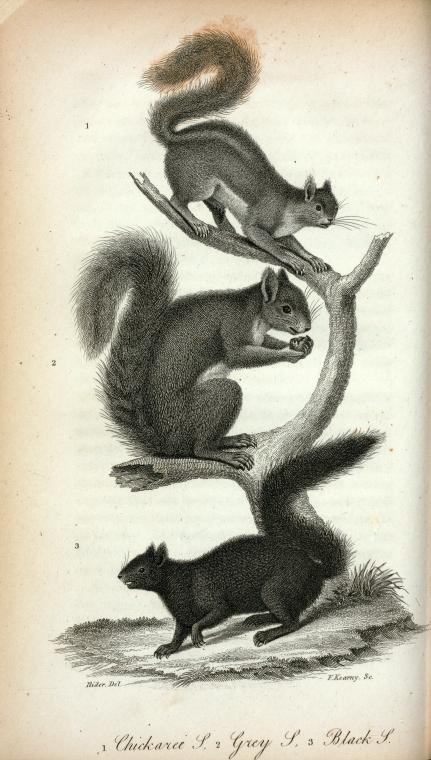
John D. Godman undertook the formidable task of cataloguing North American fauna in his multivolume American Natural History (1826–1828). Among his subjects were the Chickaree, Grey and Black Squirrels, illustrated here with admirable scientific detachment. One suspects that the canine companions of Godman’s era found the plate considerably more difficult to examine without editorial intervention.
Image: John D. Godman, American Natural History (1826–1828). New York Public Library Digital Collections.
Meanwhile, the engineers acknowledged that the existing sidewalks and steps near Blunden Junction were not ADA compliant. Full reconstruction could require extensive grading, retaining walls, and the removal of one to three mature trees.
Thus experts paid by the Town had identified a physical accessibility barrier, the Mayor discussed the engineering consequences of addressing it, and the Cumberlandians continued debating whether the neighborhood possessed a pedestrian-access problem.
Before concluding the July gathering, the Mayor returned to an earlier suggestion that people uncomfortable on Cumberland might simply avoid the street. His final appeal was admirably plain:
“I don’t think that’s the right way to think about our community.
Every resident should feel welcome using every street in Somerset.
The goal is not to tell people where they should or shouldn’t walk.
The goal is to understand whether we can make our public spaces safer and more accessible for everyone.”
There it was. We’d all spent two hours on Zoom and the Mayor concluded by explaining to the Cumberlandians that the public realm ought to be available to the public.[17]
(I admit, that evening, I began mentally drafting a request for reinforcements to the Society for the Propagation of Modern Civilization.)
The proceedings did not end with the meeting. In the email correspondence on the next few days, one longtime inhabitant offered a practical observation:
“Nothing prevents a child or a pedestrian from stepping on to the grass when a car is coming up or down the street.”
This was especially illuminating. The statement was intelligible as a description of what an ambulatory person might do. It became rather less satisfactory when applied to a person using a power wheelchair.
Grass is not invariably traversable by such equipment. Neither are curbs, steep grades, saturated soil, or the other conditions distinguishing a lawn from an accessible pedestrian route.[18] The missionary had not discovered a difference of opinion. He had discovered a difference of physical possibility.
Another correspondent reported that many inhabitants believed “doing nothing is the preferred option.”[19] This was, at last, a proposition whose meaning required no further clarification.
The inhabitants valued their street. The engineers had identified genuine constraints. The Mayor had asked the gathering to recognize different experiences of safety.
All these things could be true simultaneously. What could not follow was that the experiences of those most comfortable with existing arrangements established the conditions under which everyone else must travel.
The Society will recognize the distinction.
Whether the Cumberlandians would do so remained an open question.
V. Concerning faith, evidence, and occasional recidivism
The Society will be pleased to learn that the Cumberlandians are not strangers to the doctrines of modern civilization. Indeed, evidence of their conversion appears throughout the settlement.
Certain inhabitants display upon their automobiles official devotional objects bearing the exhortation Share the Road, accompanied by an image of a bicycle. The bicycle has evidently achieved recognition as a legitimate participant in public transportation.
This represents considerable theological progress. The precise status of wheelchairs, walkers, strollers, and other forms of pedestrian life remains under discussion.
I do not suggest that the inhabitants oppose these conveyances. On the contrary, nearly every Cumberlandian professes a commitment to safety and neighborliness. The difficulty arises when those commitments encounter the physical requirements of the people who use them.
The Cumberlandians possess extensive knowledge of their street. They understand its trees, drainage, parking arrangements, history, and the movements of large vehicles that increasingly disturb its tranquility. Their testimony reveals conditions professional engineers might otherwise overlook.
But knowledge of one’s own circumstances does not confer knowledge of every other person’s circumstances. Nor does the absence of witnessed injury establish the absence of danger.
These are not competing philosophical traditions. They are distinctions between what evidence establishes and what someone wishes to infer from it. I commend them to the Society’s educational department.
The correspondence following the July gathering revealed another curious feature of local religious practice. Several inhabitants requested more evidence, better consultation, and a clearer definition of the problem. These were legitimate requests. Yet some of the same discussion treated decades of personal comfort as persuasive evidence that the problem did not exist.[20]
One may reasonably question engineering, expense, environmental consequences, or the effects of a proposal upon neighboring streets. One cannot establish that a public route is accessible to a wheelchair by observing that one’s grandchildren have walked it successfully. The grandchildren may be delightful! Their ambulatory accomplishments are not dispositive.
And yet, the ministry had begun to produce signs of hope. Following the July gathering, I conducted two additional expeditions with a smaller company, approximately five inhabitants in all. These conversations differed markedly from those of the spring. The participants now knew more about engineering alternatives, their neighbors’ objections, and the experiences of people who could not simply step onto the grass.
Some began acknowledging that the absence of sidewalks presented a genuine difficulty and that improvements might require changes to familiar arrangements.
One longtime inhabitant contemplated the possibility of waiting several minutes while a garbage truck occupied the street, rather than expecting another citizen to negotiate the resulting danger.[21]
I confess that I was deeply moved. Here, without ecclesiastical instruction or the intervention of a traffic engineer, an inhabitant had independently approached one of the central doctrines of civilization:
The freedom of another person may occasionally require something of me.
The sacrifice under consideration was modest. No property was to be surrendered. No tree was to be felled. The inhabitant might simply have to wait.
Nevertheless, I regarded this as a promising development.
I did not declare a general conversion. Five participants do not constitute a representative survey of Lower Cumberland, and one thoughtful observation does not establish a transformation of municipal culture. It does, however, establish that the conversation had changed.
Some inhabitants had begun considering what they might reasonably be asked to contribute.
VI. Dispatch to Rockville
I submit this report with considerable affection for the Cumberlandians amid mounting concern for the continued progress of their civilization.
Lower Cumberland remains a beautiful place. Its trees are magnificent. Its gardens reward careful study. Its inhabitants possess considerable knowledge, and many have shown generosity toward a missionary whose enthusiasm for pedestrian ecology occasionally exceeds the conventions of ordinary neighborly conversation.
I remain grateful for their hospitality.
The Society should understand that these observations rest upon a substantial documentary record: municipal proceedings, correspondence, engineering materials, walking itineraries, and field observations. These are being organized into the TownStory Archive, a developing research collection whose arrangements for public examination remain to be determined. The documents exist.
For the sake of neighborly comity, I have withheld the identities of individual inhabitants. My purpose is not to embarrass them, but to explain how a community of intelligent, well-intentioned people can encounter extraordinary difficulty applying principles to which nearly all profess allegiance.
I arrived believing that the propagation of modern civilization would require patience, botanical knowledge, and a modest facility with municipal government. I now fear that I underestimated the undertaking.
The Cumberlandians possess nearly all the outward instruments of civilization. They have schools, engineers, committees, written declarations, and a formidable swim team. They understand gravity. They recognize the existence of wheelchairs. They generally agree that public safety is desirable.
Yet agreement upon these elementary propositions has not produced agreement upon their consequences.
I have already undertaken the considerable journey to Yale University, where I sought the attention of another learned society: American Studies, the discipline in which I trained. Its practitioners have long investigated the curious chasm between what Americans profess and how Americans arrange their everyday lives.
I explained that the Cumberlandians require more than roads, sidewalks, and the occasional functioning curb. They require scholars, historians, artists, and other practitioners capable of interpreting the relationship between their declared principles and their customary arrangements.
I have requested that Brothers and Sisters of American Studies consider an expedition to Lower Cumberland, bringing scholarship, the arts, and such instruments of cultural understanding as may survive the journey. I cannot report that Yale has dispatched reinforcements. Yet.
From your Society in Rockville, however, I require assistance of a more immediate character: engineers, accessible infrastructure, and persons prepared to explain why the public realm must accommodate the public. I fear that neither expedition will succeed without the other.
I therefore respectfully request the establishment of a permanent mission in Lower Cumberland, with additional Brothers and Sisters of Civilization dispatched from Rockville as circumstances permit.
They should possess patience, sturdy footwear, some familiarity with horticulture, and a willingness to distinguish personal experience from universal truth. A deep understanding of antiquarian stormwater technologies would be advantageous.
I do not recommend that they arrive bearing completed sidewalk plans. I recommend that they arrive prepared to walk.
The work is considerable. The inhabitants are not without hope. Some have already begun contemplating the possibility that the public realm belongs equally to people whose bodies, vehicles, and circumstances differ from their own.
But the conversion is incomplete, and the missionary cannot accomplish it alone. I await the Society’s instructions.
My work continues.
Notes on the propagation of civilization
The following notes are offered for the assistance of future investigators, municipal authorities, and any Brothers or Sisters of Civilization who may be dispatched to Lower Cumberland. They distinguish what the documents establish from what the missionary has inferred, misunderstood, or found too remarkable to leave unremarked.
A note concerning sources, testimony, and the TownStory Archive
This dispatch is a work of historical satire grounded in municipal records, published histories, engineering materials, public proceedings, correspondence, and the author’s field observations. Its fictional missionary and the Society for the Propagation of Modern Civilization should not be mistaken for actual municipal offices. Rockville has not, to the author’s knowledge, commissioned the expedition.
The documentary materials are being organized into the developing TownStory Archive. Publicly available records are linked below. Other materials, including correspondence, working transcripts, walking itineraries, and field notes, are held in the author’s research collection. The archive is not yet a public repository; access, permissions, privacy review, and stable identifiers remain to be determined.
Two principal sources deserve particular explanation: the December 1, 2025 Cumberland sidewalk-extension charrette and the July 27, 2026 pedestrian-safety listening session. Both were recorded by the Town of Somerset. The author subsequently prepared edited, speaker-attributed transcripts from the recordings, removing filler, transcription artifacts, and obvious errors for readability. Quotations in the essay follow those edited working transcripts. Readers seeking the original spoken proceedings should consult the recordings themselves.
The distinction is intentional. A recording documents what was said; an edited transcript makes that record easier to examine; a historian interprets its significance. Confusing these operations is an excellent way to produce municipal history that is both confident and wrong.
Individual residents are generally unnamed in the narrative, although their identities may appear in the underlying public records. Their views are quoted or characterized for the purpose of examining a civic argument, not establishing deficiencies of personal character. Where a document reports an individual’s experience, that experience is treated as evidence of the experience reported, not automatically as evidence of conditions experienced by everyone else.
Historical foundations and the first encounters
[1] On the founding of the experimental settlement. ↩ See Lesley Anne Simmons and Donna Harman, Somerset: One Hundred Years a Town (Town of Somerset, 2006), and Maryland General Assembly, Acts of 1906, Chapter 795. Somerset originated in 1890 as a development undertaken by five scientists associated with the United States Department of Agriculture and was incorporated on April 5, 1906. The Town’s own historical account describes incorporation as a means of exercising greater local control and organizing the provision of shared services.
The experiment in self-government therefore began with a question familiar to students of civilization: how to induce individual property owners to contribute to arrangements from which the community as a whole benefits. The present missionary makes no claim that the founders anticipated power wheelchairs. He observes only that the underlying administrative problem appears to have enjoyed remarkable longevity.
The Society’s alleged failure to evaluate the settlement after 136 years is, of course, a literary conceit. No accusation of dereliction is intended against the Maryland State Archives.
[2] On the missionary’s published articles of faith. ↩ Andrew Lewis, “Making Somerset Sidewalks More Accessible to All,” Somerset Town Journal, vol. 70, no. 10 (October 2025; publication date September 9, 2025), pp. 1, 3. The article describes its author as a “pro-growth vegetation conservative with a liberal need for personal safety and accessibility” and invites conversations with residents about their plants and sidewalks.
The same issue reports the Town Council’s September 2, 2025 approval of an annual Safe Sidewalks Day, recommended by five Town committees and intended to address vegetation obstructing pedestrian passage. The Town’s stated standard included a minimum continuous clear width of 48 inches, drawn from the U.S. Access Board’s Public Right-of-Way Accessibility Guidelines.
The missionary’s botanical approach was therefore not devised retrospectively to explain his subsequent activities. It was announced in print, before the Lower Cumberland expeditions began. Whether the inhabitants understood the invitation as an invitation to horticultural conversation or as the opening movement of an evangelical campaign is not recorded.
[3] On the prior existence of the problem. ↩ “Sidewalk on lower Cumberland,” petition to the Mayor and Town Council, February 21, 2024, signed by six household groups; author-held copy, TownStory Archive collection. The petition requested a sidewalk connection along Lower Cumberland, citing the absence of a safe pedestrian route to Somerset Elementary School. Its signatories acknowledged possible impacts on trees and landscaping and referred to an earlier Public Safety Committee recommendation.
The document is important because it precedes the author’s committee service, neighborhood walks, and proposed experiments. The pedestrian question was not invented by the missionary, notwithstanding his later enthusiasm for discussing it.
The petition establishes that six household groups formally identified a problem. It does not establish that all residents agreed, that the petitioners’ preferred remedy was optimal, or that subsequent engineering alternatives were satisfactory. It does, however, complicate the proposition that no one had identified a problem requiring consideration.
[4] On the first great council and its engineering instruments. ↩ Town of Somerset, Cumberland Sidewalk Extension Charrette, December 1, 2025; Dewberry engineering presentation; author-held edited, speaker-attributed transcript, seven pages. The meeting considered three potential sidewalk arrangements along Cumberland Avenue and their consequences for trees, grading, retaining walls, drainage, driveways, and the public right-of-way.
The preliminary construction estimate discussed in the meeting was $283,645, excluding additional stormwater-management costs. The north-side alternative contemplated potential removal of 17 mature and five understory trees. These figures describe a particular stage of preliminary design, not an approved construction contract or a final determination of environmental impacts.
The January 20, 2026 Town Council work-session packet independently identifies the December 1 charrette and records $65,900 in committed ARPA funding for the charrette project. That figure concerns project funding and should not be confused with the preliminary construction estimate.
The quotations concerning accidents, the definition of the problem, and the distinction between hearing options and debating them follow the edited transcript. Their preservation is particularly useful because they reveal three distinct questions: whether a problem exists, what problem should be solved, and which engineering solution should be considered. The meeting did not resolve these into a single question. Gravity, meanwhile, remained entirely unaffected by the proceedings.
[5] On the missionary’s commission and its limits. ↩ Author’s account of communications with Town officials during December 2025 and January 2026 concerning permission to explore Lower Cumberland’s pedestrian conditions and possible improvements. The exact date, scope, and conditions of the Town’s approval remain to be reconstructed from contemporaneous correspondence.
Approval to undertake exploratory work should not be confused with appointment to represent the Mayor or Council, authority to bind the Town, or endorsement of any subsequent proposal. The missionary’s spiritual commission was conferred by his wife; his municipal permission, insofar as the record establishes it, was a different and more limited matter.
The distinction will be of particular interest to scholars of jurisdiction, domestic government, and the distribution of evangelical energies.
The ministry of Sidewalk Botany
[6] On the number and character of the expeditions. ↩ Author’s spring 2026 fieldwork and presentation to the July 27 listening session; see Town recording and author-held edited transcript, pp. 1–4. Thirty-five neighbors participated in one or more walks or conversations over roughly six weeks. Some encounters were organized; others occurred spontaneously.
The figure is an estimate of participation, not a scientifically selected sample, a count of simultaneous walkers, or a referendum. The purpose of the walks was observational: to examine the same physical environment together and develop language for its features. The missionary did not discover thirty-five converts. He discovered approximately thirty-five people willing, at least briefly, to walk and talk.
[7] On the geographical nomenclature. ↩ “A Somerset That Flows — A Field Guide to Somerset,” April 14 and 16, 2026, and “Somerset Walk & Talk — Talking Script,” author’s field materials, TownStory Archive collection. The documents identify the observational stations called Bolten Crest, Blunden Junction, Quan Crossing, Brown’s Bloomin’ Burden, the Devon Dilemma, and the Sidewalk of Accepting Less.
These names are the author’s inventions, not official Town designations. The underlying street intersections, topography, drainage patterns, and sidewalk discontinuities are real. The distinction between an invented place-name and an invented place should not require explanation, but experience suggests otherwise.
[8] On the Pledge of Community Gravity. ↩ “Somerset Walk & Talk — Talking Script,” spring 2026, author’s research collection. The pledge encouraged careful observation, neighborly respect, listening, and the examination of competing claims before reaching conclusions.
The pledge was neither a Town ordinance nor an enforceable covenant. It was an attempt to establish a modest common procedure for examining physical conditions. Its title reflects the author’s conviction that gravity, unlike municipal opinion, does not require consensus before operating.
[9] On the neighboring passage of Devon Lane. ↩ Letter from three Devon Lane residents to the Mayor and Town Council, June 4, 2026, “Request for Vehicle Size, Weight, and Speed Restrictions on Devon Lane”; author-held copy, TownStory Archive collection. The signatories reported damage to trees, fences, stone walls, and other property associated with oversized vehicles and raised concerns about speeding and construction traffic. Their statement that the lane was “simply not built for the vehicles now using it” is quoted in the narrative.
The letter attributes Devon Lane’s creation to a 1921 conveyance and describes a narrow deeded right-of-way. The underlying deed has not been independently examined for this essay; those details remain attributed to the signatories rather than presented as independently verified land records.
For historical context, see John Gibson, “Growing Up in the Town of Somerset, Montgomery County, during World War II,” The Montgomery County Story, vol. 50, no. 3 (August 2007), which recalls Devon Lane as an unpaved passage commonly called the alley. This independently supports the lane’s historically modest character without establishing the precise measurements asserted in the 2026 letter.
The Devon correspondence matters because it demonstrates that changes in one street’s circulation may affect another street’s safety and physical conditions. Municipal geography does not cease at the boundary of the committee’s immediate agenda.
The great council and the problem of evidence
[10] On the second great council. ↩ Town of Somerset, Cumberland Pedestrian Safety Listening Session, July 27, 2026, recorded Zoom meeting; author-held edited, speaker-attributed transcript, 42 pages. The Mayor convened the session so the Town’s traffic consultants could hear residents’ observations before developing recommendations.
The Mayor expressly distinguished the event from a Town Council meeting and emphasized that no final proposal was before the Council. The presence of engineers and discussion of possible interventions should therefore not be represented as approval of a project. The gathering was an exercise in consultation, albeit one that demonstrated the considerable intellectual demands of consultation itself.
[11] On the testimony of the uninjured. ↩ July 27 listening session, edited transcript, pp. 8–9; recording. A longtime Cumberland resident questioned what pedestrian-safety problem was being described and stated that he had not witnessed injuries apart from historical sledding incidents.
The testimony establishes what the speaker reported observing. It does not establish the complete history of injuries, the absence of hazardous conditions, or the experience of pedestrians whose physical capacities differ from his own.
For a broader transportation-policy framework, see Montgomery Planning, Pedestrian Master Plan, approved by the Montgomery County Council in October 2023 and adopted by M-NCPPC in November 2023. The plan addresses comfortable, safe, and accessible travel for people walking and rolling. Its concern with accessibility does not depend exclusively upon a location’s prior injury count.
The missionary does not question the resident’s longevity or the authenticity of his recollection. He questions the logical operation by which one person’s recollection becomes a universal assessment of risk.
[12] On the corroboration of uncertainty. ↩ July 27 listening session, edited transcript, resident testimony expressing doubt that the Town was addressing an existing problem. The quotation in the essay omits an introductory reference to another resident while retaining the quoted assessment itself.
The narrator’s designation “Brother Certain-of-Himself” is satirical and does not appear in the meeting record. The argument concerns the difference between independent corroboration and agreement among speakers who share a position. Two people may be entirely sincere in doubting the existence of a problem. Their sincerity does not convert doubt into proof.
[13] On the Mayor’s repeated interventions. ↩ July 27 listening session, edited transcript, pp. 16–20 and 40–42; recording. The Mayor repeatedly distinguished residents’ different experiences of Cumberland, recognized the legitimacy of concerns about design and neighborhood impacts, rejected the premise that safety improvements need await a serious injury, and asked participants not to dismiss neighbors who experienced the street differently.
These remarks should be understood in their sequence and context. The Mayor was not asserting that a particular painted lane or sidewalk had been proved effective. He was defending the legitimacy of examining pedestrian safety while acknowledging that possible interventions involved tradeoffs.
The Society may find it instructive that the Mayor was obliged to defend both the existence of differing experiences and the propriety of considering them. Neither proposition ordinarily requires advanced engineering.
[14] On the possibility that two people may experience the same street differently. ↩ July 27 listening session, edited transcript, p. 16; recording. The Mayor stated that residents genuinely experienced Cumberland differently and acknowledged that he himself did not consider the shared roadway sufficiently safe.
He further observed that the Town had received a letter from residents requesting a sidewalk and that pedestrian-vehicle conflicts presented recognized transportation-safety concerns. He did not regard the absence of serious incidents as sufficient reason to postpone examining the problem.
The missionary regards this as an important moment in the proceedings. The Mayor had introduced the possibility that a public street could possess more than one legitimate description, depending upon the capacities and circumstances of its users. The proposition was not universally received as dispositive.
[15] On the proposed doctrine of alternative routes. ↩ July 27 listening session, edited transcript, pp. 18–20; recording. A resident described her family’s positive experience of Cumberland, raised concerns about children, bicycles, parking, and the possible effects of a painted pedestrian lane, and suggested that someone uncomfortable walking there might choose a different route.
The essay quotes the alternative-route suggestion while acknowledging the other concerns. Its comparisons to hospitals and schools are the missionary’s extrapolations, not arguments made by the resident.
The distinction between choosing a preferred route and being unable to use a public route is central. The Public Right-of-Way Accessibility Guidelines provide technical standards for accessible pedestrian facilities. Whether particular requirements apply to a specific proposed or existing facility requires attention to jurisdiction, project type, and applicable law. The missionary’s argument does not depend upon declaring a legal violation where no such determination has been made.
[16] On the civic status of other inhabitants. ↩ July 27 listening session, edited transcript, p. 20; recording. Responding to testimony concerning the proposed pedestrian lane, the Mayor asked participants not to dismiss residents who experienced Cumberland differently and reminded the gathering that those residents belonged to the same community.
The Mayor’s intervention is significant because it did not require agreement with any particular proposed improvement. It required recognition that neighbors whose experiences differ from one’s own are entitled to participate in defining a public problem.
For scholars of American civic religion, this constitutes a useful example of the distance that may separate professed inclusion from the ordinary administrative labor of practicing it.
[17] On the final proposition that public streets should be public. ↩ July 27 listening session, edited transcript, pp. 41–42; recording. In his closing remarks, the Mayor returned to the suggestion that people uncomfortable using Cumberland might avoid it, including the implication that a resident using a wheelchair should seek another route. He rejected that approach and affirmed that every resident should feel welcome using every street in Somerset.
The statement was a principle of civic inclusion, not a declaration that every existing street met accessibility standards or that a particular remedy had been selected. It occurred at the close of the July 27 meeting, before the subsequent written correspondence discussed in notes 18 and 19.
The missionary has searched the available proceedings for evidence that the Mayor’s proposition required an amendment to the laws of physics. None has been located.
[18] On the doctrine of the grass. ↩ Written Cumberland Avenue correspondence, July 31, 2026; author-held copy, TownStory Archive collection. A longtime resident observed that a child or pedestrian could step onto grass when a vehicle approached. The quotation appeared in correspondence after the July meeting and was not spoken during the recorded proceedings.
The observation may accurately describe an available maneuver for some ambulatory pedestrians. It does not establish an accessible alternative for someone using a power wheelchair. Grass, uneven ground, saturated soil, steep grades, and curbs impose physical conditions that differ from a continuous accessible pedestrian route.
The relevant distinction is not between courageous and timid pedestrians, nor between those who enjoy lawns and those who do not. It is between a maneuver physically available to one person and a maneuver physically available to another. The Society is respectfully advised that this distinction cannot be resolved by exhortation.
[19] On the preference for inaction. ↩ Cumberland Avenue correspondence, July 28, 2026; author-held copy, TownStory Archive collection. A correspondent reported that many residents believed “doing nothing is the preferred option.” This statement records the correspondent’s characterization of others’ preferences. It should not be presented as a verified majority position or unanimous neighborhood conclusion.
Doing nothing is itself a policy choice, with consequences for the distribution of convenience, risk, cost, and access. Its principal administrative advantage is that the consequences of existing arrangements may remain less visible to those who do not encounter them.
Concerning recidivism and the possibility of conversion
[20] On the request for further evidence. ↩ Cumberland Avenue correspondence, July 28–August 1, 2026; author-held letters and structured issue summary, TownStory Archive collection. Residents requested fuller consultation, better information about alternatives, attention to construction traffic and adjoining streets, and additional evidence supporting proposed changes.
These requests were legitimate. Questions about expense, tree preservation, stormwater, traffic circulation, and unintended consequences belong in any responsible infrastructure inquiry. The missionary’s criticism is not that residents asked for evidence, but that personal experience was sometimes treated as sufficient evidence concerning the experiences of others.
One may question a proposed sidewalk without questioning the existence of people who cannot safely use the street as it stands. The distinction is modest. Its consequences are considerable.
[21] On the garbage truck and the first signs of conversion. ↩ Author’s recollection of one or two additional Lower Cumberland walks after July 27, 2026, involving approximately five participants. During one discussion, a longtime inhabitant contemplated waiting while a garbage truck occupied the street rather than expecting another person to negotiate the resulting danger.
The observation is paraphrased from recollection, not offered as a verbatim quotation. The precise date, number of participants, and surviving field documentation remain to be reconstructed. The episode cannot establish neighborhood consensus or a durable change in civic attitudes.
Its evidentiary value is narrower and, for the missionary, more encouraging: an inhabitant considered the possibility that accommodating another person’s safe passage might require a small sacrifice of personal convenience.
No tree was removed. No retaining wall was constructed. No appropriation was required. The contemplated expenditure was several minutes.
The Society will understand why the missionary regarded this as promising.
A concluding observation for future investigators
The evidence assembled here does not establish that every proposed improvement to Lower Cumberland was wise, affordable, environmentally responsible, or technically feasible. Nor does it establish that residents skeptical of particular proposals were indifferent to safety. Their concerns about trees, drainage, parking, circulation, construction vehicles, and neighborhood character were substantial and deserve examination.
It establishes something more limited and more consequential: residents identified a pedestrian-access problem; the Town examined engineering alternatives; people reported materially different experiences of the same street; and the resulting discussion repeatedly encountered difficulty distinguishing individual experience from the requirements of a public realm intended for everyone.
These are historical findings, not missionary revelations. Whether they will eventually produce a safe, accessible, environmentally responsible pedestrian connection is a question for the inhabitants and their institutions.
The documents exist. The terrain remains available for inspection.
Gravity continues to gravity.