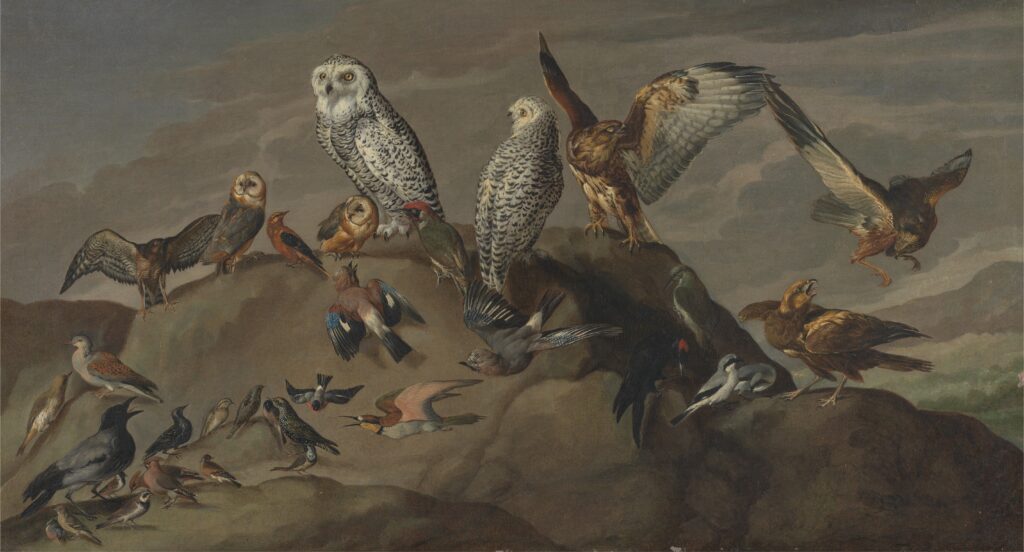
Unknown artist, Study of Birds, ca. 1840. Oil on canvas. Paul Mellon Collection. Image courtesy of the Yale Center for British Art.
Andrew J Lewis
I returned to Yale University last week after roughly twenty-five years away, this time in a power wheelchair. I came for an American Studies conference, to begin some new conversations, and to revisit a place that had once occupied a considerable amount of my intellectual life.
With an hour before the conference, I visited the Yale Center for British Art, a national treasure I remembered as rather stuffy and overpopulated by aristocrats, horses, and lions attacking horses. In the late 1990s, I could endure only so many paintings of English gentlemen standing beside their livestock before wondering whether British civilization had produced anything else.
In the intervening years, I’ve spent a great deal of time in museums, particularly in London. So I figured I’d give the Center another look.
And, my goodness, what a difference.
The exhibition Loyalists and Sons of Liberty: America 250 was terrific. Here was a subject I knew reasonably well, presented with energy, imagination, and a willingness to complicate familiar stories.
Nicely done, YCBA.
Then I headed into In a New Light: Five Centuries of British Art, the Center’s presentation of its permanent collection. I wasn’t entirely sure where to begin, but everything was on the same floor, and I had no agenda beyond looking at pretty pictures.
Always visit the permanent collection, people.
J. M. W. Turner was there, making nineteenth-century maritime travel look like an extraordinarily bad idea. His fascination with light, weather, and the power of nature produced some of Britain’s most extraordinary paintings.
Beautiful work, Mr. Turner. But did you ever consider letting a ship arrive safely?
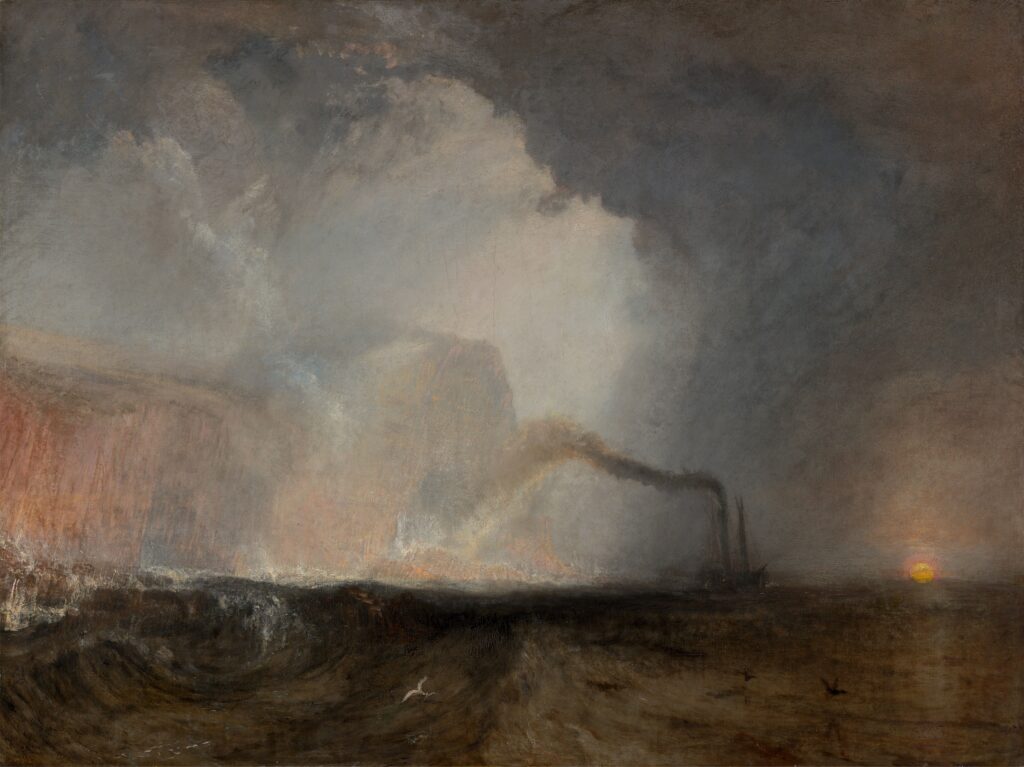
J. M. W. Turner, Staffa, Fingal’s Cave, 1832. Oil on canvas. Paul Mellon Collection. Image courtesy of the Yale Center for British Art.
And then I began noticing the birds.
At first, nothing remarkable. A gull or tern dissolving into Turner’s atmosphere. Some game birds hanging in the background of a painting featuring gentlemen admiring horses. A dead pheasant here, a live duck there.
Perfectly normal British behavior.
But the birds kept coming. At some point, I began to wonder whether the British had painted anything that wasn’t either a bird or another creature preparing to eat one.
Eventually I entered the Long Gallery, where paintings hang densely from floor to ceiling, and found myself confronting what appeared to be an ornithological emergency.
Francis Barlow’s Jay, Green Woodpecker, Pigeons, and Redstart (ca. 1658). Marmaduke Cradock’s Peacocks, Doves, Turkeys, Chickens, and Ducks by a Classical Ruin (ca. 1700).
A classical ruin! With the global poultry department!
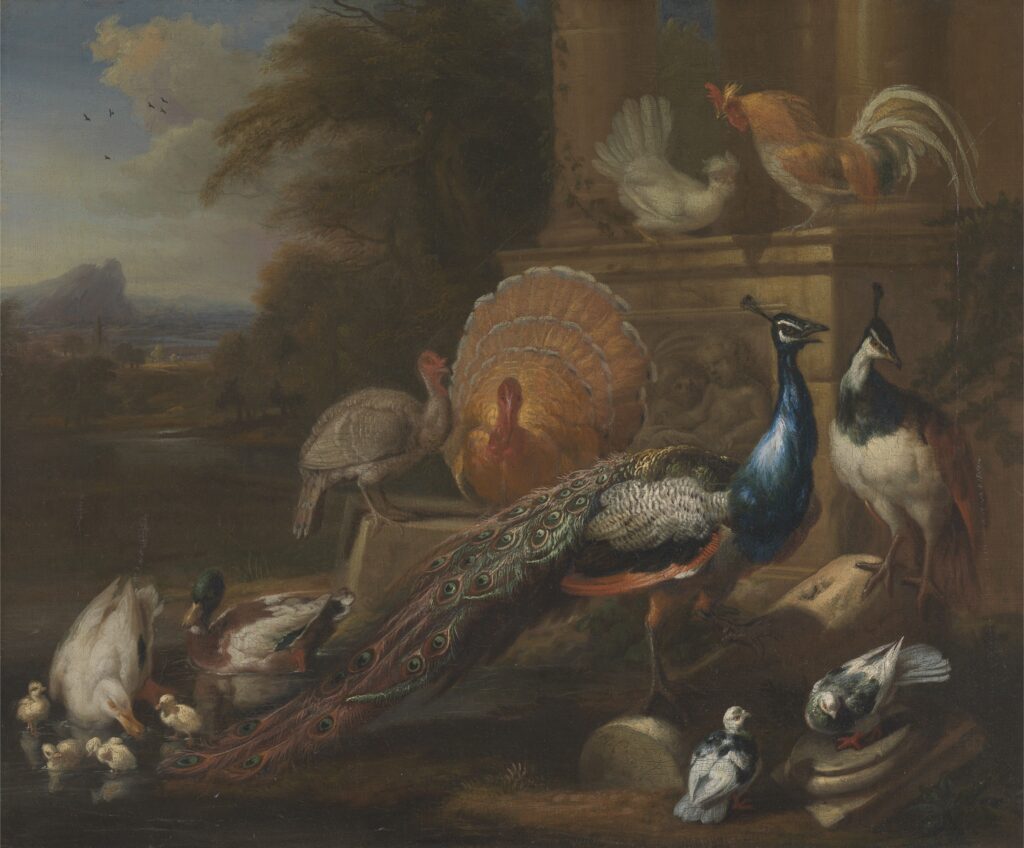
Wait. Is Cradock blaming turkeys for the fall of Rome? Who else knows about this, Yale?
Marmaduke Cradock, Peacocks, Doves, Turkeys, Chickens and Ducks by a Classical Ruin, ca. 1700. Oil on canvas. Paul Mellon Collection. Image courtesy of the Yale Center for British Art.
And then there was Study of Birds, an anonymous painting from around 1840 featuring a peculiar assembly of birds, including a Barn Owl that looked rather unlike the dozens of healthy Barn Owls I’ve encountered.
And, then, I couldn’t quite decide whether the white birds were Snowy Owls or white-morph Gyrfalcons. I just loved it.
It wasn’t folk art, exactly. Somebody here very much knew how to paint. But somebody also apparently believed that all these birds needed to attend the same shareholder meeting.
Dork art. And I mean that affectionately.
Somebody, nearly two centuries ago, apparently loved birds enough to assemble this improbable gathering. And here I was, another bird dork, appreciating the extraordinary effort.
The Barn Owl appeared to have received some questionable anatomical advice, while the white birds had declined to identify themselves. One suspects the artist was working from a combination of observation, imagination, and whatever birds happened to be available that particular Tuesday.
An admirable contribution to artistic ornithology. A somewhat less reliable field guide.
But the larger question remained.
Good Lord, Britain. What was going on with all these birds?
Quite a lot, actually.
There’s an enormous scholarly literature on British birds: empire, natural history, collecting, aristocratic patronage, the whole business. Generations of scholars have produced monographs, dissertations, catalogues, and bibliographies about precisely this sort of thing.
Nerds being nerds, standing on the shoulders of other nerds.
I say that with affection. I’m one of them. Yale trained me to take such things seriously, which is both an extraordinary gift and, occasionally, a rather expensive occupational hazard.
I hadn’t come to the Center to research British ornithological painting. I’d come to look at pretty pictures. Yet here I was, finding the history of empire and scientific knowledge in a funny-looking-owl-falcon thing.
I later discovered that the museum had already organized eleven paintings into a section labeled BIRDS, complete with a gallery guide and scholarly programming.
Excellent. The matter is in very capable Yalie hands.
Please continue your magnificent nerding, colleagues.
What strikes me now is what an extraordinary thing a Yale education can be.
Not merely a credential or preparation for a specialized academic career. It’s a way of learning to look at the world, recognize connections, and discover questions hiding in apparently ordinary things.
Twenty-five years ago, I already loved birds. But I was also a graduate student learning to take my scholarly responsibilities very seriously, perhaps too seriously to imagine that my assorted interests might someday become material for something as frivolous as a funny little essay.
Now I’m back, older, in a different but same body, and considerably less concerned about whether a thousand words on British birds constitutes a proper contribution to the discipline or the storehouse of human knowledge.
I can admire the specialists, benefit from their scholarship, and make something different with it. The education is still doing its work, even when I’m not entirely sure what I’m making or whom it’s for.
Does this have an audience? No idea.
But is it a deeply pleasurable way to spend a few hours? Oh, absolutely.
Perhaps I should have spent more time with the birds when I was a graduate student.
Instead, all I could see were horses and lions and ships in danger.
Funny what you learn to see.