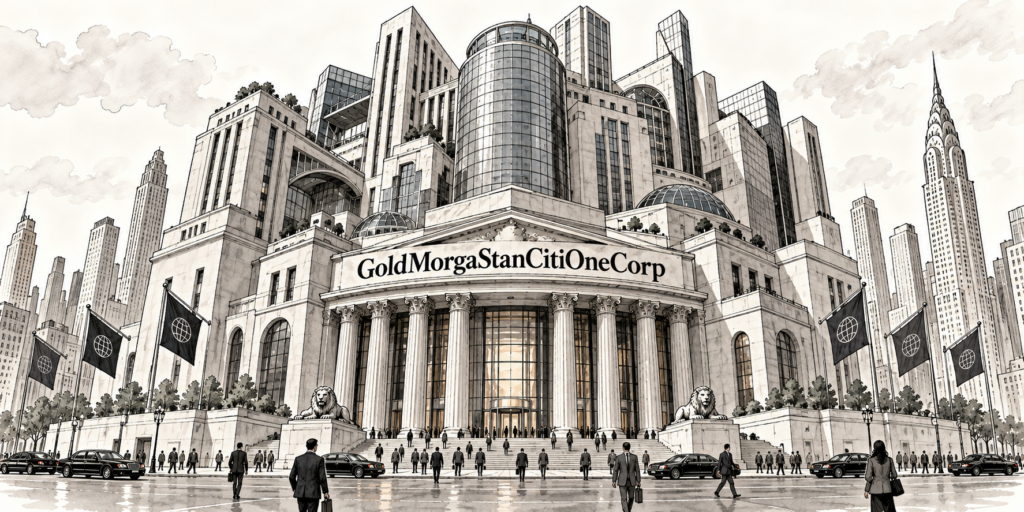
Big Finance, as imagined by the author. A composite rendering of the American financial services industry, whose constituent institutions are undoubtedly quite different from one another, but how? No actual financial institutions were merged in the production of this illustration.
Illustration: AJL + SGPT, October 12, 2026.
Andrew J Lewis
I have a favorite investment bank.
This is not a sentence I ever expected to write. I have favorite birds, favorite golf courses, favorite historians, and a few favorite people. But investment banks?
Until recently, I couldn’t have reliably distinguished one from another. Honestly, it’s all GoldMorgaStanCitiOneCorp to me, except perhaps for their occasional appearances in congressional investigations and financial crises.
Nevertheless, my favorite investment bank is Morgan Stanley.
Allow me to explain.
In July, my friends Chris Maher and Bob Ludke invited me to an impact-investing conference at Foundation House in Greenwich, Connecticut. It was my first such gathering, and I had only a vague idea what to expect. I understood that impact investing involved making money while doing good, which struck me as an excellent proposition, particularly since I had recently established a company dedicated to doing both and had thus far demonstrated considerably more aptitude for the latter.
A few days prior, I informed my son that he would be driving me from the Town of Somerset, Maryland, to Greenwich. As an enticement, I offered him a round at the newly renovated Yale Golf Course, recently profiled in The Athletic as a work in progress. This was a splendid arrangement, particularly for me, since I no longer play golf but enjoy his company.
Mother Nature had other ideas. A moving rainstorm accompanied us up the Eastern Seaboard, rendering the golf excursion impossible. My son had now agreed to drive several hundred miles for the privilege of watching his father attend a finance conference.
Parenthood is full of teachable moments.
Foundation House was lovely. Chris and Bob were enormously generous with their time, introducing me around and making me feel welcome. But they were also hosting an actual conference, which meant they had responsibilities considerably more pressing than shepherding a novice entrepreneur through his first encounter with the capital markets.
Fortunately, I had come prepared.
Several days earlier, I had studied the conference program and identified someone I particularly wanted to meet: a Morgan Stanley professional whose work seemed unusually relevant to what I was attempting to build. The Banker, as I shall call this person, was among the conference speakers, which made the identification phase of my research considerably easier.
I am, after all, a cracker-jack historian and not just a pretty face.
By early afternoon, the weather had turned suffocatingly hot, the conference was winding down, and people were understandably contemplating departure. Which struck me as an excellent moment to approach the Banker and explain my business.
I cannot reconstruct precisely what I said. I suspect it involved a shocking number of words delivered in an exceedingly short period of time, with jazz hands for subtle emphasis.
But somehow, miraculously, the Banker invited me to follow up. Then came an email, a copied assistant, and suddenly I had a meeting with Morgan Stanley.
For thirty minutes.
I was a disabled former professor, an entrepreneur of approximately nine months’ standing, attempting to build a company called The Coherence Portfolio. Its central proposition is that disability represents not just a social problem requiring accommodation, but an enormous, underdeveloped commercial market.
I had ideas, prototypes, a website, and a manifesto. I had even begun testing actual products with actual people, some of whom, astonishingly, seemed to want to use them. What I did not have was much revenue, any meaningful history of raising capital, or a particularly persuasive answer to the question of why anyone should give me money.
I prepared accordingly.
My manifesto was revised, reorganized, and subjected to the sort of scrutiny normally reserved for doctoral dissertations. From four pages to four sentences, I attempted to explain how a portfolio of ventures addressing disability, mobility, memory, recreation, and accessibility might become an actual business.
More astonishingly, I incorporated financial concepts. Not just words like Yield Curve and Private Credit, which I had previously attempted to master, but actual propositions about markets, customers, products, and growth.
About two weeks later, I sat down at my computer in Maryland for a Zoom meeting with Morgan Stanley.
This was Big Finance. Actual Manhattan finance, conducted by a person who presumably understood what all those enormous buildings were for. Meanwhile, I was sitting at home with my impassioned pitch, née manifesto, attempting to look like someone who knew what he was doing.
The Banker listened carefully and asked questions. I answered them, sometimes coherently. At one point, I believe we both experienced a moment of mild astonishment that I had managed to produce something resembling a commercial argument.
It was rather like witnessing a baby’s first words, except the baby was fifty-three years old and asking soft-headed questions about venture capital.
And then, somewhere around minute twenty-eight of our meticulously protected thirty-minute appointment, I did something I had never done before in my life.
I reintroduced myself and asked Morgan Stanley for money.
There. I’d done it.
Not hinted at it. Not suggested that perhaps, someday, someone might consider supporting some worthy initiative vaguely affiliated with Andrew J Lewis. Rather, I had asked an investment bank to invest in my company and me.
The Banker said no. A little too quickly.
But then came laughter.
Now, I have considerable experience being laughed at, and not all of it has been encouraging. I was therefore preparing to receive this particular laugh as a useful lesson in the distance between entrepreneurial enthusiasm and financial reality.
But the Banker interrupted my interpretation.
“You haven’t heard why I’m laughing.”
The Banker explained that the answer might be different in six months. There was, apparently, a there there. I needed to keep building, demonstrate that the products had a market, and stay in touch.
I was stunned.
Later, I shared this astonishing development with my wife, whom I love beyond my ability to explain and who possesses a considerably firmer grasp of household economics than I do.
She listened patiently, much as she listens to my accounts of extraordinary bird sightings. I describe the remarkable plumage, an unusual song, the improbable geography, and then, somewhere in the middle of my own story, realize that I’ve once again identified a Song Sparrow.
She allowed me to finish my breathless account of the encounter with Big Finance before pointing out one small detail.
“The Banker said no, Andrew.”
Well, yes. Technically.
My wife also reminded me that we had college tuition bills to pay, and that failure to do so could result in our children returning home to live with us.
This was an outcome neither of us wished to contemplate.
Thus restored to financial reality, I began considering my next move. Naturally, I wanted to consult someone who actually understood investment banking. As luck would have it, I know someone in the financial services industry who understands these matters considerably better than I do.
Perfect!
Except he will not talk to me about any of it.
He is so scrupulous about professional boundaries that merely mentioning the subject causes him to withdraw from the conversation at remarkable speed. At this point, I half expect him to produce a nondisclosure agreement in triplicate if I ask whether he thinks the Minnesota Vikings are going to win on Sunday.
I admire this enormously. I also find it profoundly inconvenient.
Here I am, attempting to understand the world of finance, and someone who might actually be able to explain it has apparently been placed under an injunction against discussing anything remotely financial with me.
But I digress.
Morgan Stanley did not invest in my company. The Banker did not promise to invest in my company. There was no endorsement of my business plan or declaration that I was the next great American entrepreneur.
Nevertheless, I have a favorite investment bank.
For those of you who work in investment banking, private wealth management, venture capital, or any of the other mysterious professions through which money moves around the world, I have a modest suggestion.
Every so often, consider granting a meeting to someone whose ambitions substantially exceed their balance sheet. A real meeting. Thirty minutes.
It may be a waste of your time. But it wasn’t a waste of mine. Not at all.
So thank you to the Banker who heard me out. Thank you to the assistant who made the meeting happen. Thank you to my friends who brought me to Greenwich in the first place. And thank you, Morgan Stanley, for the unexpected generosity of a serious hearing.
I am not suggesting that anyone transfer their life savings to Morgan Stanley on my account. Please don’t. I have no qualifications whatsoever to offer financial advice, as my wife would be delighted to confirm.
But if you happen to be a Morgan Stanley client, employee, investor, or otherwise acquainted with someone who moves large quantities of money around, perhaps you might mention a little outfit called The Coherence Portfolio.
Not because we’re ready for your money. Not yet.
But because somebody at Morgan Stanley was kind enough to suggest that there might be something worth watching.
And I intend to show you what that is.