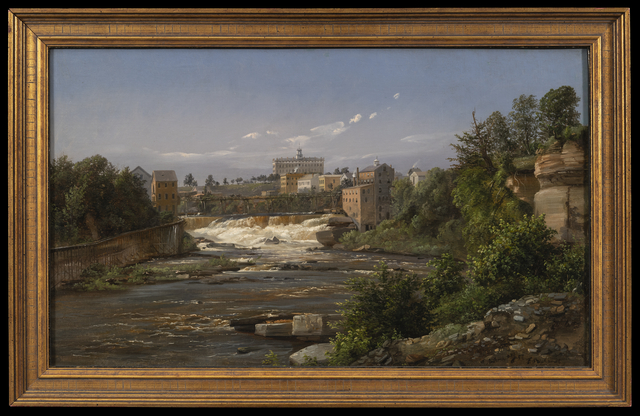
Ferdinand Reichardt, St. Anthony Falls, 1857. Here, the Mississippi interrupted navigation but supplied the waterpower that made Minneapolis a milling capital. Geography has consequences. Courtesy of the Minnesota Historical Society.
Andrew J Lewis
The other day I made a pastoral visit to a friend recovering from surgery.
Mind you, I possess absolutely no spiritual authority that would qualify this as anything other than a heathen visit. But given my own faith maladies, I’m calling it pastoral. I was concerned about my friend, and I went to see how he was doing.
My friend and his wife are, in certain respects, the fully equipped Jewish doppelgängers of my own family. He grew up in Minnesota, she in New Orleans, and both appear to have arrived with all the Jewish factory settings enabled. My wife is Jewish and also grew up in New Orleans. I grew up Nordic Christian in Minnesota, spent roughly fifty years exploring and avoiding Christianity rather deeply, and have lived jewishly for more than thirty years.
Nowadays, I hang around with rabbis and ask really annoying questions. I’m exploring. Chill.
I’m a deeply conservative fellow, intellectually speaking, and not terribly creative. So, with whatever time remains available to me, I’ve decided to limit my scope. Henceforth, I promise to concentrate primarily, but not exclusively, on the Abrahamic faith traditions in the Americas. I figure several thousand years of accumulated argument and two entire continents should keep me busy for a while.
Anyway, there we were, enjoying an otherwise ordinary conversation about surgery, recovery, and family life, when my friend’s wife introduced me to a concept that had somehow escaped my decades of religious education.
Cajun Kosher.
I’m sorry. What?!
She explained that this is not, strictly speaking, kosher. It’s more of an… understanding.
As one approaches New Orleans, apparently, certain Jewish dietary restrictions begin yielding to local conditions. By the time one reaches her family, the accommodation is sufficiently advanced that a backyard boil might contain shrimp, crawfish, and assorted other bottom-feeders expressly disfavored by Leviticus.
Pork, however, is absolutely prohibited.
“We’re Jewish, Andrew.”
I accepted this explanation because I am learning that Judaism has survived several thousand years without requiring me to resolve all apparent inconsistencies.
I subsequently investigated and discovered that Cajun Kosher is not a family eccentricity. New Orleans Jews have been working this territory for generations. Temple Sinai held seafood dinners beginning in the 1950s and, more recently, crawfish boils involving hundreds of pounds of the expressly non-kosher crustaceans. If the internet contains truth, there is an old New Orleans joke that Jews require five sets of dishes: meat, dairy, Passover meat, Passover dairy, and crawfish.
At the same time, other New Orleans Jews took precisely the opposite approach and made Creole food kosher: gumbo with kosher sausage instead of andouille and shrimp; salmon étouffée; imitation stuffed crab; even kosher king cake for Mardi Gras.
Faced with the collision between Judaism and Louisiana cuisine, New Orleans Jews apparently developed two schools of thought: adapt the recipe to their Judaism. Or eat the crawfish.
But I grew up in Minnesota. Nordic Christian Minnesota. And sitting right there was my friend, a product of one of the great Jewish concentrations of the Upper Midwest. By the late twentieth century, more than a third of the Twin Cities’ Jews lived in St. Louis Park.
Minnesota Jews have spent generations living among people with a powerful regional food culture, too.
Yet I have never heard of Minnesota Kosher.
Nobody has ever explained that as one travels north along the Mississippi River, Jewish dietary law gradually accommodates Scandinavian cuisine until, somewhere around Lake Pepin, a plate of lutefisk becomes culturally obligatory.
Quite the opposite.
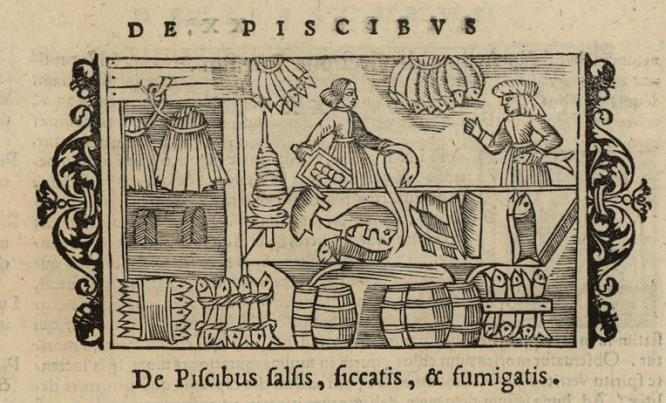
Olaus Magnus, Historia de gentibus septentrionalibus, Rome, 1555, Book XX, Chapter XXVI, p. 722. Digital facsimile: Project Runeberg.
This is particularly curious because lutefisk begins as cod, a perfectly respectable kosher fish. It is then dried, soaked in lye, and subjected to a series of procedures I do not fully understand, until both its texture and reputation have been transformed beyond recognition. The resulting substance helped sustain human life through perilous Norwegian winters and, according to tradition, was particularly suitable for babyer og tannlause gubber—babies and toothless old geezers.
An unusually narrow target market, but a durable one.
Crawfish, meanwhile, has no defense whatsoever.
And so, we appear to have discovered an American Jewish culinary paradox.
Near the northern reaches of the Mississippi is a regional delicacy Jews could conceivably eat but, understandably, choose not to. Near its mouth is an entire category of animals they are specifically instructed not to eat but which some Louisiana Jews have apparently decided are too delicious, and too central to life in Louisiana, to surrender.
The Mississippi connects them.
This interests me less as a question of religious consistency than as a question about America. Jews did not simply become American. They became Minnesotans and Louisianans, Texans and Californians, Alabamans, New Yorkers and rather cheerful folk from Ohio.
Inherited traditions encountered climate, landscape, neighbors, ingredients, accents, and appetite. Some things changed. Some things didn’t. And the resulting boundaries do not always make sense from the outside.
I am still sufficiently new to asking these questions in earnest that I occasionally stop at such boundaries and ask someone to explain the governing principle.
Perhaps there isn’t one.
Or perhaps the river offers one.
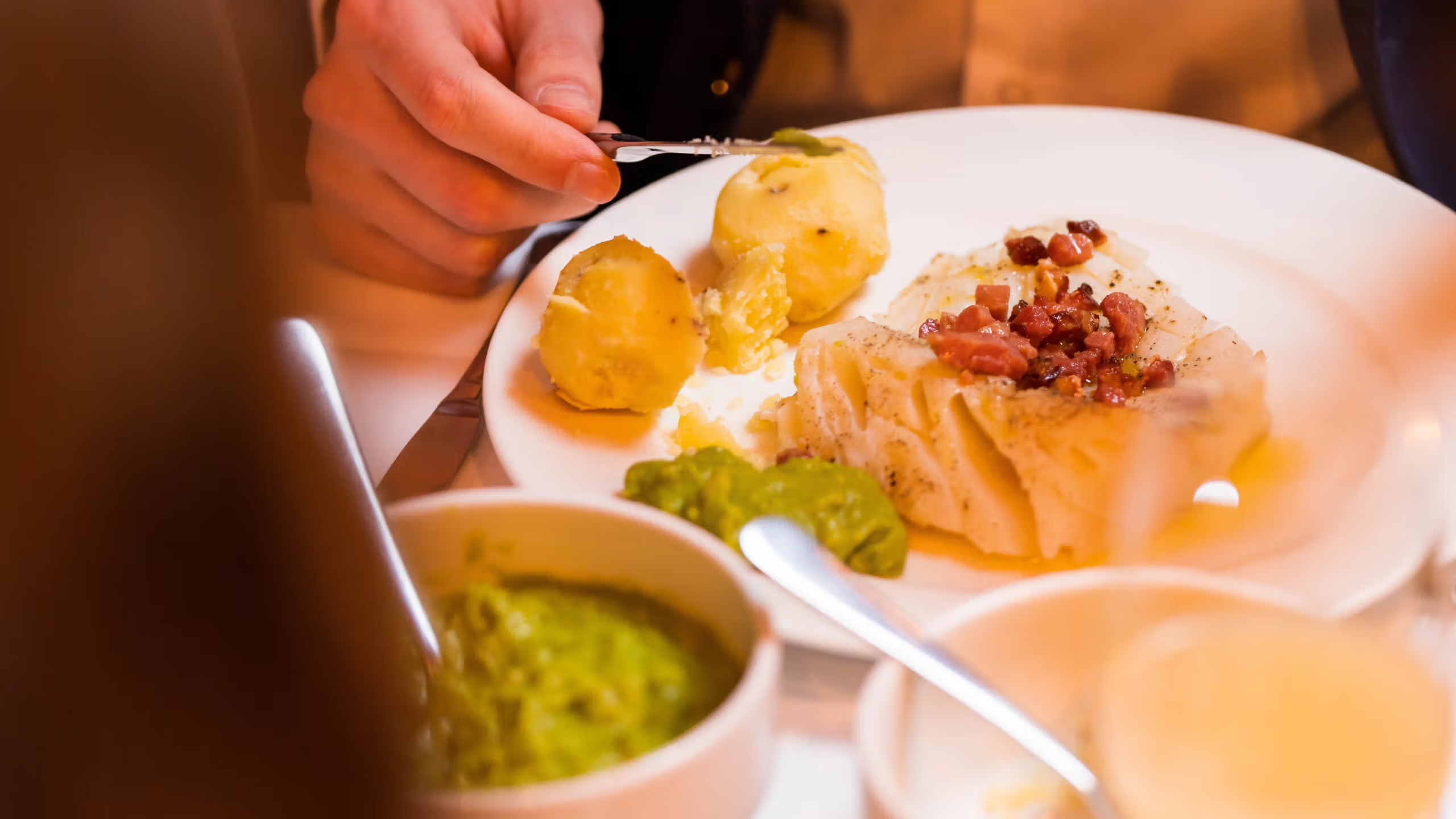
Photograph via Visit Norway.
Start in Minnesota with an ostensibly kosher fish substance nobody likes but eats to remind them of suffering.
Follow the river south.
Watch the winters soften, the accents change, the food improve, and the dietary restrictions encounter increasingly serious competition.
Two thousand miles later, somebody hands you a crawfish.
Eat it. Or not.
Just don’t ask for pork.
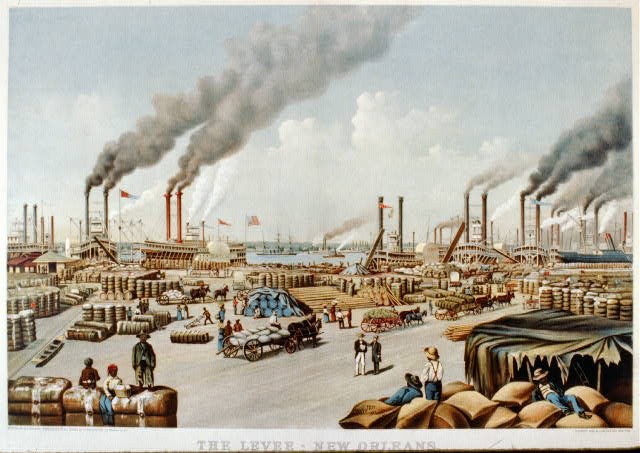
William Aiken Walker, The Levee—New Orleans, 1884. Published by Currier & Ives. At the southern end of the Mississippi’s great commercial corridor, steamboats, cotton, cargo, and commerce converge on the bustling New Orleans waterfront. Two thousand miles downstream from Minneapolis, a very different American culture takes shape.
Courtesy of the Library of Congress, Prints and Photographs Division.
Source: Library of Congress — The Levee—New Orleans (1884)