
Vädersolstavlan (The Sun Dog Painting). An extraordinary display of atmospheric halos and sun dogs above Stockholm on April 20, 1535. Today we understand these phenomena as sunlight refracting through ice crystals in the atmosphere. What they meant to the people who witnessed them was another matter. Painting attributed to Jacob Heinrich Elbfas (1636), after a lost original traditionally attributed to Urban målare (1535). Storkyrkan (Stockholm Cathedral).
Andrew J Lewis
In November 1664, a comet appeared above New England. This was not necessarily good news. For centuries, Europeans had regarded comets as warnings of catastrophe: war, plague, famine, the deaths of kings. A blazing object appearing unexpectedly in the heavens was not generally interpreted as an invitation to enjoy the evening sky.
Naturally, Roxbury’s Reverend Samuel Danforth, natural philosopher, decided to check things out.
Danforth was a Puritan minister, mathematician, astronomer, poet, and, alas, Harvard scholar. In 1665, he published An Astronomical Description of the Late Comet or Blazing Star, examining the visitor with considerable scientific seriousness. He observed its movement, calculated its position, and investigated its physical properties.
Across the Atlantic, a young Isaac Newton was watching the same comet from Cambridge, England. Modern astronomers identify the comet nowadays as C/1664 W1, whose reconstructed orbit is approximately parabolic, with no established period of return. It may never visit our skies again, in other words.
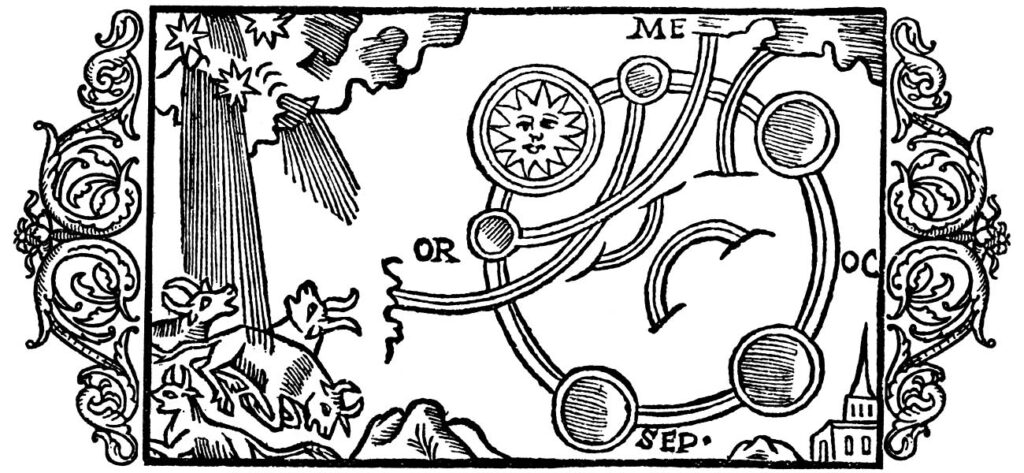
Olaus Magnus, Historia de gentibus septentrionalibus (History of the Northern Peoples), Book I, Chapter XV, “On Suddenly Appearing Circles and the Effects of Comets” (Rome, 1555). Magnus describes atmospheric halos and comets, drawing on ancient natural philosophy and Seneca’s observation that human beings are more astonished by novelty than by greatness. The unfamiliar comet leaves the observer uncertain whether to marvel or to fear. Woodcut, public domain. Image: Wikimedia Commons.

Danforth, meanwhile, had some additional thoughts.
Having explained what he could about the comet, he proceeded to a second section of his treatise, bearing the wonderfully economical heading A Brief Theological Application. Here he considered the historical association between comets and calamities. After a quick but fulsome review of the evidence, Danforth concluded that New England ought to examine its conduct and repent.
The Reverend, it turned out, had been there all along.
Modern astronomers would have objections, of course. But Danforth had done something rather interesting. He had distinguished between understanding what the comet was and deciding what its appearance meant. For him, astronomy and theology belonged to the same providential universe, but investigating a phenomenon and interpreting its significance nevertheless required different kinds of intellectual work.
Five years later, Danforth delivered an election sermon titled A Brief Recognition of New-Englands Errand into the Wilderness. Why, he asked, had the Puritans come to New England? What had they intended to accomplish? And had their descendants forgotten?
In 1952, the historian Perry Miller returned to these questions in a lecture at the John Carter Brown Library. Miller was fascinated by the ambiguity of errand. Were the Puritans carrying out an assignment on behalf of the English Reformation, or had their undertaking acquired purposes independent of the world they left behind? What happens when people inherit a mission whose original meaning no longer adequately describes their circumstances?
Miller spent a great many pages pursuing the question. He was very good at that.
And now, three and a half centuries after Danforth’s comet, we find ourselves confronting artificial intelligence. We have developed machines capable of producing language, interpreting images, solving problems, and performing activities once thought to require distinctly human intelligence. Researchers are investigating how these systems work, philosophers are debating what their capabilities mean, and the rest of us are discovering that they can compose surprisingly competent emails.
Somewhere, Samuel Danforth is preparing a theological application.
But I wonder whether we’re overlooking a more interesting question than whether AI is intelligent, conscious, creative, or likely to replace the people currently attending meetings about those subjects.
Whose errand are we sending it on?
Much of the commercial development of AI has been directed toward familiar objectives: increasing productivity, reducing costs, accelerating professional work, and making existing institutions more efficient. These are perfectly respectable ambitions. I have no objection to making accountants happier, lawyers faster, or PowerPoint presentations marginally less dreadful.
But consider what we’re doing. We’ve developed an extraordinary new set of intellectual instruments and immediately assigned them to helping the existing world operate more efficiently.
The institutions remain largely as they were. Their purposes are accepted. The people whose productivity matters have already been identified. And the problems worth solving have, conveniently, been defined by the people currently paying to solve them.
This is not necessarily a conspiracy. It is how markets and institutions generally behave. They invest in recognizable needs, familiar customers, and improvements they can measure. There is considerable economic value in doing so.
But it does raise the possibility that we’re using an astonishing new technology to pursue a rather old errand.
Danforth might recognize the predicament. His astronomical observations could establish facts about the comet’s movement, but they could not establish that God intended its appearance as a warning to Massachusetts. That required another argument, drawing upon inherited religious assumptions. Likewise, an AI system’s ability to perform a task tells us something about its capabilities. It does not tell us whether that task deserves priority, whose needs ought to matter, or what entirely different purposes the technology might serve.
The distinction is important because new technologies do not arrive with instructions specifying the most interesting things humanity might accomplish with them. We supply those instructions, often without noticing how much of the old world we’ve smuggled into the assignment.
Consider disability.
For generations, buildings, transportation systems, workplaces, and consumer technologies have been designed around relatively narrow assumptions about human bodies and capabilities. Accessibility has often meant adapting those arrangements so that disabled people can participate in a world designed largely without them.
Important work, certainly. But perhaps not the most interesting errand.
Disabled people, working with AI, may identify possibilities that conventional designers and institutions have overlooked. Not because disability confers special wisdom—it doesn’t—but because people who routinely encounter the limitations of existing systems have good reasons to question the assumptions behind them.
Someone whose independence depends upon coordinating a wheelchair, an automobile, a transportation network, and several government agencies may have interesting thoughts about technological integration. Someone who cannot enter a beautiful natural environment may recognize an opportunity for hospitality innovation that a conventional resort developer has never considered.
And someone who has spent years being told what technology cannot do might be particularly interested in discovering what it could do if we stopped accepting those limitations as permanent.
These experiences are not simply requests for accommodation. They can reveal products, services, and markets that do not yet exist.
What if disabled people, empowered by AI, have more to teach us about intelligence, agency, and independence than another generation of technologies optimized for able-bodied productivity?
I find that question considerably more interesting than whether AI can reduce the time required to prepare a quarterly earnings presentation.
There is, of course, a historical complication. The Puritans were themselves extraordinarily serious about their errand, and their conviction did not prevent them from participating in a colonial enterprise that disregarded Indigenous peoples and their sovereignty. Intelligence, conviction, and impressive institutional organization are no guarantees that one has chosen a particularly admirable purpose.
Indeed, that’s rather the point.
Danforth studied his comet with the best instruments available to him, then interpreted its significance through the intellectual categories he had inherited. Some of his observations were sound. Some of his interpretations were not. But he understood that the appearance of something extraordinary called for more than simply improving the techniques by which familiar work was accomplished.
We have considerably better instruments today. We also have an extraordinary opportunity to reconsider the purposes to which we put them.
The comet was real. Its meaning was an argument.
Artificial intelligence is real, too. And while we continue improving its ability to accomplish the errands we’ve already assigned, perhaps we might occasionally ask whether those were the errands worth undertaking in the first place.
Or, as Perry Miller might have asked, whose errand are we on, anyway?
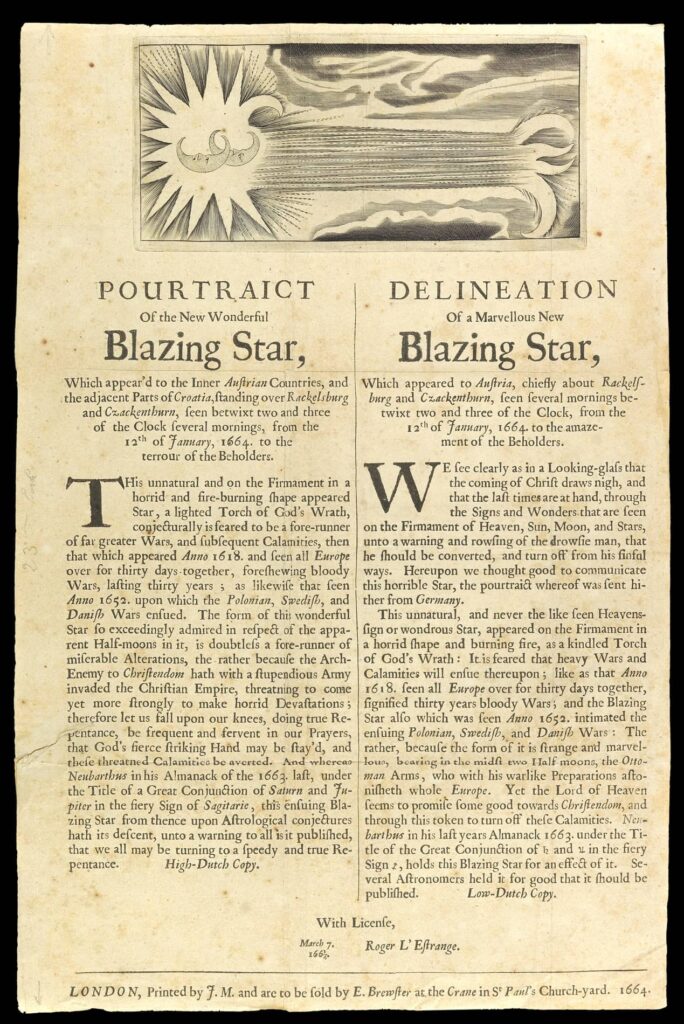
Pourtraict of the New Wonderful Blazing Star (London, 1664). An English broadside describing a celestial apparition over Central Europe in January 1664, months before Samuel Danforth observed his comet above New England. Different sightings, but a shared conviction that extraordinary things in the sky demanded explanation.
Image credit: Pourtraict of the New Wonderful Blazing Star, anonymous English broadside, London, 1664. Public domain.