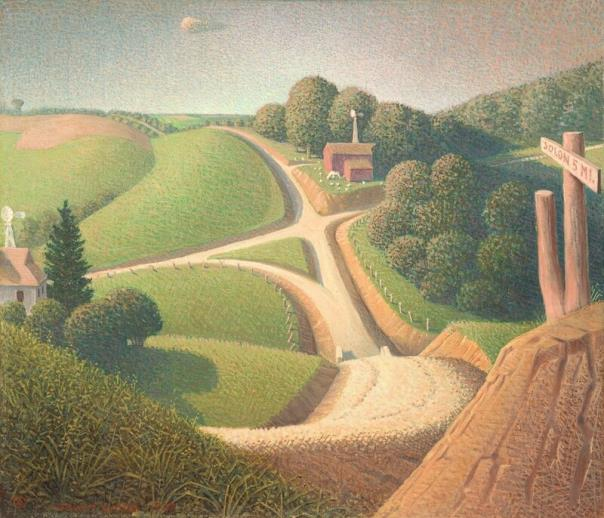
Grant Wood, New Road, 1939. A new road promises a better way forward. The question, of course, is whether everyone can get there.
Oil on canvas mounted on hardboard. Collection of the National Gallery of Art, Washington, DC. Gift of Mr. and Mrs. Irwin Strasburger.
Andrew J Lewis
Written in response to a Yom Kippur 5787 (September 2026) teaching at Washington Hebrew Congregation, this letter considers what might come after the fifth chapter of Portia Nelson’s Autobiography in Five Short Chapters—and what happens when learning to avoid a problem doesn’t actually repair it.
Dear Rabbi Shankman and WHC Clergy,
Happy New Year. I realize we’ve only just finished Yom Kippur and everyone is eager to get back to sinning. But before we get too far along, I have one small question about Portia Nelson’s Autobiography in Five Short Chapters: is there a Chapter Six?
First, I loved the poem. More annoyingly, I needed it. I am an accomplished faller into holes. I can fall into the same hole repeatedly, become furious about the hole, investigate who is responsible for the hole, and only much later consider the possibility that I might stop walking down the hole-filled street.
So, I was with you. Fall in. Recognize the pattern. Take responsibility. Walk around the hole. Eventually, take another street. Teshuvah. Excellent. Then the congregation chuckled. And I thought, hold on…
Not because the chuckle was wrong. I chuckled too. It’s the lovely sound a room makes when everyone gets the point. Which was precisely the problem. Everyone got the point. Everyone was about to leave. And I was sitting in my wheelchair thinking, uh, guys?
The hole had served its theological purpose. We’d learned from it. But you were all heading toward the new street. I would very much like to join you there. It looks lovely. I’m just wondering how I’m supposed to get to it.
Presumably someone is coming tomorrow to fill the hole?
Or, if we have collectively decided to abandon this street—which honestly sounds reasonable—someone is going to connect it to the new one? A curb cut would probably do it. I’m flexible.
This made me think about the other story you told: the man searching for his keys beneath the streetlamp even though he lost them somewhere else. Why look here? Because the light is better, duh.
We Americans do like the light. The new street, the new building, the new program, the new technology, the new solution. Often the new thing really is better. But repair tends to happen somewhere darker.
Repair means going back to the street everyone else has successfully left. I wonder whether our ability to navigate around something broken allows us to stop noticing that it remains broken.
Which brings me back to that chuckle. Don’t stop chuckling. Goodness knows, don’t take that away too. I just wonder whether there is a moment after the chuckle, before everybody moves on, when someone should turn around and ask: hey, is everyone coming?
Maybe that’s Chapter Six. Not a correction to the first five. Just what happens next.
I see the hole. I recognize my part in repeatedly falling into it. I learn. I turn. I take another street.
And then, perhaps, I turn around once again. Because someone else is coming tomorrow, and the hole is still there.
With much affection,
AJL