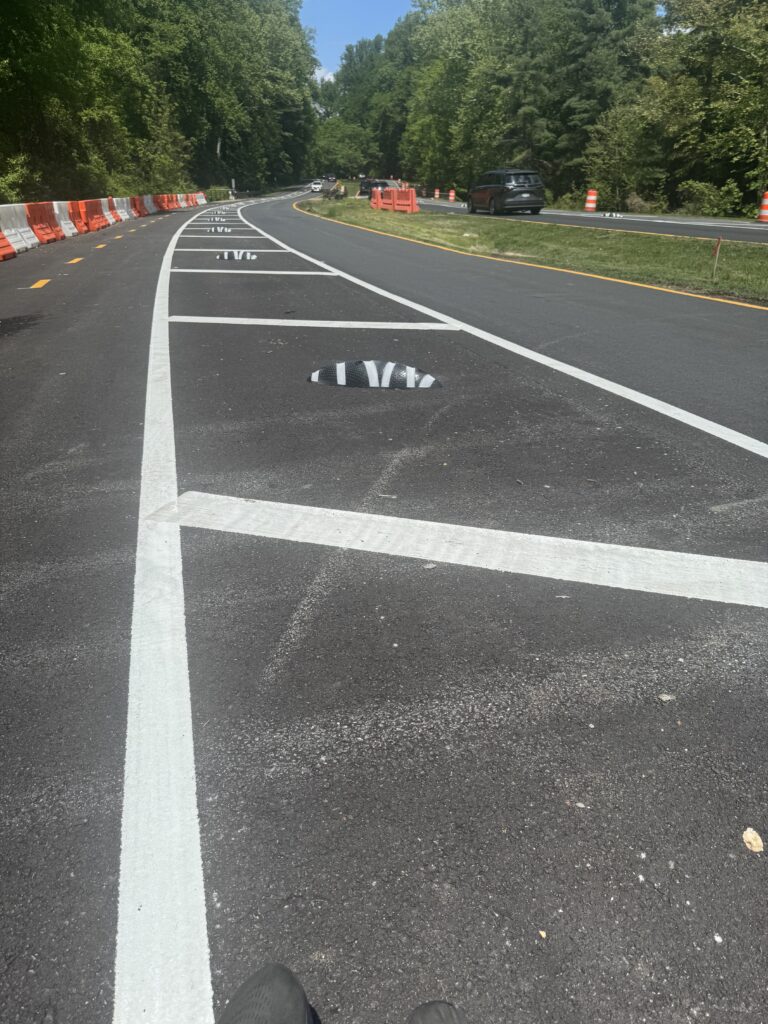
Fresh pavement, new markings, and room to move. Little Falls Parkway, Montgomery County, Maryland, Spring 2026. Photograph by Andrew J. Lewis.
Optional musical accompaniment: Suki Waterhouse, “Back in Love,” (2026). An entirely coincidental selection bearing no intended relationship to the essay that follows. No endorsement, affiliation, or romantic entanglement is implied, Ms. Waterhouse. I will of course remove this immediately upon request.
Andrew J. Lewis
I am in love with a road. Not metaphorically. Not in some abstract, public-spirited, good-government sort of way. I am genuinely, passionately, perhaps unreasonably in love with a stretch of asphalt just outside my neighborhood in Montgomery County, Maryland.
It’s the Little Falls Parkway. And I think it’s time the people responsible knew.
Before we proceed, an important disclaimer: I have not yet confirmed every detail of this project’s history with Montgomery Parks or the other agencies involved. I’ve consulted the official records, but some engineering decisions, costs, and construction details remain mysteries. What follows combines that research with my recollection of watching this thing unfold over several years.
I intend to investigate the remaining details. But my love can no longer be contained. It must be free!
A Pandemic, a Parkway, and a Rather Good Idea
As I remember it, Little Falls Parkway began its transformation early in the pandemic. The world had stopped going places. Roads were empty. People were home. And somewhere in Montgomery County, somebody apparently looked at a parkway and thought: hold on, what if we let people use this thing for something other than driving?
MAN ALIVE. You could walk there. You could ride a bicycle. You could move around outdoors without constantly worrying about automobiles. There was this enormous, already-paved public asset sitting there, and suddenly we were using it differently. Quick win!
Montgomery Parks, it turns out, had a name for this: Open Parkways. Launched in 2020, the program temporarily opened portions of three parkways to recreational use. Little Falls Parkway was one of them, although its weekend closures were interrupted before resuming in March 2021.
And guess what? It made more sense than what we’d been doing before. How do I know? Because I’m telling you it’s better.
Now, I recognize that this is not the evidentiary standard ordinarily employed by civil engineers, transportation planners, or people entrusted with millions of taxpayer dollars. They have traffic counts, safety studies, engineering standards, public hearings, and other irritating mechanisms for determining whether an idea is any good. Fine. We’ll get to those. But I have something they don’t necessarily have: the experience of using a powerchair on that glorious asphalt. And I have opinions.
Here’s something else I learned: Montgomery Parks says its stream-valley parkways were originally intended as recreational amenities, not primarily commuter routes. Early parkways were associated with the American pastime of joy-driving—taking a drive for the pleasure of the experience rather than simply getting somewhere.
So perhaps this wasn’t some radical innovation after all. Perhaps we were remembering what a parkway was supposed to be.
Historians LOVE this sort of thing.
The Most Expensive Toy Anyone Ever Bought Me
Let me explain what Little Falls Parkway means to me. I use a power wheelchair, a sophisticated piece of adaptive technology capable of moving considerably faster than I can ordinarily travel through my neighborhood.
The problem isn’t the chair. It’s the world.
Sidewalks are narrow, uneven, interrupted, tilted, cracked, obstructed, and occasionally designed in ways that suggest the person responsible has never encountered a wheelchair outside a hospital corridor. Even when they’re technically accessible, they’re not necessarily places where I can move comfortably, confidently, or quickly.
Then there’s Little Falls Parkway. Beautiful, wide, butter-smooth asphalt. A generous corridor through the trees. Room to move. Room to see what’s ahead. Room to experience something approaching the full capability of the machine beneath me. And, crucially, a degree of separation from automobile traffic that makes the experience feel safe.
I can move. I can really move. (Well, top speed is limited at 10 km/6.2 mph. I MORE than know.)
There’s a particular kind of freedom in being able to travel at the speed your equipment was designed to achieve, without spending every second calculating whether the next crack, curb, root, driveway, or poorly positioned object is going to interrupt your progress. For most people, a smooth stretch of pavement is just pavement. For me, it’s an expansion of the possible.
And the astonishing thing is that somebody built this magnificent recreational asset just outside my neighborhood. For me! Well, obviously not just for me. There are cyclists, walkers, runners, families, children, and plenty of other people enjoying it. But I choose to believe it was built for me, and I would appreciate it if nobody spoiled that interpretation.
Taxpayers of Montgomery County and Maryland: you have done well.
I don’t know what this project cost or which agencies paid for which improvements. But measured against the freedom it has given me, the return on investment is spectacular. Possibly the greatest public expenditure in Maryland since the state helped fund my adaptive van. Except, wait. The parkway money was presumably allocated before the van funding. So the chronology of my gratitude may require adjustment.
Whatever. Excellent work, taxpayers.
The Great Public Experiment
But the really fascinating part isn’t simply the finished pavement. It’s watching how we got here. Little Falls Parkway didn’t emerge from the pandemic as a fully realized transportation masterpiece. It evolved.
There were temporary barricades, different lane configurations, changes to turning patterns, and various little devices whose technical names I do not know. There were also counters and camera-looking contraptions apparently collecting information about how people used the space. I assume somebody was studying something. This is the level of technical sophistication I bring to the investigation.
But I watched. Configurations appeared and disappeared. Barriers moved. Traffic patterns changed. I couldn’t tell how much was planned, how much reflected public feedback, or how much resulted from engineers discovering that an idea worked differently once actual human beings began using it.
From the outside, it looked like something rather wonderful: government was trying things.
And they had a problem worth solving. According to Montgomery Parks, the recreational closures attracted more than 3,000 users on an average weekend, but also diverted automobile traffic into nearby neighborhoods. Could they preserve the recreational space while keeping enough of the parkway open for cars?
In 2022, Montgomery Parks and the county transportation department tested a two-lane configuration. Their studies found that two lanes could accommodate traffic volumes similar to those previously carried by four, while reducing cut-through traffic on certain neighborhood streets.
Four lanes, apparently, had not been indispensable. Huh, really makes you think.
This was government experimenting on an actual road, with actual people, measuring what happened and adjusting accordingly. Not merely declaring a commitment to accessibility or commissioning another study.
And eventually, sometime around 2025, Authority had apparently decided. As it happens, Authority had several names.
The Montgomery County Planning Board approved a permanent two-lane arrangement between Arlington Road and Dorset Avenue in April 2023. The County Council considered an alternative and approved a revised configuration in January 2024. The National Capital Planning Commission approved the project that September.
And in September 2025, the construction crews arrived.
Several public bodies, a few years of study, and a fair amount of engineering. But eventually somebody got to paint the lines.
Brothers of the Sacred Stripe
There came a period of construction and permanent-looking improvements. New pavement. New lane markings. Beautiful white lines. Bright green sections. Physical separators and those marvelous little black-and-white raised bumps that help define the protected space. I LOVE those things. I don’t know what they’re called, and I don’t care. They are delightful.
And then there were the striping guys. Two brothers, as I recall, working on the pavement markings. I made friends with them, and I want to pause here to acknowledge something that has probably escaped the attention of the American public: we are being cheated. These two gentlemen are apparently employed painting stripes on roads when they could be touring the country as a stand-up comedy act.
Except it wasn’t really an act. It was more of a life philosophy. I can’t reconstruct our conversations, and I’m not going to invent dialogue for them, but I remember the pleasure of our encounters. Here were two people doing highly specialized, physically demanding, exacting work in the middle of an active road project—and somehow making the experience hilarious.
At some point, the United States Army entered the conversation. There were stories of military shenanigans involving striping machines, late-night adventures, and lines that may have been considerably less straight than military regulations ordinarily prefer. Accounts differ as to what happened next. I have neither corroborating evidence nor the slightest intention of conducting a court-martial.
What I can report is that the lines on Little Falls Parkway are excellent. Beautiful work, gentlemen. Taxpayers of Maryland and Montgomery County, well done. You’ve acquired some first-rate infrastructure workers and, quite possibly, deprived the American public of two remarkable careers in entertainment.
But I digress.
The Seven-Foot Arm Problem
Now we come to my favorite little episode, because the photographs preserve something genuinely marvelous about the difference between designing accessibility and actually achieving it.
At one of the crossings, the project included a pedestrian signal with a push button. Wonderful. The equipment appeared to be at an appropriate height. It looked like the sort of thing that had been designed with accessibility requirements in mind.
There was just one small problem. The button was installed in a location that, from my wheelchair, I couldn’t actually reach. To operate it, I would have needed arms approximately seven feet long. Which, regrettably, were not included with my muscular dystrophy.
From every perspective except that of the intended user, the installation looked perfect. The pole was there. The button was there. The signal was there. The concrete was there. Accessibility had been installed! Except the user couldn’t use it.
I found this absolutely hilarious. Not because the mistake was inconsequential—a crossing button that cannot be reached is a serious problem—but because the absurdity was so complete. Somewhere between the engineering drawing, the construction crew, the concrete, and the actual human body, the entire purpose of the installation had apparently escaped.
And then something even more wonderful happened. They fixed it.
I don’t know who noticed the problem or who reported it. Perhaps an inspector caught it, a contractor recognized it, or somebody in authority looked at the installation and said, more or less, “Oh, come ON.” But the next thing I knew, the pole had moved. New concrete. New position. Whatever adjustments were necessary. And, swear to Robert Moses himself, it seemed to happen overnight.
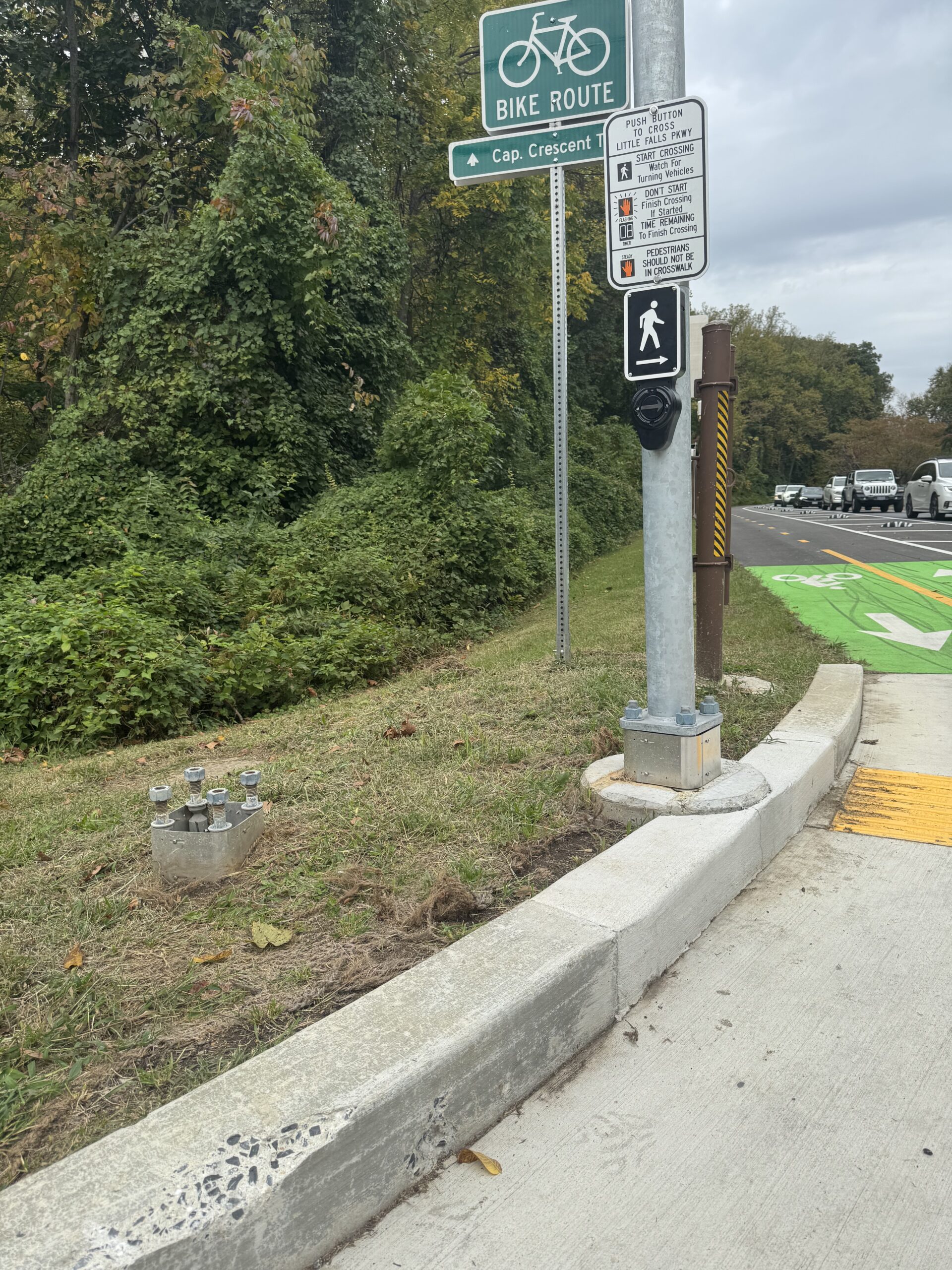
Before my beloved striping comedians had even finished their work, the crossing had been corrected. The old mounting hardware remained visible in the grass beside the new installation—an archaeological record of the first attempt. I took photographs. Because how could I not?
Somebody built something intended to be accessible. It wasn’t usable by at least one of the people it was supposed to serve. And then somebody corrected the problem. No grand theory required. Just an observation, a decision, and some concrete.
Perhaps the administrative history was more complicated. Perhaps there was an inspection report, a change order, and an enormous chain of correspondence. I don’t know. But from my perspective, government had made a mistake and fixed it. Quickly. In the physical world.
What a concept!
An Ode to the People Who Build Things
I spend a great deal of time thinking about institutions, accessibility, technology, and the enormous distance between what organizations say they intend to accomplish and what people actually experience. And I’m often critical. Sometimes extremely critical.
But Little Falls Parkway has given me an opportunity to observe something else: an extended public experiment that produced an extraordinarily valuable result. Not perfect. Not necessarily universally popular. Not beyond criticism or improvement. But real.
There is pavement where I can move freely. Markings that organize different kinds of traffic. Crossings connecting the route to the surrounding community. And people behind all of it: engineers, planners, construction workers, inspectors, contractors, public employees, elected officials, taxpayers, and two very funny brothers with a striping machine.
I don’t yet know who deserves credit for what. That’s part of the peregrinating I intend to do. But I know the result, and I want to say thank you.
Public infrastructure is usually discussed in terms of budgets, traffic volumes, design standards, and competing political priorities. All necessary. But sometimes the value of an investment is measured by what becomes possible for one person who previously couldn’t do something.
For me, Little Falls Parkway is not primarily a transportation improvement. It’s freedom. Beautiful, butter-smooth, publicly funded freedom. And I treasure it.
So, to everyone involved: thank you for the experimentation, the engineering, the construction, the corrections, and the willingness to turn a public road into something more useful than it had been before. You made my world bigger. That’s no small accomplishment.
Now that I have your attention… my dear friends at Montgomery Parks and Recreation, let’s discuss the embarrassingly inaccessible accessible paved path associated with the Willet Branch, and the pedestrian trail leading toward Norwood Park on the other side of Little Falls Parkway.
Because, from the perspective of this powerchair user, some of this infrastructure makes me wonder whether anyone responsible for evaluating its accessibility has actually tried to navigate it from a wheelchair lately.
I have observations. And photographs.
And I suspect we’re going to need another conversation about asphalt.
Works Cited / Consulted
Montgomery Parks. Roads & Parkways: History of the Parkways and Open Parkways Program. Background on the recreational origins of parkways and the 2020 pandemic initiative.
Montgomery Parks. Little Falls Parkway Vision Zero Project. Official project history, pilot configurations, Planning Board and County Council actions, and federal approval chronology.
Montgomery Parks. Little Falls Parkway Council Memorandum, Fall 2023. Recreational usage, neighborhood traffic impacts, and pilot findings.
Montgomery Parks. Suspension of Open Parkways on Little Falls Parkway to Study a Permanent Lane Reduction. June 9, 2022. Contemporary announcement of the pilot’s objectives.
Montgomery Parks. National Capital Planning Commission Approves Little Falls Parkway Vision Zero Project. September 9, 2024.
Montgomery Parks. Construction Begins on Little Falls Parkway Vision Zero Project. September 15, 2025.
Town of Somerset. Town Code § 149-1: Designation of Town Parks. Description of Vinton Park.
Maryland Department of Natural Resources. Montgomery County FY2026 Annual Program. Documentation of the Willett Branch Greenway Park area.
Author’s observations and photographs, 2020–2026, provide the firsthand account of changing roadway configurations, construction crews, crossing-signal relocation, and wheelchair experience. Those observations have not been independently verified in every particular.