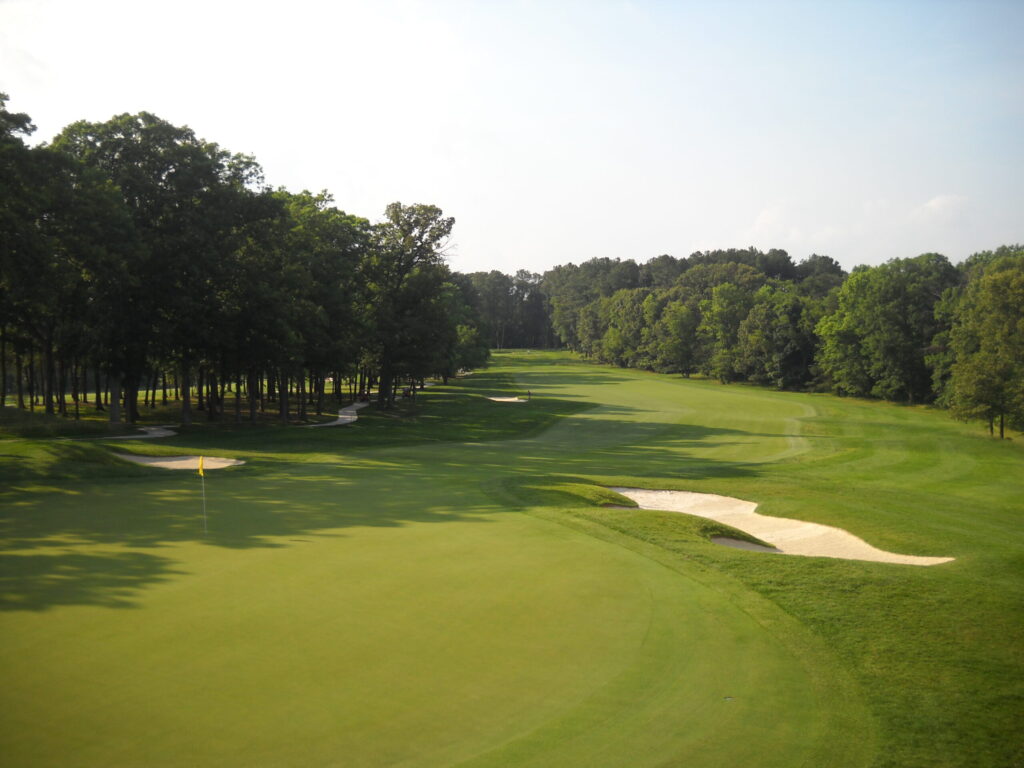
The sixth hole at the University of Maryland Golf Course, site of the 2023 Maryland Public School Boys Golf Championship. Photograph courtesy of the University of Maryland Golf Course.
Andrew J. Lewis
The most consequential round of golf I ever witnessed came at the 2023 Maryland Public School Boys Golf Championship. I watched my son finish T-26th.
On paper, that doesn’t sound like much. I witnessed something different.
I started this story in 2025 for my father—the one who taught me to hold a club, tried to teach me a repeatable swing, and tolerated my perfectionist outbursts when golf was… well, being golf.
Not the father he became later. Not the man who died by suicide in 2021.
This story is for the father I remember from the range, the fairways, and the greens. The one who didn’t always know what to say but at least showed up. The one who gave me a map I didn’t know I’d need until it was time to walk beside my own son.
I wanted him to see my son play. He never got to.
This is a story for my Golf Dad.
The Work
When your body starts failing young like mine did, humans learn to adapt in ways that aren’t always visible. I got sharp, attentive, and verbal. You learn to anticipate—because you have to. So my superpower became deep watching and careful listening: observing closely, hearing what was said and what wasn’t, and saying what I saw. That’s how I make sense of the world. I watch, I listen, and I speak it back. I’m a storyteller.
My son fell in love with golf in the late summer of 2019, long after the advent of affordable technology and the stats-fetish era in golf. I could never relate to Walter Hagen or Bobby Jones. But launch angles, spin rates, slow motion, side-by-side video overlays of my son from last week, last month, last year? That I can understand.
And I had a collaborator—the Boy—who was willing to talk to his father about a single topic for hours and sit with me most weekends for a portion of the final round on television. This was research, theory testing, and refinement. And four times a year—the Holy Weeks—I was treated to a four-day blitz of focused, intense golf talk.
He’s not verbal in the same way that I am, but we were communicating just fine.
I discovered a golf industry—not necessarily built for someone like me—that nonetheless offered a seemingly infinite set of tools to trial, adopt, and customize. My collaborator and I could test different technologies, hire pros to sharpen mechanics, and break down footage frame by frame. We weren’t just watching swings; we were building something.
Repetitions. Sequences. Adjustments. The work.
Without intending to, I found myself cobbling together a way to play golf—not with my body, but with my brain, my voice, and the body of a young man willing to share the project.
Total coincidence but massively helpful: he’s lefty and I’m righty.
Gravy Day
We parked at the course and he went to warm up. I entered the pro shop just in time to learn that all the carts had sold out.
I could have asked. That would have been the safe play. But I didn’t, because this is how it would have played out: some official from the State Athletic Association would make an announcement before the start. From the balcony with a crappy PA:
“Yeah, uh, we’ve got a handicapped father. Would anyone be willing to give up their cart to the disabled guy?”
That’s what this would become: an awkward public favor. A shift in the entire mood of the day. Not for me—for my son.
That’s the part no one sees. The moment I’m singled out, so is he. Not as a player, but as someone to watch. The kid with a Dad in a powerchair at a golf tournament. The kid who comes with a story.
That’s not what I wanted. So I drove my powerchair onto the course and we hoped for the best.
I’d never done this before, and I didn’t want to distract from my son’s tournament in any way. This day was about him, and we were here to celebrate his accomplishments as a golfer—an excellent junior golfer, but not an ELITE junior golfer. One who really believed he could have been.
His body and his mind were still telling him, “We screwed this one up, Dad. I should have quit soccer one year earlier. That might have been enough time.”
But also: perspective. It was the pandemic. We needed some kind of routine, something to do, so we did soccer for one more year. First child stuff.
We were at the driving range for two hours before soccer practice, sometimes afterward too. He took his clubs to soccer tournaments. We even played rounds of golf between tournament games. It was obvious where the interest now lay.
He didn’t quit soccer so much as he said goodbye, and thanks.
The Championship was held at the University of Maryland course. One of those places that can’t quite decide what it is—some mashup between college muni and country club cosplay.
The range is full of kids with forged irons and cute-animal headcovers. But it’s not snooty. Some players might belong to country clubs, but these kids go to public school. And that matters. Because they’re still trying to earn it.
And my kid? He earned his way here just like they did, and he made the cut.

A family dog immortalized as a three-wood headcover. Courtesy of Daphne’s Headcovers.
The weather was that kind of Fall Golf day people wait all year for. Fast fairways, fast greens, a temperature that’s just warm enough, a chill when you’re in the shade. Dry leaves rustling in the trees, some falling, and that not-entirely-unpleasant moldy smell where it’s wet. A little breeze for color. Is that wood smoke?
I only went for the final round. Because at that time, my son was the kind of golfer who didn’t want me there. Making the cut shouldn’t have been a problem—and it wasn’t. But it was just better for all parties involved that I showed up for Round II.
So it was a gravy day. He weren’t thinking about winning. Stick with your plan, your process, set some reasonable goals and aim for par. Maybe something amazing happens today? Totally reasonable stuff.
Swear to Royal and Ancient, I recall we started the shotgun on the 13th, and it was an omen. Halloween a few days early. Opening par 5, and he ends with a triple.
A familiar cascade of physical and mental errors when my presence could give license for things to go sideways fast. There was always this belief that it was DAD! who was holding us back. Something about my presence made him play tight, made him play reckless, made him play judged.
But this day played out differently.
Stabilizing, no-sweat par on the next hole. He fizzes a cut-off 7-iron to eight feet for birdie on the next. Couple more pars, maybe a bogey in there somewhere, along with two or three putts that certainly deserved to go in.
What’s different this time is I can see him grinding, and that’s not something I’ve necessarily seen before. He sees me, we don’t talk—mostly because I’m desperately trying to keep up with the group while closely monitoring battery consumption.
Using a powerchair is NOT effortless. Also, I can’t just pop into a bathroom or disappear behind a tree. So I decide not to eat or drink. The round is long, the terrain is uneven, and I’m determined not to get in the way of his golf.
Meanwhile, he’s playing some magnificent golf.
I notice he’s walking a little taller, confidence growing from one hole to the next, thinking his way around the course. Smiling. I swear I watched him mature three years on the front nine.
And a few of the shots. Just breathtaking.
From the top of a hill, ball slightly below his feet, still-dew fairway, and he architects a thing of beauty: a gorgeously rising, then arching 5-wood that finishes about 35 feet from the pin. One of the coach/officials from another school gasped, “Nice shot,” in the way real golf guys do—the ones who know quality when they see it and keep their mouths shut otherwise.
He’s chipping for eagle. Somehow he ends with par.
It’s not, in fact, one of those days.
Another memory: in front of his coach as tee official, he bombs one. It finishes Fall Golf long—fairway, left center—a healthy 30 yards beyond anyone in his group.
Yes, this is the Maryland public school championship. But to do that in front of your coach is a Stick move at every golf tournament in America.
It’s slow, it gets warmer than expected, and some of the memories get a bit blurry. A couple more good shots, but nothing like that 5-wood.
He finishes, and he’s so proud in his way. Our debrief is coulda-shoulda stuff and lasts maybe 90 seconds. He’s satisfied and content.
I recall we went for burgers—Chipotle more likely—and I don’t remember a discussion about staying for the end. Just an understanding it was time to go.
To this day, I have no idea who won.
Some kid who always beats my kid.
Walking Together
It was one of those days that started out with a weird energy. Something felt ominous, not in a bad way, but in a this-is-a-consequential-day way.
I thought it was the tournament.
Turns out it was something much more important.
Without notice, without fanfare, and honestly, just born of necessity—it was the first time I’d ever walked a course with my son.
Up to that point, I’d waited in the clubhouse, in the car, been offered carts or asked for one. And everyone involved in those transactions felt good that I was being accommodated. Myself included.
I just never thought I could use a powerchair on a golf course.
There was never a sign that said no. Just a feeling.
(Oh, greenskeepers who might be reading this: I NEVER roll onto a green. C’mon, I’m disabled, not an ogre!)
Nowadays I go with him in my chair whenever possible. And something glorious has happened. We’re closer than ever as golfers because I’m enjoying it expansively, as a co-participant with my son.
And I’ve acquired certain responsibilities.
For example, he likes handing me his keys before a round because he wants his pockets “free of distractions.” I have absolutely no idea what this means. They’re keys. But apparently they interfere with the highly specialized business of hitting a small white ball around a field.
Fine by me. I have a chore!
I’m also slyly working on becoming his caddie, and I don’t think he’s noticed yet.
Our conversations are evolving too. For years, much of our golf talk happened in the car, in front of a television, or while watching video. Now we’re alongside each other, looking at the same lie, the same wind, the same challenge.
Maybe it’s because we’re no longer just father watching son playing golf from a distance. Maybe not needing to scream at each other across fairways or around trees was all that we needed.
And sometimes there’s nothing particularly remarkable about what we’re doing. We’re simply moving down a fairway together. He walks. I roll. Occasionally I stop to look at a bird, because apparently I cannot help myself. He thinks about his next shot.
Then we arrive at the ball.
“Tell me what you’re thinking.”
“I’m thinking the aim point is the fluffy part of the left pine. Hold it against the wind and it should be fine, right?”
“Totally agree. You got it?”
“Yup.”
We’re men working together to solve a problem on grass.
I couldn’t care less what happens next. Never will again.
Because I am playing golf with my son.