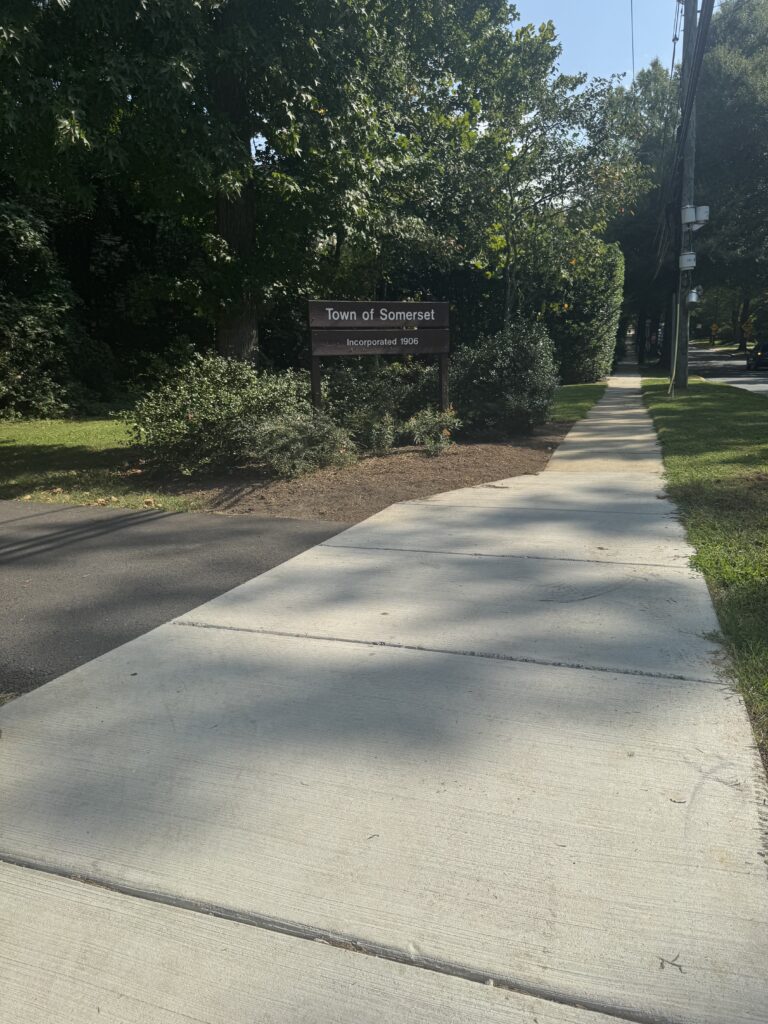
The Sidewalk of Accepting Less. Two solutions to the same problem, rendered in concrete. At the boundary between Montgomery County and the Town of Somerset, Maryland, the sidewalk narrows by approximately two feet. The difference is not technological. Photograph by the author, September 2026.
Andrew J Lewis
I. The Sidewalk of Accepting Less
There is a very nice sidewalk just outside my town. It is six feet wide, butter-smooth, and new. A paved ramp descends toward a (deteriorating) nature trail, while in the other direction it connects to bicycle infrastructure and a regional network through which I can travel for miles in my power wheelchair.
I am not describing Copenhagen. I am describing Montgomery County, Maryland, just outside the Town of Somerset.
Beside this excellent sidewalk stands a very proud sign: TOWN OF SOMERSET — INCORPORATED 1906. At precisely that boundary, the sidewalk narrows by approximately two feet. Outside the Town of Somerset, I am remarkably free. Inside my town, a different physics and gravity begin to apply.
I call it the Sidewalk of Accepting Less. The name started as a joke. The time for joking is over.
The sidewalk is no engineering marvel. It is evidence that we already know how to build something better. Which raises a larger question:
What does a civilization owe to the knowledge it already possesses?
II. The remarkable American talent for making things difficult
Americans are an ingenious people. We have built railroads across a continent, sent human beings to the Moon, connected the world through computers, and developed extraordinary technologies for improving human life. We have also become remarkably proficient at turning ordinary problems into elaborate administrative undertakings, often requiring multiple agencies, several consultants, and a public meeting at which somebody explains why the problem does not exist.
Ordinarily, Americans have little difficulty acting on incomplete knowledge. We launch businesses, finance buildings, elect politicians and undertake public works without knowing precisely how everything will turn out. We begin with evidence, a plausible proposition, and an objective. We investigate costs, decide whether the next investment is justified, and try something. If it works, excellent. If not, we adjust. This is how responsible people build things.
Accessibility, however, seems to require a different procedure. We have laws, engineering standards, professional expertise, and decades of scholarship explaining how environments enable or disable people. The Americans with Disabilities Act, signed in 1990, established enforceable civil rights obligations, not merely an aspiration to be considerate. Thirty-six years later, we remain remarkably good at endorsing accessibility and less reliable at delivering it.
In my town, I have spent much of the past year investigating how someone using a wheelchair might travel safely through ordinary public spaces, including what the municipal budget reveals about the things a town recognizes. This has involved neighborhood walks, meetings, municipal correspondence, historical research, and an impressive quantity of footnotes. The footnotes came naturally. Their necessity for explaining to my neighbors the purpose of pedestrian walkways, a technology older than Rome, remains disappointing.
The problem extends far beyond the Town of Somerset. Across America, people encounter systems that almost work: a malfunctioning automatic door, an inaccessible crossing, a transportation service requiring special arrangements. Each failure acquires an explanation and somebody responsible for helping the individual work around it. Meanwhile, the costs become somebody else’s transportation expenses, lost time, paid assistance, or diminished independence. Americans are accomplished at transferring public costs into private lives and congratulating ourselves on the savings.
This is where the comedy loses its charm. Scholars, advocates, engineers, and designers have spent generations establishing how environments affect participation. Why must every person encountering a barrier become an advocate, investigator, and occasional project manager to put that knowledge to work? I have become reasonably proficient at explaining why I should be able to move through my own community. I would prefer to become proficient at something else.
Like, say, shore bird identification.
III. Legs are infrastructure
In my town, residents with decades of experience walking a particular street have explained that pedestrians encountering cars can step onto the grass, choose another route, or jump out of the way. Excellent suggestions. I used to follow them myself. Unfortunately, my power wheelchair lacks the necessary legs.
Legs, it turns out, are infrastructure. So are balance, ankle strength, the ability to climb a curb, cross wet grass, or step around a pothole. Most Americans carry these pieces of infrastructure around with them, seldom noticing how much their bodies compensate for what their communities have not built.
I used to operate my legs quite well, too. Now I carry batteries.
Legs, Exhibits A & B. At Blackwater National Wildlife Refuge in October 2026, my mother, Uncle Ralph, and I encountered Greater and Lesser Yellowlegs standing nearly side by side. Their long legs let them forage in shallow water beyond the reach of shorter-legged birds. We’d neglected the spotting scope, a casualty of traveling with a power wheelchair and its logistics. Fortunately, the birds cooperated, and binoculars, assisted by some experience with Cornell’s Merlin Bird ID, sufficed.
Blackwater NWR is a disabled birder’s paradise. Its paved Wildlife Drive offers superb car birding, with accessible trails and observation areas beyond it. Someone has already worked out that people need not possess shorebird legs to enjoy watching them.
Disability scholars have spent decades examining what happens when the human body encounters an environment built around somebody else’s assumptions. Rosemarie Garland-Thomson calls this misfitting: a relationship between a particular body and a particular world, not a permanent defect residing in either one.[1] Misfitting can also produce knowledge, because people who encounter an environment’s limitations discover things about it that successful users may never notice. My wheelchair fits beautifully on the Montgomery County sidewalk, for example, and rather less beautifully where that sidewalk ends. The chair has not changed. Neither have I. The relationship has.
This is a sophisticated way of explaining something that most children understand when they discover that the square block will not fit through the round hole. But the scholarship is necessary because adult Americans have developed elaborate institutions for insisting that the block is the problem.
Lichen Hamraie’s history of accessible design takes the question further. In Building Access, Hamraie shows how disabled people and sympathetic professionals challenged the supposedly neutral expertise of architects and designers, changing not only who counted as a legitimate source of knowledge but also the standards by which buildings and their users were understood. Accessibility was not simply bestowed upon the public by thoughtful professionals. People had to change the way professionals knew things.[2]
Put less elegantly, it turns out that asking people whether they can use something is a useful part of designing it. This discovery has had a surprisingly difficult journey into American public administration.
My wheelchair is an extraordinary machine, but it cannot jump or reliably cross wet grass. An alternate route consumes battery capacity; when pavement becomes dirt or gravel, the journey may end. Engineers understand surfaces and slopes. Municipalities understand sidewalks. We have constructed roads for millennia, although Americans have developed a remarkable talent for treating the pedestrian portion as an optional accessory.
None of this should come as a great surprise. The question is what we intend to do about it.
IV. Knowing and doing
I have spent much of my working life among institutions that produce knowledge and institutions expected to act upon it. In academia, I learned how difficult it can be to get a good argument heard. In business, I learned that recognizing the future and preparing for it are different accomplishments.
We could see computers becoming connected, transactions becoming digital, and paper becoming less important. None of this required supernatural powers of prediction. Yet next quarter’s results could command more attention than next decade’s products. The existing business worked, so changing it had to compete against the evidence of its own success.
I also helped build Lapa Rios, a rainforest lodge in Costa Rica, around the proposition that conservation and hospitality might reinforce one another. We had an idea, evidence that it might work, and a willingness to find out. Building taught us things discussion alone could not.
A Knot, regrettably absent. Blackwater NWR provides habitat for migrating shorebirds, including the Red Knot, whose extraordinary journeys depend on suitable coastal stopping places. We did not see one. Unfortunate for an essay entitled Knot Accessible America, but I decline to manufacture an observation to improve the literary architecture.
Mobility is not simply a property of the traveler, it’s a continuum. Even a bird capable of flying thousands of miles needs somewhere to land, rest, and refuel. Blackwater understands this. The authors of municipal pedestrian plans may wish to take note.
These experiences left me with an uncomplicated view of knowledge. I admire people who produce it and people who question it. But eventually somebody must decide what to do with it.
And this is where America ties itself into a knot.
A community inherits an environment designed around assumptions about its users. Those who fit those assumptions use it successfully for decades. Successful use becomes familiarity, familiarity becomes expertise, and expertise becomes authority over whether anything needs changing. Eventually, those best served by an inherited arrangement gain influence over whether others’ difficulties deserve investigation.
Then everyone votes.
This is admirably American, except that the system was designed around those most likely to approve of it. Someone who has walked a path four times daily for thirty years knows things about it that I never will. But those thousands of successful trips cannot establish whether I can make the journey once.
The inherited system enjoys another advantage: it is already there. Doing nothing appears neutral. Accessibility becomes the proposed change, requiring justification, funding, and agreement. The costs of continued exclusion disappear from the ledger. Nobody must defend them or win a vote to preserve them.
Kalindi Vora and Neda Atanasoski, writing about robotics and artificial intelligence, examine how technologies promising to eliminate human labor can instead conceal, redistribute, or devalue the work on which they depend. Their subject is not suburban sidewalks, and their analysis of race, labor, and technological power is considerably broader. But it suggests a useful question: whose work disappears from view when a system is declared efficient?
Accessibility failures operate through a related accounting trick. A municipality avoids an expenditure; the inaccessible journey becomes somebody else’s time, assistance, transportation expense, or lost opportunity. The costs have not vanished. They have changed owners.[3]
The status quo does not have to win a vote.
Someone encounters a failure. Successful users explain that the system works. The person produces more evidence. The institution calls for consultation. Nobody decides what happens next. None of this requires bad people; Americans can tie this knot while trying to be reasonable. We value experience, respect property, and avoid unnecessary spending. Admirable instincts, until reasonableness becomes an instrument of inertia.
Instead of treating the remaining questions as problems of design, investment, and implementation, we keep reopening questions that should already have been settled.
V. Enough heroes
America has a distinguished history of disability rights advocacy. The Americans with Disabilities Act and generations of improvements in public life did not appear because somebody in government had a particularly thoughtful Tuesday. No. People organized, protested, litigated, and demanded that the country live up to its promises.
We have disability rights heroes, histories of disability rights heroes, and now movies about disability rights heroes. Have we entered the era of the Disability Superhero?! Excellent. I admire them enormously. I would also like us to stop needing quite so many.
Enough herons. Oops, I misread my heading. I intended disability rights heroes, not herons. Anyway, at Blackwater NWR, we saw Great Blue Herons and a Black-crowned Night Heron, if memory serves. Both have excellent wading legs, although the Great Blue specializes in standing motionless for extended periods before eventually doing something useful.
An admirable strategy for catching fish. Less successful as a model of American public administration. My apologies. Back to the disability heroes!
Judith Heumann and her colleagues helped establish rights that transformed American life. Scholars and designers developed knowledge to put those rights into practice. We have laws, standards, research, expertise, and successful examples. These are not preliminary findings awaiting confirmation. They are accomplishments of modern American civilization.
Meanwhile, I have spent much of the past year producing historical investigations into the accessibility of a few hundred yards of suburban Maryland. This has required archival research, municipal records, public meetings, and an unfortunate quantity of footnotes. I have enjoyed parts of it while other parts have traumatized me. None of it should have been necessary.
A person ought not need an advanced degree, an attorney, a political organization, or a compelling personal narrative to establish that an ordinary public system should be usable. Nor should the outcome depend on that person’s resources, time, health, or patience. The freedom to participate in ordinary life should not depend on an extraordinary capacity to demand it.
Surely the objective is to build a society in which fewer people must become superhero extraordinary simply to participate in ordinary American life.
VI. Start where it breaks
There is a better approach, and it does not require a new branch of philosophy, although I would be delighted to help establish one if funding becomes available.
Begin where the system fails. Then stop. Now, read it again. Twice more.
If I want to know whether a bridge can support a truck, I do not send bicycles across it for forty-five years and conclude that the bridge is excellent. I test the load. If I want to know whether software works, I examine errors, not merely successful transactions. And if I want to know whether an environment is accessible, I should not begin with the person for whom it works best.
My wheelchair detects failures: the crack everyone steps across, the grade nobody notices, the missing curb cut, the path that disappears when pavement becomes earth, the extra quarter-mile described as “just going around.” It measures distance differently because distance consumes battery, and redundancy differently because when one route closes, the alternative may not exist.
Not because disabled people are wiser. Because we get stuck.
I have documented one such expedition in considerably more detail than the circumstances ought to have required. Apparently, I am not alone in my research interests.
Yochai Eisenberg and his colleagues examined whether American local governments had developed adequate plans for removing pedestrian barriers. Of 401 governments studied, only 54 had readily available ADA transition plans, and just seven of those plans met all the minimum criteria evaluated. The distance between recognizing a civil right and maintaining a usable pedestrian network is therefore not merely a philosophical concern. It is a documented problem of local government performance. We know something about the failure. We might now consider fixing it.[4]
Jennifer Mankoff and her colleagues offer another useful approach. In recent research, they worked with mobility-aid users to identify frustrations with existing equipment, develop customizable improvements, and evaluate prototypes with the people who would use them. The resulting designs included modular components and 3D-printed adaptations. The work does not eliminate the need for professional engineering or institutional responsibility. It demonstrates how making and testing with users can produce knowledge that conventional product development may overlook. A failure becomes something to investigate with the people who encounter it, rather than an inconvenience they must repeatedly explain to those who do not.[5]
Identifying a failure does not establish the remedy. That’s when building begins. Define the objective, examine evidence, investigate alternatives and costs, establish authority, and decide upon the next justified investment. Test what can be tested. Learn from the result.
Bring in engineers, planners, arborists, environmental scientists, historians, officials, and people who have used the place successfully for decades. Everybody contributes knowledge. Nobody’s experience gets discarded. Most importantly, the failure does not get voted out of existence before anyone studies it.
Sometimes an improvement should not proceed. Engineering may be infeasible, environmental costs too high, or another solution preferable. Fine. But no—or not yet—should be a conclusion, not the inherited starting condition disguised as neutrality.
Then somebody must decide what happens next: a feasibility study, reversible pilot, engineering design, capital appropriation, or determination of which institution has authority. The next step need not be enormous. It needs to be real. And it needs funding.
VII. America can do better
Which brings me back to the Sidewalk of Accepting Less.
On the Montgomery County side of the sign, my wheelchair works beautifully. The pavement is smooth, the width gives me room, and the connections give me choices. I can travel for miles without special arrangements, permission, or a committee. The infrastructure does not make me feel included. I barely think about disability at all.
It simply lets me go somewhere.
Across the municipal boundary, the sidewalk narrows. Elsewhere in Somerset, paths become impassable and ordinary journeys require extraordinary attention. I love this little town, its trees, creek valley, swimming pool, and ridiculous intersections. My children grew up here. I have no desire to wage war against my neighbors, and I would prefer not to have one.
But I am no longer willing to accept inherited infrastructure’s limitations as the presumed boundaries of my freedom.
America can do better than the Town of Somerset has.
The evidence is right there, on the other side of the sign. We have the engineering, technology, resources, and experience to make ordinary participation substantially easier. We need not invent a new civilization. We need to use what we already know.
There will be difficult engineering problems, legitimate disagreements, environmental constraints, and decisions about public money. Those are reasons to investigate, design, and decide—not to postpone the work.
A civilization owes something to the knowledge it has already acquired.
Not endless admiration, another declaration of principle, or an indefinite invitation to continue the conversation. It owes that knowledge a serious attempt at application.
We have spent quite enough time explaining why the sidewalk ends. I’m building the next one.
Wanna join me?
Notes
[1] Rosemarie Garland-Thomson. “Misfits: A Feminist Materialist Disability Concept”, Hypatia 26, no. 3 (2011): 591–609. ↩
[2] Aimi Hamraie (now Lichen Hamraie). Building Access: Universal Design and the Politics of Disability (Minneapolis: University of Minnesota Press, 2017), especially chapter 5, “Epistemic Activism: Design Expertise as a Site of Intervention,” 131–174. ↩
[3] Neda Atanasoski and Kalindi Vora. Surrogate Humanity: Race, Robots, and the Politics of Technological Futures (Durham, NC: Duke University Press, 2019), especially chapter 3, “Automation and the Invisible Service Function: Toward an ‘Artificial Artificial Intelligence.’” ↩
[4] Yochai Eisenberg, Amy Heider, Rob Gould, and Robin Jones. “Are Communities in the United States Planning for Pedestrians with Disabilities? Findings from a Systematic Evaluation of Local Government Barrier Removal Plans”, Cities 102 (2020): 102720. ↩
[5] Jerry Cao, Krish Jain, Julie Zhang, Yuecheng Peng, Shwetak N. Patel, and Jennifer Mankoff. “‘A Tool for Freedom’: Co-Designing Mobility Aid Improvements Using Personal Fabrication and Physical Interface Modules with Primarily Young Adults”, Proceedings of the 2025 CHI Conference on Human Factors in Computing Systems (2025). ↩