Andrew J Lewis
Every golf course has places that acquire unofficial names. Not names you’ll find on the scorecard. Not the elegant Augusta National names like Pink Dogwood or Firethorn. No. The names that emerge because members eventually surrender to reality.
The Chute of Destiny.
Dead Golfer’s Gulch. (Formerly Deadman’s Gulch.)
Gambler’s Corner.
Argyle Country Club in Silver Spring, Maryland has the Goose Belt, and it begins almost immediately.
Somewhere near the approach to the first green, you enter it, and by the second tee you’re completely immersed in the Belt. From there it stretches—with varying density—along Bel Pre Creek, around the pond below the ninth tee, through the low ground via extensive fingers, and eventually toward the water guarding the 12th green. The exact boundaries remain somewhat fluid because the citizens themselves appear to maintain flexible zoning regulations.
If you play Argyle often enough, you begin noticing small pods of geese scattered throughout the Goose Belt. Three. Rarely more than five. I have concluded this is intentional. Larger gatherings would reveal the true scale of the civilization.
Because of this highly effective strategy, it is also theoretically possible to play an entire round at Argyle, pass through the Goose Belt several times, and never actually encounter a goose. (I checked with Fran and KT. They’ve never met anyone who’s managed it.)
The curious thing is that the Belt is not necessarily where the geese are. It’s just where they live. It’s less like visiting a wildlife refuge and more like driving through a small town on a weekday late-morning. The houses are there. The streets are there. There are signs that life is happening everywhere. You just don’t happen to catch many people standing in their front yards. The town hasn’t emptied. Everyone is just somewhere else.
The Re-Goosening
I don’t know whether it’s the angle of the sun, the cooling air, an internal goose calendar, or some deeply held constitutional requirement of Canada Goose society, but sometime during the late afternoon the Goose Belt begins repopulating.
Stand on the 17th tee around this time of day and you can watch the whole process unfold. It’s the closest thing Argyle has to a proper goose census. The pond near the second tee begins filling. Bel Pre Creek grows busy. The approaches around the 12th green acquire a distinctly avian quality. Individuals become pairs. Pairs become family groups. Family groups become neighborhoods. Neighborhoods become what can only be described as municipal government.
It is as though someone has announced over an invisible loudspeaker that the humans will soon be departing, and it is time to prepare the golf course for the evening’s Re-Goosening.
The adults are easy enough to understand. They’ve seen some things. They move with the confidence of creatures who know perfectly well that golfers dislike them considerably more than golfers are willing to admit in polite company.
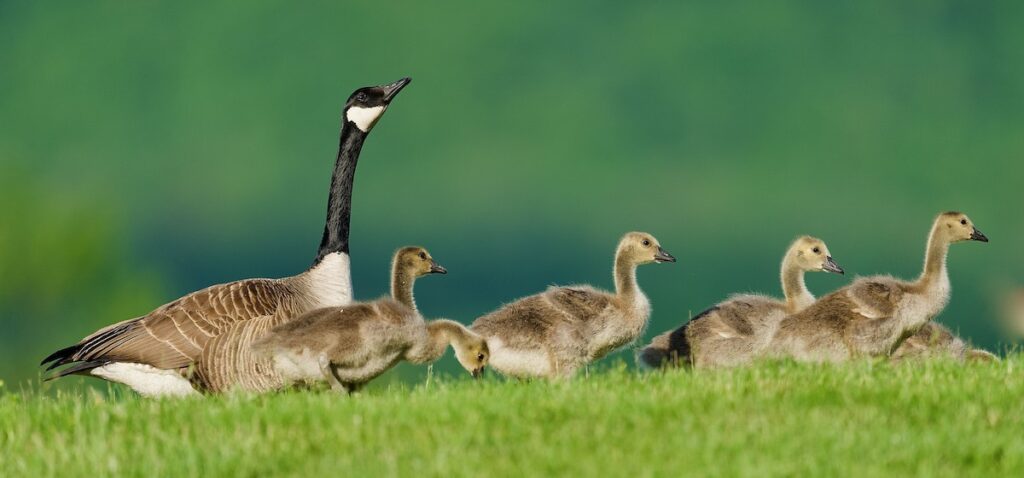
The teenagers, however, the teenagers are magnificent. Gangly. Half-grown. Too much neck. Not enough dignity. They spend their afternoons trying out wings that appear to have arrived before the instruction manual. One runs furiously across the grass, flapping with complete conviction while achieving only intermittent agreement with loft. Another seems unable to decide whether flying is preferable to speed-walking, ultimately settling on an awkward combination of both.
Meanwhile, the parents wear the unmistakable expression of every parent who has ever shepherded adolescents through summer. ‘Please stop eating that.’ Or ‘your brother is not a runway.’ Too often, ‘Honestly, what were you thinking? Get over here!’
Collateral Damage
Golfers, naturally, become collateral damage.
The Goose Belt is many things. A wildlife corridor. An ecological success story. A remarkable demonstration of what happens when carefully maintained turf, open water, and very few predators accidentally combine into what geese apparently regard as luxury real estate.
It is also, regrettably, a place where golf balls occasionally come to rest in circumstances no civilized person should be asked to accept. During a recent match my son, Asher, found his ball sitting in a particularly unfortunate concentration of goose droppings.
He looked at his opponent. “Mind if I move it an inch?” The response graciously delivered, ‘Of course. This is not the U.S. Open.’
The funniest part of the afternoon came a few holes later. My son—normally among the gentlest human beings I know, a young man inclined to find something admirable in nearly every living creature—looked out across the Belt, now fully populated, and delivered such a sustained and creative line of invective regarding Canada Geese that even LIV Golf’s broadcast standards might have considered muting the audio.
I chose not to interrupt. Sometimes a young man simply needs his moment.
Besides… the geese weren’t listening. They had a golf course to reclaim.