Andrew J Lewis
This story begins in April, which is not actual spring but Golf Spring. The season when the fairways are still greening unevenly, low spots remain mysteriously saturated, and every golfer explains poor contact by referencing rust with an ironworker’s confidence.
Also, The Masters.
Anyway, it was one of those glorious spring weekend afternoons that arrive after mid-Atlantic winters and convince everyone that life will be improved through walking outdoors carrying forged metal and hitting a ball.
My son Asher and I had joined up with another father-son pair waiting on the third tee, a duo about a half-decade ahead of ours in the natural chronology of club life at Argyle CC. Close enough in age that we recognized each other, sort of. Far enough apart that the boys had never quite overlapped.
The golf was excellent. And when it wasn’t, that’s because April golf is inherently unstable. One bunker dry as Arizona. Another holding enough moisture to support amphibians.
Nobody cared. The boys were hitting it well enough, making some tough putts, and occasionally revealing they had not swung a club properly in a while. The fathers were relaxed. The course had that early-season feeling where everyone seems genuinely happy simply to be outside again.
By the time we reached the little bridge crossing Bel Pre Creek below the 13th green, spirits were high. Three golfer/walkers. One spectator/narrator in a wheelchair. Four reasonably confident human males chattering their way through the back nine.
That was when we encountered The Goose. Or perhaps more accurately, when The Goose encountered us.
It was standing at the far edge of the bridge with the unmistakable bearing of a creature who believed itself to be in complete possession of My Domain™.
Now geese at golf clubs are not unusual. In fact, one suspects they view golf clubs as failed attempts by humanity to construct superior goose habitat.
But this goose had chosen the bridge. And it was making its position known.
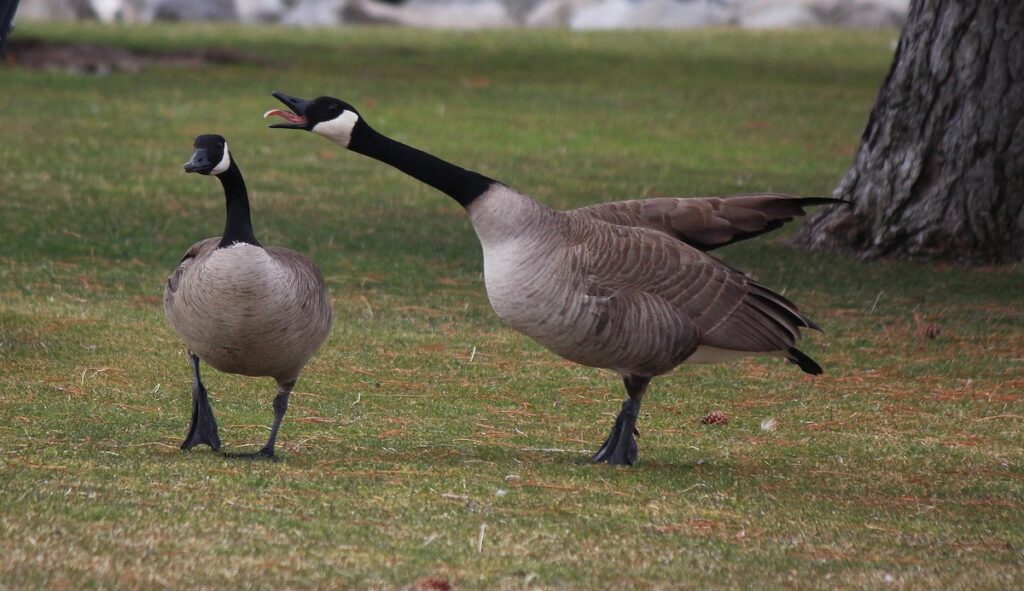
The head lowered, neck outstretched, wings lofted with menace. Then the honking.
Not ordinary honking, but an unsettling goose combination of hiss and snort-fury which sounds less avian and more air compressor developing hostile intent.
The boys reacted. Without discussion each unsheathed a seven-iron. Young men acknowledging that events had entered a phase requiring equipment.
We took a step forward. The Goose, to his immense credit, did not yield.
Instead, he stepped directly onto the bridge himself. One black, webbed foot planted. A statement made. This changed the calculus considerably. Eyes narrowed, as did exit options. Because four golfer-type humans and one aggressively self-possessed migratory bird had all concluded simultaneously that the narrow concrete crossing belonged exclusively to them.
Now friends, what happened next remains one of the finer examples of subconscious tactical adaptation I have witnessed.
Because despite all prior bravery, iron-brandishing, and masculine resolve, once the crossing commenced, the three walkers quietly repositioned themselves behind the narrator-spectator in the wheelchair.
No announcement nor panic. Just a collective acknowledgment that if one required a lead vehicle during a close-quarters goose engagement, perhaps the seated gentleman with several hundred pounds of metal, battery power, and momentum represented the soundest strategic option.
We advanced. As did he.
Mid-span, The Goose and our foursome passed within inches of one another, the bird and I sharing eye-level.
Neither species backed down. But the Republic held.
As we crossed, The Goose turned his head directly toward me and opened his beak more than enough for me to glimpse the strange, ridged machinery inside its mouth. Prehistoric structures that make a goose appear less evolved than simply grandfathered into modern ecosystems.
And in that moment, through some combination of adrenaline, spring fever, bird folklore, and golf-course misinformation, I had a flash insight: the tongue of a Canada Goose is called the ‘gyle’ by ornithologists.
Alas, reader, this bird-fact may not be accurate. But does it really matter?
Because once a thing sounds true on a golf course in April, there is a reasonable chance it remains true forever.