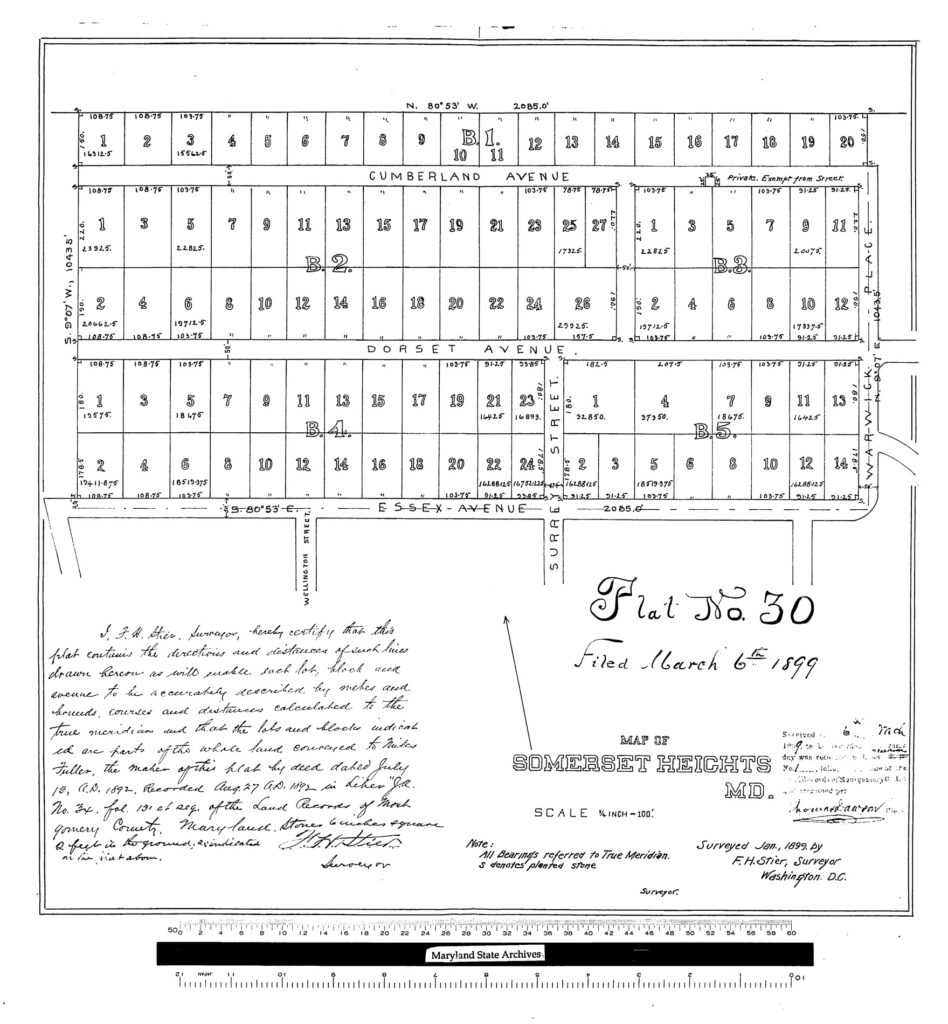
Somerset Heights, 1899. The original subdivision plan records the streets and property divisions of a community founded through real-estate speculation and subsequently incorporated as the Town of Somerset in 1906. Map of Somerset Heights, Md., Plat No. 30, Montgomery County Land Records, Plat Book 1. Courtesy of the Maryland State Archives.
Andrew J Lewis
I. A very pleasant suburb
In 1890, five scientists associated with the United States Department of Agriculture purchased fifty acres of rolling farmland just beyond the District of Columbia. Their ambition was to establish an attractive residential community, modeled on the pleasant suburbs of Boston and other northern cities, where families could enjoy spacious homes, tree-lined streets, and the conveniences of modern life while remaining connected to Washington by electric railway.
Their enterprise, the Somerset Heights Colony Company, included men of considerable distinction. Harvey W. Wiley would become famous for his work in federal food safety. Daniel E. Salmon was an internationally recognized veterinary scientist. Charles A. Crampton, who occupied the development’s first completed home in 1893, would become Somerset’s first mayor.
The founders were also real-estate entrepreneurs. They purchased land for $19,000, established building restrictions, laid out streets, constructed houses, and subdivided property for speculative sale. Their intentions were both domestic and commercial: to create a desirable place to live and profit from its development.1
The venture did not immediately fulfill its promises.
The broad avenues advertised by the developers remained muddy roads. Water came from wells and a windmill, with pipes that froze during winter. Sewage drained into nearby streams. Fire protection was distant, and children walked across fields and waterways to attend school.
Residents organized themselves to address these difficulties. A citizens association maintained wooden sidewalks and repaired roads. In 1902, the women of Somerset established the Wednesday Club, gathering in one another’s homes to share domestic work, conversation, and growing concern for the community’s welfare.
But voluntary cooperation proved insufficient. By 1905, only about one-third of Somerset’s thirty-five households reliably contributed money or labor toward maintaining the settlement.
The residents needed a government. On April 5, 1906, the Maryland legislature incorporated the Town of Somerset. The new municipality possessed powers to levy taxes, enact ordinances, employ officers, and provide the public services necessary to sustain suburban life.2 Charles Crampton became the first mayor. The Town Council established property assessments, addressed sanitation, improved streets, and began the work of transforming a speculative residential development into a functioning municipality.
The significance of incorporation was straightforward. Somerset’s residents had concluded that the conditions they inherited were inadequate. Rather than accept them, they organized to change them.
Over the following century, Somerset’s citizens would pave roads, build a school, create parks, establish a swimming pool, and defend their community against the increasingly intensive development of metropolitan Washington.
Women played an especially important role. Their civic organizations championed public improvements, education, beautification, and community celebrations, even before women gained the right to vote in municipal elections in 1921.
The town gradually acquired the physical and social institutions that its founders had imagined.
Somerset’s official histories celebrate these accomplishments. The 1977 account describes a community whose residents preserved their way of life through continuing vigilance. The 1981 Diamond Jubilee history emphasizes the ingenuity and cooperation required to establish municipal government. The 2006 centennial history presents Somerset as an enduring residential refuge, its attractive environment maintained through generations of determined civic action.3
It is a familiar American story: enterprising founders, practical challenges, democratic cooperation, and the gradual construction of a successful community. It is also substantially true.
But there is another history running alongside it, just down Wisconsin Avenue.
II. The other suburb, 1906
In the same year that Somerset became a municipality, four African American businessmen undertook a remarkably similar enterprise nearby. Charles Cuney, Alexander Satterwhite, Michel Dumas, and James Neill organized the Belmont Syndicate to develop an upscale residential community along Wisconsin Avenue, between Friendship Heights and Chevy Chase.
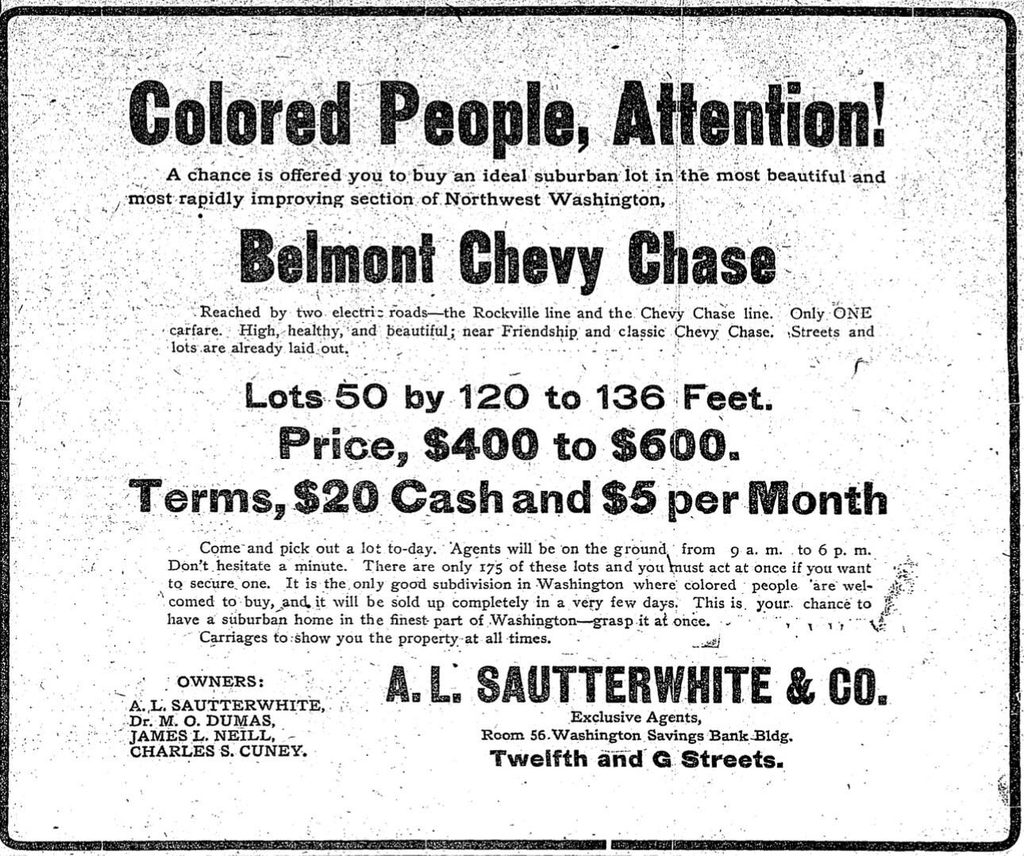
Belmont, an opportunity denied. Advertisement promoting residential lots in Belmont, a proposed African American suburb adjoining Somerset. The Washington Post, July 1, 1906. Reproduced in historical research on the Belmont Syndicate.
Their ambitions closely resembled those of Somerset’s founders sixteen years earlier.
They intended to purchase land, subdivide it into residential lots, attract prosperous households, and establish a desirable suburban neighborhood. Their prospective purchasers included professionals, businesspeople, and members of Washington’s established Black community.
Belmont was not conceived as a settlement for domestic servants or impoverished families. It was an opportunity for African Americans to participate in the expanding suburban property market on terms comparable to those enjoyed by white purchasers.
At least twenty-eight Black buyers acquired lots. Yet Belmont’s developers encountered a response very different from the one Somerset’s founders had received.
White property owners in neighboring communities, including Somerset, organized to oppose the development. Their objections were explicitly racial. The prospect of a prosperous Black suburb adjoining established white neighborhoods provoked protests, hostility, and threats.
The opposition was not simply an argument about traffic, architectural standards, or the density of residential construction. It was an effort to prevent Black people from establishing a community in a place where white residents did not want them to live.4
Somerset had just acquired the institutions of municipal self-government. One of those institutions was the office of Town Marshal.
In July 1906, Somerset’s newly appointed marshal, Elbert Richmond, arrested Alexander Satterwhite, one of Belmont’s principal investors, for allegedly selling real estate without the necessary license.
Satterwhite challenged the charge and was acquitted.
Richmond arrested him again, this time for selling real estate on a Sunday.
Satterwhite was acquitted again.5
The arrests occurred in July 1906, just three months after Somerset’s incorporation, amid organized racial opposition to Belmont by white residents of Somerset, Drummond, Chevy Chase, and neighboring communities.
The second arrest is particularly revealing. When the first prosecution failed, Richmond brought another charge against the same Black entrepreneur. The repeated prosecutions placed the authority of Somerset’s newly established municipal government behind efforts to obstruct Satterwhite’s commercial activity.
Belmont’s developers continued their work, but opposition extended beyond the arrests. Financial and legal maneuvers involving the property’s ownership and financing ultimately undermined the enterprise. Foreclosure followed in 1909, and the proposed Black suburb disappeared from the developing suburban landscape.6
Somerset survived and prospered. There is no need to suggest that Somerset incorporated for the purpose of opposing Belmont. The problems that prompted incorporation were real, and the town’s early government undertook necessary public improvements.
But there is equally little reason to separate the two histories.
In 1906, Somerset’s residents obtained the legal and political authority to govern their suburban community. That same year, residents participated in opposition to a comparable Black development, and their newly appointed marshal twice arrested one of its principal investors.
These were not unrelated episodes occurring in distant places. They belonged to the same rapidly changing suburban landscape, shaped by land speculation, transportation improvements, property ownership, and competing claims to residential opportunity.
The contrast is fundamental. Somerset’s founders had been celebrated for their ambition to transform farmland into an attractive suburban community. Belmont’s founders pursued much the same ambition.
One enterprise became a municipality whose history would be told through generations of civic celebration. The other was defeated.
Somerset’s official centennial history describes the town’s early struggle to obtain the powers necessary for self-government and subsequently to defend its residential character. It does not recount the Belmont controversy or Richmond’s arrests.
Yet Somerset’s own more recent historical materials acknowledge both the opposition to Belmont and the marshal’s conduct. The town’s 2023 Resource Guide records the protests and the two arrests as part of its municipal chronology.7
The omission from the older histories is therefore not evidence that these events belong outside Somerset’s story. It reveals how much the familiar narrative depended on what its authors chose to include.
The history of Somerset’s incorporation is a history of residents acquiring the power to shape their community.
The history of Belmont shows how that power, and the broader political and economic power of neighboring property owners, could be exercised against people seeking comparable opportunities.
The question is not whether Somerset’s founders created a successful community. They did.
The question is how the power to create and improve a community became intertwined with the power to exclude others from its benefits—and, eventually, to preserve the resulting arrangements against further change.
That question would recur throughout Somerset’s twentieth century.
III. The making of New Somerset, 1946–1960
Forty years after the Belmont controversy, Somerset underwent another transformation.
In 1946 and 1947, approximately 115 acres of the former Bergdoll estate were offered for residential development. The property would become New Somerset, extending the town through streets including Falstone, Grantham, Greystone, Trent, and Uppingham.
The development was part of the enormous postwar expansion of metropolitan Washington. Returning servicemen, growing families, federal employment, and rising demand for suburban housing created opportunities for developers and purchasers alike.
But the opportunities were not equally available.
The Bergdoll land transactions incorporated racial restrictions. Auction purchasers were required to agree that subsequent sales would be limited to white buyers. An August 16, 1948, agreement between the Bergdoll estate and O. F. Smith & Bros. restricted occupancy to Caucasians, with an exception for domestic servants.8
The distinction between ownership and service was explicit. Black people could work in the new neighborhood but were excluded from occupying its houses as residents on equal terms.
These restrictions were not incidental features of suburban development. They helped establish the residential population of New Somerset at the moment when much of its physical landscape was being created.
The legal mechanisms differed from those employed against Belmont in 1906. Instead of arrests and prosecutions, the postwar restrictions operated through private agreements, land sales, and property records. Their purpose, however, was unmistakably racial.
Such covenants were widespread in metropolitan Washington and throughout the United States. They helped structure suburban access to homeownership and the opportunities for accumulating wealth associated with it. In 1948, the Supreme Court’s decision in Shelley v. Kraemer prohibited judicial enforcement of racially restrictive covenants, although discriminatory practices and recorded restrictions persisted.9
Somerset’s postwar expansion proceeded rapidly. The town’s population grew from approximately 430 residents in 1950 to 1,444 in 1960. New streets and houses transformed what had been a relatively small municipality into a substantially larger suburban community.10
The new residents built families, developed friendships, participated in town institutions, and contributed to Somerset’s civic life. Their neighborhood became an integral part of the community that subsequent generations would cherish. Yet the conditions under which that neighborhood had been created deserve equal attention.
Patricia M. Barry’s research, published in the Somerset Town Journal in December 2022, documented the racial restrictions in local land records and identified a preliminary estimate of as many as one hundred affected properties. Her work belongs to a growing body of historical research within Somerset itself that has begun to recover aspects of the town’s past omitted from its earlier commemorative accounts.11
The significance of these restrictions extends beyond the exclusion of individual purchasers. Between 1946 and 1960, Somerset created much of the residential landscape subsequent generations would regard as the town’s defining character. Its houses, streets, property arrangements, and patterns of ownership became the conditions later residents inherited.
But those conditions were not produced through a market equally open to everyone. The Bergdoll restrictions helped determine who could participate in New Somerset’s development, who could accumulate property in the growing suburb, and who would be excluded from those opportunities.
The community that subsequent generations would devote themselves to preserving had itself been shaped by exclusion.
IV. What preservation preserved
Somerset began as a speculative real-estate development. Its founders purchased farmland, subdivided it, built houses, and promoted a new residential community.
Their successors increasingly organized to prevent others from transforming the surrounding landscape.
The distinction is revealing. Somerset’s founders understood development as an opportunity. Later generations increasingly understood development as a threat.
By the middle of the twentieth century, Somerset had become remarkably effective at resisting projects that might alter its residential character. Residents opposed apartment buildings, commercial development, road widening, and other proposals that threatened to bring the surrounding metropolitan landscape into the town.
These campaigns required organization, political skill, and persistence. Somerset’s citizens attended meetings, negotiated with developers and public officials, and defended their conception of the community against powerful outside interests.12
Sometimes the results were substantial public achievements. Under Mayor Warren Vinton, Somerset negotiated with the Bergdoll property’s developers to secure approximately twelve acres for public parkland. The agreement, reached in 1969, helped establish the park that now bears Vinton’s name.
Vinton Park became a defining public amenity if you’re able-bodied: green space protected from development and available for recreation, gathering, and enjoyment by successive generations of residents.
The campaign demonstrated the value of municipal authority and sustained civic cooperation. Somerset had used its collective power to secure something that individual property owners could not readily have accomplished alone.13 Vinton Park demonstrated what Somerset’s preservation tradition could accomplish for the public good. But the same political capacity could also be used to maintain established arrangements against further change.
By the late twentieth century, the defense of Somerset’s residential character had become one of its most celebrated civic achievements.
The question was no longer simply what the town could preserve. It was also who would be permitted to participate in the community being preserved.
In 1988, that question would become the explicit subject of a consequential municipal decision.
V. Preserving the boundaries, 1988–1990
In 1988, Somerset voted to remove approximately eighteen acres from its municipal boundaries rather than risk a transformation of its political community.
Developers had proposed constructing three high-rise condominium buildings on the property. Residents feared that the new occupants might eventually outnumber those living in Somerset’s existing single-family houses—and acquire the electoral power to determine the town’s future.
The 1988 de-annexation preserved the town’s existing political community by preventing a prospective residential population from becoming part of it.14
The decision was celebrated as a victory for local self-government and the preservation of Somerset’s distinctive character. In the town’s centennial history, the episode appears among the successful campaigns through which residents defended their community against unwanted development.
One participant, Fay Cohen, summarized the sentiment with a phrase that captured the prevailing philosophy: “Smaller is better.”
The significance of the decision extends beyond the particular development proposal.
Somerset had exercised its municipal authority to determine not merely what kinds of buildings might be constructed, but who might eventually participate in governing the town.
This was not the racial exclusion of Belmont or the Bergdoll covenants. The circumstances, mechanisms, and historical stakes were different.
But the de-annexation demonstrated how the defense of an established community could operate through the exclusion of prospective members.
The town’s ability to preserve its existing political arrangements was treated as an achievement, while the exclusion necessary to accomplish it received far less scrutiny.
Two years later, Somerset achieved another milestone in the preservation of its physical environment.
In 1990, Montgomery County designated Old Somerset as a historic district. The designation recognized fifty-four houses, including thirty-one primary resources constructed before 1915, and established protections for the architectural landscape associated with the town’s original development.15
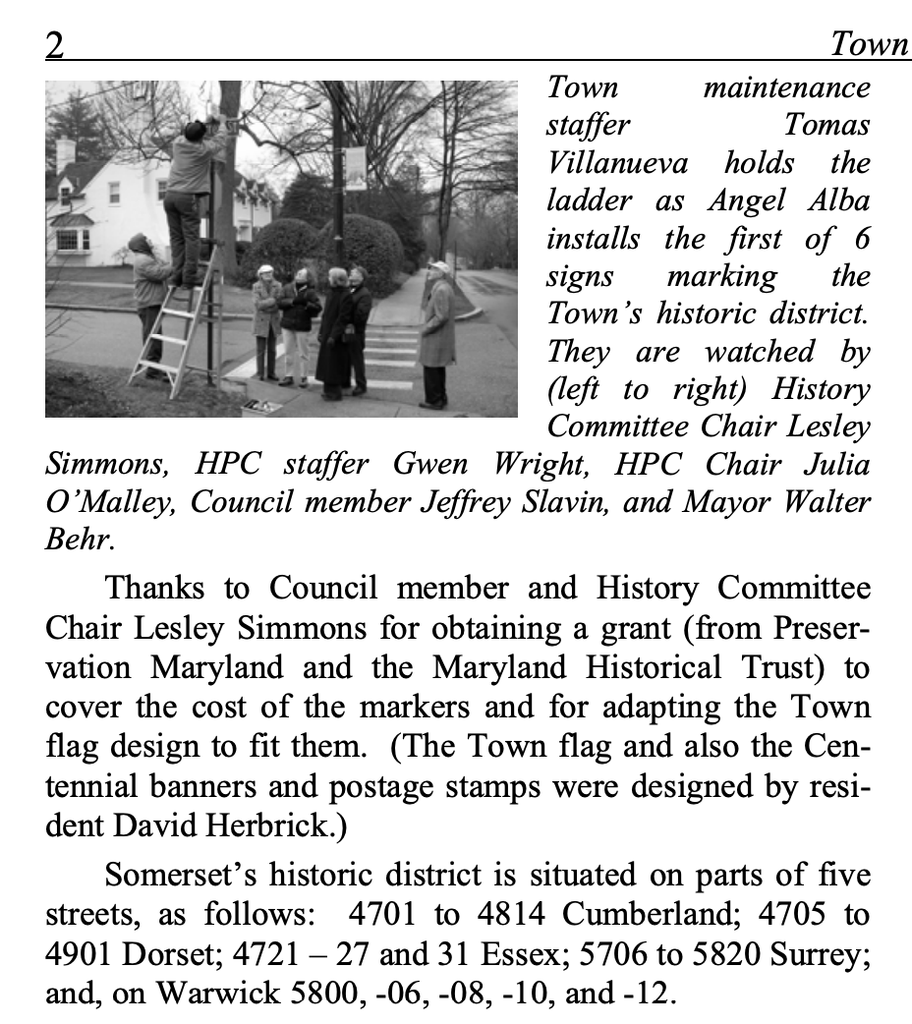
Marking Old Somerset. Town staff install the first of six historic-district signs as municipal officials and preservation advocates look on. Somerset Town Journal, February 2007, p. 2.
The designation acknowledged something real and valuable. Somerset’s early houses, streetscapes, and residential scale represented an important surviving example of suburban development at the turn of the twentieth century.
Yet the sequence of events is revealing.
In 1988, Somerset had acted to preserve the composition of its political community. In 1990, the county formally recognized the historic significance of its original residential landscape.
Both decisions reinforced the town’s capacity to maintain the conditions it had inherited.
And both became part of a broader civic narrative in which preservation itself was understood as evidence of Somerset’s success.
VI. The history Somerset celebrates
Somerset’s official histories celebrate a community whose residents repeatedly acted together to create and preserve a desirable place to live. They document genuine accomplishments: infrastructure, public institutions, parks, and the protection of a distinctive residential landscape.
But those histories have largely celebrated preservation without fully examining the conditions being preserved.
The opposition to Belmont, the Bergdoll covenants, the development battles, and the 1988 de-annexation were not interchangeable events. They involved different circumstances and mechanisms of exclusion and control. Yet together they illuminate a recurring feature of Somerset’s history: the exercise of collective power to determine who and what could become part of the community.
More recent research by L. Paige Whitley, Patricia Barry, Neil Flanagan, and Kimberly Bender makes it possible to reconsider that familiar narrative.16
Whitley’s work on slavery restores the lives of people who inhabited this land before Somerset’s founding. Barry documents the racial restrictions governing its postwar expansion. Flanagan and Bender recover the Black entrepreneurs who imagined a neighboring suburb—and the opposition that defeated their ambitions.
Their scholarship does not diminish Somerset’s civic accomplishments. It places them within a fuller history of how the community developed.
Somerset’s history of exclusion and its celebrated history of preservation are not two entirely separate histories. They intersect repeatedly, sometimes explicitly and sometimes through the consequences of land-use and political decisions.
The question, then, is not simply what Somerset succeeded in preserving. It is how the community was created, who was excluded from its opportunities, and which inherited conditions the town subsequently chose to protect.
That distinction matters when preservation shifts from protecting valuable things to defending existing arrangements merely because they already exist.
Somerset’s founders understood the difference. They incorporated because roads, sanitation, and infrastructure were inadequate, and voluntary cooperation could no longer accomplish the necessary improvements.
Their achievement was not the preservation of existing conditions.
It was the creation of the civic capacity to change them.17
One hundred and twenty years later, that distinction remains consequential.
VII. What Somerset can do
In the summer of 2026, an extraordinary demonstration of Somerset’s civic capacity took place at the town swimming pool.
When wildfire smoke made outdoor conditions hazardous and Montgomery County pools closed under county regulations, the Somerset Dolphins faced the sudden prospect of losing the Division J championship meet.
The Dolphins had approximately thirty-six hours to organize an alternative. They succeeded. (We also won! Home cookin’!)
Parents mobilized, responsibilities were distributed, equipment and logistics were coordinated, and an entire divisional swimming championship was hosted under extraordinary circumstances.
The achievement depended on more than enthusiasm. Somerset’s swim team had accumulated generations of practical knowledge, including a detailed operational handbook developed by parents who had organized an earlier championship meet. That experience had been preserved, shared, and made available to the next generation of volunteers.
These were people with children to raise, careers to pursue, households to manage, and countless other demands on their time. Yet when the circumstances required it, they assumed responsibility, organized themselves, made decisions, and accomplished something remarkable.
They did not need to be persuaded that community service mattered. They demonstrated what it meant.
And they did not preserve a cherished Somerset tradition by insisting that circumstances remain unchanged. They preserved it by adapting, drawing on inherited knowledge, and making something possible that otherwise might not have happened.
Their accomplishment offers an illuminating contrast to another tradition in Somerset’s history.
In 1906, Town Marshal Elbert Richmond twice arrested Alexander Satterwhite, a Black entrepreneur attempting to establish a neighboring residential development. When one prosecution failed, another followed.
Richmond’s conduct occurred within a campaign of explicit racial exclusion. It should be understood and condemned in that historical context.
But it also illustrates a broader institutional possibility: authority exercised to obstruct another person’s initiative rather than enable a constructive outcome.
Somerset’s history contains both capacities.
Its residents have repeatedly demonstrated extraordinary ingenuity in organizing to accomplish difficult things. They have also developed a formidable tradition of organizing to prevent changes.
The question is what happens when the capacity to prevent becomes more important than the capacity to improve.
That question is hardly abstract. Somerset’s founders incorporated the town in 1906 because they were dissatisfied with muddy roads, inadequate sanitation, unreliable infrastructure, and the inability of voluntary organizations to solve collective problems.
They established municipal government to make improvements possible.
Today, Somerset confronts its own inherited problems: deteriorating sidewalks, aging infrastructure, barriers to accessibility, and the difficulty of turning proposals for public improvements into completed work.
Preserving the town’s attractive residential environment is a worthy ambition. But preserving existing conditions cannot be the measure of success when those conditions themselves exclude.
The Dolphins offer a useful reminder of what civic institutions can accomplish when knowledge is shared, responsibilities are clear, and the objective is to make something happen.
They inherited a handbook that made future achievement easier. Somerset’s municipal institutions have inherited more than a century of rules, practices, precedents, and civic experience.
Does that inheritance make improvement easier—or harder?
The town’s history suggests that civic determination is not, by itself, a virtue. Somerset’s residents have displayed determination in creating public amenities, protecting parks, defending racial boundaries, and preventing prospective residents from entering its political community.
What matters is not merely how effectively people organize, but what their organization makes possible for others. That distinction is especially important in a community whose history has so often been written by those who succeeded in preserving it. The people excluded from Belmont, from New Somerset’s housing market, or from Somerset’s prospective electorate might have understood those celebrated victories differently.
Somerset cannot change those decisions. It can, however, decide how honestly to remember them—and whether the civic authority inherited from earlier generations will be used primarily to defend existing arrangements or to improve the community for those who live in it and those who might yet belong.
Perhaps Somerset’s civic traditions can be reduced, for the moment, to two competing instincts.
Richmondism: When an obstacle fails, find another mechanism to impede.
Dolphinism: When an obstacle appears, find a way forward for everyone.
The historical circumstances behind those examples are profoundly different. But the distinction between obstructing and enabling remains worth considering.
Somerset has produced both Richmonds and Dolphins. Both understood the power of collective action. Both knew how to mobilize their community. What distinguished them was not their determination, but what they made possible for others.
That leaves Somerset with two questions.
Are you a Dolphinist or a Richmondist?
And if you’re certain you’re a Dolphin, when was the last time you asked the people affected by your decisions—including those who aren’t yet your neighbors—whether they agree?
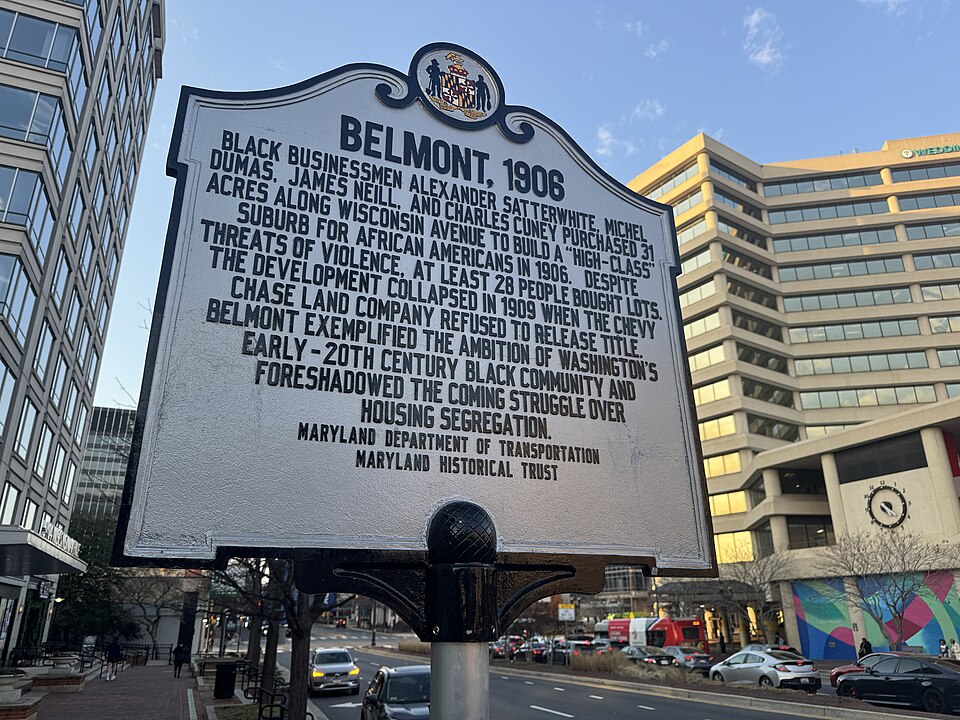
The signs are all around us. History is not simply what happened, but what we choose to remember, commemorate, and celebrate—and whose stories we leave untold. Sometimes the evidence is hiding in plain sight.
“Belmont, 1906” historical marker, Friendship Heights, Maryland. Photograph by PRRfan, March 2025, via Wikimedia Commons, CC BY 4.0.
Notes and Sources
- Dorothy O’Brien and Helen H. Jaszi, “The Town of Somerset”, The Montgomery County Story 20, no. 2 (May 1977), 1–5; Helen H. Jaszi, “Town of Somerset History—Beginnings” (1981). Both describe the founding investors, original property transaction, and speculative development. ↩
- Maryland General Assembly, Acts of 1906, Chapter 795, approved April 5, 1906; Lesley Anne Simmons with Donna Harman, Somerset: One Hundred Years a Town (2006), chapters 1–2. ↩
- O’Brien and Jaszi, “The Town of Somerset” (1977); Jaszi, “Beginnings” (1981); Simmons and Harman, Somerset: One Hundred Years a Town (2006), introduction. ↩
- Neil Flanagan and Kimberly Bender, “Four Black Men Developed a Montgomery County Suburb to Provide a Better Life for Some in Their Community. They Received Something Very Different in Return”, Greater Greater Washington (2021–2022). ↩
- Flanagan and Bender, “Four Black Men”; Town of Somerset, Resource Guide (2023), historical milestones for 1906. ↩
- Flanagan and Bender, “Four Black Men”. Their account draws on contemporary newspapers, property records, and financial litigation concerning Belmont. ↩
- Town of Somerset, Resource Guide (2023), 1906 milestone; compare Simmons and Harman, Somerset: One Hundred Years a Town (2006), chapters 1–2. ↩
- Patricia M. Barry, “The History of Racial Covenants in Local Land Records”, Somerset Town Journal (December 2022), p. 7; Town of Somerset, Resource Guide (2023), discussion of Bergdoll land transactions and racial restrictions. ↩
- Shelley v. Kraemer, 334 U.S. 1 (1948); Richard Rothstein, The Color of Law: A Forgotten History of How Our Government Segregated America (New York: Liveright, 2017). ↩
- Dorothy O’Brien and Helen H. Jaszi, “The Town of Somerset”, The Montgomery County Story 20, no. 2 (May 1977); Lesley Anne Simmons with Donna Harman, Somerset: One Hundred Years a Town (2006). ↩
- Barry, “The History of Racial Covenants in Local Land Records”, Somerset Town Journal (December 2022), p. 7. The estimate of affected properties was preliminary. ↩
- O’Brien and Jaszi, “The Town of Somerset” (1977); Simmons and Harman, Somerset: One Hundred Years a Town (2006), accounts of twentieth-century development controversies and neighborhood organizing. ↩
- O’Brien and Jaszi, “The Town of Somerset” (1977); Simmons and Harman, Somerset: One Hundred Years a Town (2006), discussions of Mayor Warren Vinton and the 1969 parkland agreement. ↩
- Lesley Anne Simmons with Donna Harman, Somerset: One Hundred Years a Town (2006), account of the 1988 de-annexation and proposed condominium development; Dorothy O’Brien and Helen H. Jaszi, “The Town of Somerset” (1977), for earlier development controversies. ↩
- Montgomery County Historic Preservation Commission, Old Somerset Historic District designation (1990); see also the Montgomery County Office of Legislative Oversight’s 1999 historic-district report, which lists Somerset’s 1990 designation and 54 properties; Simmons and Harman, Somerset: One Hundred Years a Town (2006). ↩
- L. Paige Whitley, “Somerset History: Slavery Roots”, Somerset Town Journal (July 2020), p. 8; Patricia M. Barry, “The History of Racial Covenants in Local Land Records”, Somerset Town Journal (December 2022), p. 7; Neil Flanagan and Kimberly Bender, “Four Black Men Developed a Montgomery County Suburb”, Greater Greater Washington (2021–2022). ↩
- Helen H. Jaszi, “Town of Somerset History—Beginnings” (1981); Simmons and Harman, Somerset: One Hundred Years a Town (2006), discussion of the circumstances surrounding incorporation in 1906. ↩