Somerset Town Hall, 4510 Cumberland Avenue, Somerset, Maryland. Photograph: Diane F. Evartt, January 2003. Courtesy of the Maryland State Archives.
Andrew J Lewis
The Town of Somerset, Maryland, is a rather extraordinary little place. We have beautiful trees, lovely parks, a swimming pool, a swim team, our own government, and a remarkable capacity to become passionately interested in matters that might escape the attention of people living elsewhere.
We care about our immense trees immensely, our houses, our streets, our neighbors, and the proper disposition of practically everything within our municipal boundaries. Occasionally, we disagree. Indeed, vigorous disagreement may qualify as one of Somerset’s most enduring civic traditions. And preserving.
But Somerset has been around for more than a century. And there’s a question worth asking:
What would we like this place to become over the next seventy years? What kind of community might we leave to the people who will live here in 2097?
The Coherence Portfolio (TCP) has been exploring that question through seven initiatives involving accessibility, community history, environmental stewardship, and the ordinary business of making a small town work better.
Some are modest. Others are more ambitious. One involves a shrub. Another concerns how people and water move across an entire landscape.
Seven initiatives. Seven Years. Seven decades of legacy. Ninety days to begin making decisions.
Welcome to the Somerset Seven.
Entirely optional listening: Prince and the New Power Generation, “7” (1992). Seven initiatives, seven years, and a modest proposal to rearrange the civic universe. What could possibly go wrong?
Why We’re Doing This
The Coherence Portfolio develops products and ventures informed by historical inquiry, disability, and firsthand experience navigating institutions that don’t always function as their designers intended.
Our working proposition is simple: Making things teaches us things we couldn’t have known before we made them.
TCP’s SwimStory and TownStory initiatives received limited Town Council authorization for pilot work with the Town of Somerset in January 2026, without a commitment of town funds or endorsement of the additional proposals presented here. Since then TCP’s Somerset relationship has operated under the auspices of the Town Manager.
That relationship provided enough opportunity to begin working, observing, and learning. The Somerset Seven grows from that year of observation and research and from years of living in this community.
These aren’t seven demands for immediate municipal action, exactly. They’re invitations to act together expeditiously to fulfill Somerset’s original promise made in 1906 and reaffirmed in its Inclusion Statement: Somerset is a place where individuals can live freely, be themselves, and express their opinion.
1. The Marnie Shaul Path
When a path crosses a boundary, who takes care of it?
Somerset has a pedestrian path named in honor of a beloved resident. A lovely gesture, although it would be even lovelier if everyone could actually use it. Because for roughly 111 days in 2026, the Marnie Shaul Path has been inaccessible to me as a power wheelchair user.
The path connects Somerset with a neighboring jurisdiction, Friendship Heights, and the freedom of Montgomery Country infrastructure. but responsibility for its maintenance, accessibility, and potential liability remains unclear.
The path has a name. What it apparently lacks is an agreed-upon caretaker.
And therein lies a larger problem: Pedestrian Ecology doesn’t always fit neatly within municipal boundaries, yet those most affected by its shortcomings often have the fewest alternative routes.
The proposal is straightforward: establish clear responsibility between jurisdictions or get Montgomery County to assume control.
A path named to honor a neighbor should be a path that all neighbors can use.
2. The Somerset Healing Bubbler
A little water, a little nature, birds, and a place to belong.
In Vinton Woods, there’s a lovely creekside environment many residents can enjoy with relatively little effort. But what if you use a power wheelchair? The Somerset Healing Bubbler asks whether we could create an accessible journey to one peaceful place beside the water.
Not pave the forest. Not reconstruct the landscape. Just establish a usable route where someone with limited mobility can enjoy the creek, the birds, and the quiet.
The terrain and environmental conditions require investigation, but the ambition is wonderfully small.
One accessible place in nature. Sometimes that’s enough to change how someone experiences an entire community.
Oh, and potentially a first-of-its-kind sanctuary for all three species of phoebes in the genus Sayornis. But that’s Phase II.
3. The Somerset Civic Settlement Index
What if accessibility meant MORE than getting through the door?
Most communities understand accessibility through physical infrastructure: sidewalks, curb cuts, entrances, and public facilities. Those things matter enormously. But they don’t tell us everything about whether a community works for its residents.
The Somerset Civic Settlement Index (SCSI) is a proprietary research and measurement technology being developed by TCP to expand the aperture through which we understand accessibility, belonging, and civic participation.
Rather than measuring satisfaction alone, SCSI explores how residents experience their community and where unnecessary friction limits participation.
The ambition is to help communities recognize problems, identify opportunities, and measure whether improvements make everyday life easier.
What if we could measure not simply whether a town is accessible, but how well it enables people to live there?
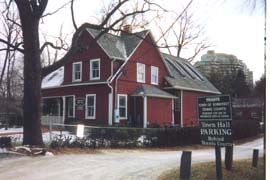
Town Hall, 4510 Cumberland Avenue, Town of Somerset, Maryland. A municipal building used for public meetings and town administration. The Town Clerk’s office is located on the second floor, without elevator access.
On September 17, 2026, a Somerset resident using a power wheelchair encountered four rocking-chairs obstructing this building’s accessible entrance. One chair broke during the attempt to enter and the resident suffered a minor laceration. Finding the exterior doors locked, the resident was subsequently admitted by the Town Clerk after several minutes.
Photograph: Diane F. Evartt, January 2003. Courtesy of the Maryland State Archives.
4. Visitability
What good is a neighborhood full of friends if you can’t enter their homes?
Somerset is a community of houses, and those houses change. Older homes are renovated, expanded, demolished, and replaced. Each new construction project helps determine what our town will look like for decades.
Visitability proposes three modest features in newly constructed homes: one step-free entrance—not necessarily the front door—with a continuous, usable route in and out; sufficiently wide doorways; and a main-floor bathroom that someone using a wheelchair can enter and use.
Not elevators. Not specialized kitchens. Not expensive retrofits.
Instead, a few targeted adjustments to building requirements for new construction could make new homes substantially more accessible at relatively little additional cost. The benefits extend to older residents, people recovering from injuries, and anyone whose mobility changes over time. As well as future you, trust me.
The Town of Somerset already considers the environmental consequences of residential construction. Perhaps we should also consider solving its human consequences.
A town becomes more welcoming one home at a time.
5. Heritage Azalea
An Unfinished Matter of Civic Accountability
On October 28, 2025, I stood before neighbors and town officials and proposed $1600 in restitution for the destruction of a family’s heritage azalea.
I also made a public commitment: if I could not help resolve the matter, I would resign from Somerset’s Public Safety Committee.
I never resigned. The town subsequently reorganized its committees, my service ended without a clear explanation, and the original matter remains unresolved.
A year later, perhaps it’s time to revisit the episode with fresh eyes.
Heritage Azalea proposes establishing the facts, considering an appropriate remedy, and bringing the matter to a decision.
One can imagine an absurdly oversized ceremonial check, a photograph, and perhaps even a few smiles. Symbolic exchanges of this sort might prove a surprisingly effective way to recycle grievance into goodwill.
A community’s future depends partly on its willingness to make peace with its past.
6. SwimStory
A community that remembers itself.
Somerset has a remarkable swimming tradition, the Somerset Dolphins.
Generations of children, parents, coaches, volunteers, and families have accumulated friendships, photographs, records, and stories around the pool.
Much of that history lives in family albums, old newsletters, and the recollections of people who were there.
SwimStory is a living, team-written yearbook designed to bring those materials together and create a continuing record of shared experience.
The platform has already been developed and piloted with 30 summer swimming communities, and the Dolphin’s 50th Anniversary in 2026 and Somerset’s existing pilot relationship offers a starting point for exploring its local use.
What if a community could preserve its history while continuing to make it?
7. The Somerset Pedestrian Ecology Compact
Somerset is not an island. Streets connect to neighboring communities, parks to trails, and trails follow stream valleys. Water moves downhill regardless of municipal boundaries. People trying to reach a school, park, or transit stop are similarly indifferent to jurisdiction.
Yet responsibility for these connections is divided among governments and agencies.
The Somerset Pedestrian Ecology Compact (SPEC) proposes a shared framework for understanding how people, water, streets, slopes, parks, and trails interact across the larger Somerset landscape.
Its focus is where systems meet: the last few hundred feet between a sidewalk and a trail, a difficult crossing, or a drainage problem that becomes a pedestrian hazard.
SPEC begins with observation: walk the routes, identify problems, listen to those who use them, and work across jurisdictions to develop practical improvements.
The landscape already functions as one connected system. We should learn to work with it.
Seven Projects. One Community.
What do an injured azalea, a swimming yearbook, an inaccessible front door, and a pedestrian path caught between governments have in common? Each concerns how people relate to the places, institutions, and histories shaping their lives.
Can we move through our community? Enter our neighbors’ homes? Enjoy its natural spaces? Understand its decisions? Preserve what matters and acknowledge what went wrong?
These questions belong not only to government, but to residents, families, businesses, civic organizations, and neighboring communities.
Nor do the answers require universal agreement. One resident cares about accessible housing. Another wants a better trail connection. Someone else wants to preserve swimming history.
Excellent. That’s how communities work.
Ninety Days to Ask. Then Decide. Then Make.
Now, ahem. Somerset is rather good at deliberation. An admirable quality, although one wonders whether a question first raised during the Eisenhower administration might still be awaiting committee assignment.
The Somerset Seven are already taking shape through research, proposals, conversations, and early collaborations. The next step is to turn that work into decisions.
Give the Somerset Seven ninety days, beginning on a mutually agreed date no later than January 15, 2027.
Three months to investigate, recruit collaborators, assess costs and funding, and determine which initiatives are ready to advance.
Not ninety days to finish seven projects. Ninety days to decide what comes next.
Study. Ask. Vote. Implement.
Each initiative should produce a recommendation, an accountable decision-maker, and a practical next step. Some will advance. Others may change or stop.
That’s fine. The point is to decide.
TCP will seek compensation for professional research, development, and coordination through the Town, grants, or partners. Any engagement requires agreement on scope, funding, and responsibilities; TCP may also pursue opportunities independently.
Ninety days of serious inquiry. Decisions in public. Then the work begins.
Somerset 2097
Imagine someone born in Somerset in 2027, still living nearby seventy years later.
Perhaps they’ll walk paths whose jurisdictional problems were settled decades earlier, visit friends in accessible homes, enjoy a creekside sanctuary, or find their grandparents in a living archive of Somerset Dolphin swimming.
Perhaps they’ll inherit a community better equipped to understand itself, solve problems, and welcome its neighbors.
We cannot know what Somerset will look like in 2097. But we can decide what to investigate, approve, and begin building.
Somerset has spent more than a century becoming the extraordinary little town we know. The next seventy years will happen whether we plan for them or not.
We might as well make something fun of them.
Entirely optional listening. U2, “40” (1983). A meditation on patience, deliverance, and the passage of time. Particularly recommended for anyone awaiting a municipal decision.
The Somerset Seven is an initiative of The Coherence Portfolio LLC. The projects described here are proposals and exploratory work, not representations of formal Town endorsement. Residents, organizations, and potential partners interested in participating are welcome to contact TCP.
Past as evidence. Present as opportunity. Future as something we participate in creating. You coming?