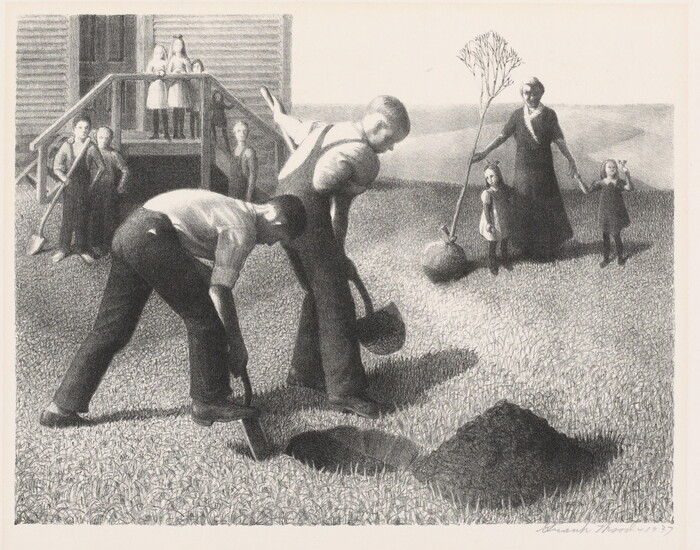
Tree Planting Group, Grant Wood, 1937. A teacher, her students, and a sapling. The shade will come later. Collection of the Amon Carter Museum of American Art.
Andrew J Lewis
Optional listening: “Righteous Life,” Sérgio Mendes & Brasil ’66, from the album, Stillness. A rather lovely place to begin thinking about the difference between professing righteousness and attempting to live it.
In the spring of 1630, John Winthrop prepared to sail for New England with an extraordinary proposition about how human beings ought to live together.
Winthrop was a lawyer, a Puritan, and the newly elected governor of the Massachusetts Bay Company. He was also a man of considerable property, education, and social standing, preparing to exchange a reasonably comfortable English existence for an uncertain future across the Atlantic. Naturally, he had some thoughts about how everyone should behave.
His A Modell of Christian Charity, traditionally associated with the voyage aboard the Arbella, is among the most consequential documents in early American religious history. Americans remember it principally for one passage, near its conclusion:
“For wee must consider that wee shall be as a citty upon a hill. The eies of all people are uppon us.”
Four centuries later, Americans are still talking about that hill. John F. Kennedy climbed it. Ronald Reagan illuminated it. Generations of politicians have admired the view, apparently forgetting what Winthrop was actually asking of the people who lived there.
But I think we’ve been reading Winthrop backwards. We remembered the city. We forgot what held it together.
Since Perry Miller made the Puritans fashionable in the 1930s, nearly a century of American historians have devoted considerable intellectual energy to explaining Puritan covenant theology, communal obligation, and the extraordinary demands of Winthrop’s A Modell of Christian Charity. The Puritans themselves have long since fallen out of fashion. Their most famous metaphor, however, remains remarkably marketable.
Meanwhile, American politicians keep climbing the hill.
I don’t propose to settle four centuries of American religious history here. But I would like to suggest that we come down from the hill for a moment and read what the man actually wrote.
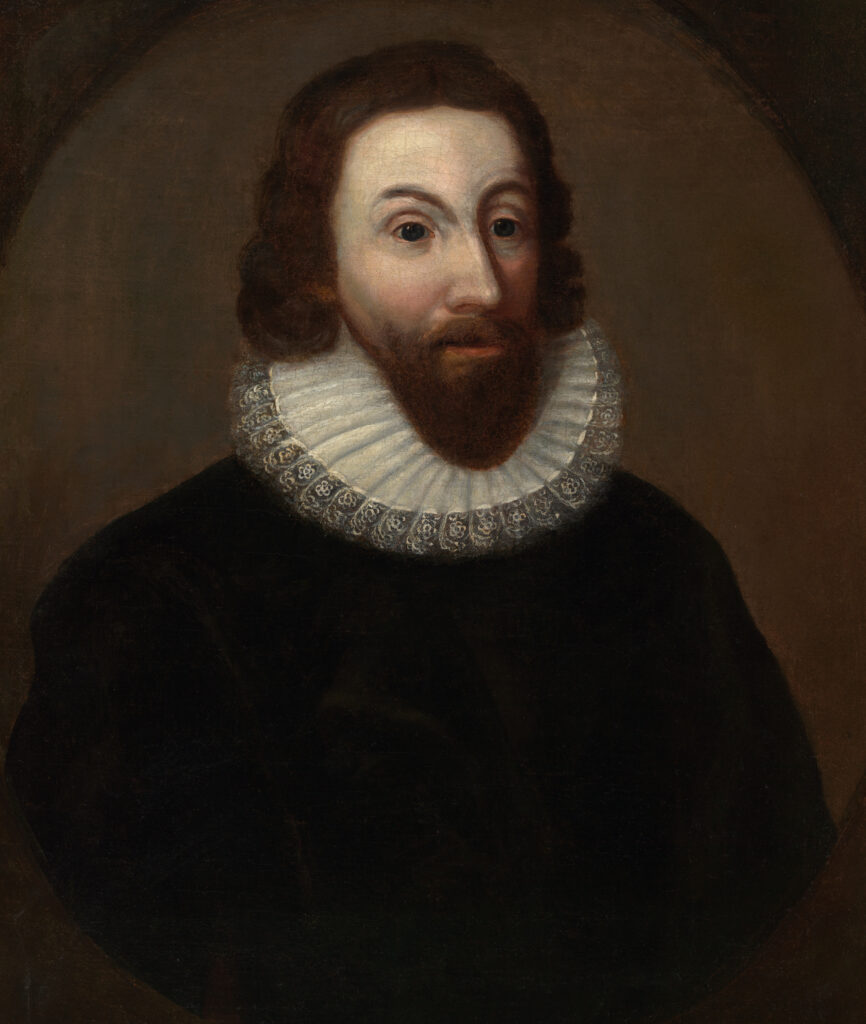
Winthrop’s sermon was not principally an argument about national greatness, divine favoritism, or the importance of being admired by one’s neighbors. It was about obligation.
Winthrop imagined a community entering into a covenant with God and one another. Its members would possess unequal resources, occupy different social positions, and encounter circumstances they could neither anticipate nor control. Some would be rich, others poor. Some would command, others obey. This was hardly a manifesto for modern democratic equality.
But inequality, Winthrop insisted, did not relieve the fortunate of responsibility. Quite the opposite.
“Wee must be willing to abridge ourselves of our superfluities, for the supply of other’s necessities.”
And then:
“Wee must delight in eache other; make other’s conditions our oune.”
There it is. Actually, stop. Read those words again. They’re easy to pass over, particularly in seventeenth-century spelling, and far too important to miss.
In contemporary English:
“We must delight in each other; make others’ conditions our own.“
Not merely tolerate one another. Not simply acknowledge that other people have difficulties, offer sympathy, and return to our own affairs. Delight in each other. Make their conditions our own.
Consider what Winthrop is asking. Another person’s circumstances are not merely unfortunate facts about someone else’s life. Their needs, difficulties, and vulnerabilities become matters of common responsibility. The distance between their problem and our problem is precisely what the covenant is meant to overcome.
That’s an astonishingly demanding proposition. And if you blink, you might miss it—especially if you’re busy admiring the city upon the hill.
Winthrop makes the distinction between profession and practice even more explicit elsewhere in the sermon, insisting that the settlers must put into familiar practice what others merely profess as religious truth.
Not simply a declaration of what the community believed. Not a set of propositions whose correctness could be established through theological argument. An obligation to act.
Winthrop’s Puritans certainly cared about doctrine. They cared about it enormously, sometimes with consequences that should make modern readers uncomfortable. But within their community, the obligations were demanding. Members were expected to lend, give, forgive, sacrifice, and sometimes surrender advantages they might otherwise claim for themselves.
The community’s survival depended upon more than the prosperity of its most fortunate inhabitants. And the city upon a hill? That was the warning. If the community failed to honor its covenant, the world would see its failure. The hill conferred no exemption from responsibility. It made responsibility impossible to hide.
The city was the consequence. The covenant was the work.
The Boundaries of Obligation
There is, of course, a problem. Actually, several.
Winthrop’s covenant was not an invitation to everyone seeking a New England lifestyle of clambakes on the Cape. It was a particular agreement among a particular people, organized around a particular understanding of God’s intentions. The Puritans did not cross the Atlantic to establish a modern pluralist democracy. They came to construct a godly society, governed by religious commitments they considered neither optional nor especially negotiable.
Religious dissent could threaten the integrity of the entire undertaking. Roger Williams and Anne Hutchinson would discover this in rather different ways. And the Indigenous peoples already inhabiting New England had not been consulted about the arrival of a new covenant community, much less invited to negotiate its terms.
We should resist the temptation to make Winthrop into someone he wasn’t. But we should also resist the opposite temptation: dismissing the covenant because its original practitioners failed to meet our contemporary standards of inclusion.
Historical ideas do not remain imprisoned in the circumstances of their creation. They travel. They acquire new meanings, sometimes in the service of purposes their originators would scarcely recognize. And occasionally, they become more interesting than their authors intended.
Consider the problem Winthrop was trying to solve. How do people with unequal resources, competing interests, different capacities, and imperfect understandings of one another establish a durable community?
Winthrop’s answer began with a shared religious commitment. But the obligations that followed were strikingly practical. People would need to lend, give, forgive, sacrifice, and sometimes surrender advantages they might otherwise claim for themselves. They would have to distinguish between what they could legitimately possess and what their neighbors genuinely needed.
And they would need to recognize that the success of the enterprise depended upon more than the success of its most fortunate members. This was not charity understood merely as an occasional act of generosity. It was an organizing principle for a common life.
Nor was covenant simply a contract. Contracts specify exchanges. Covenants establish relationships and obligations that may endure when the immediate benefits of an exchange disappear.
That distinction is worth handling carefully. Winthrop’s covenant had contractual features, and contracts can establish enduring duties. But his language reaches beyond negotiated transactions toward a community whose members are bound to one another before they know precisely what those obligations will cost.
And then there is the land.
The Puritans imagined their settlement as a sacred undertaking, a place where their commitments could become visible in the organization of everyday life. Yet the land was neither empty nor theirs simply because they understood their mission in providential terms.
Here the language of covenant encounters one of American history’s enduring contradictions: the capacity to imagine profound obligations within a community while disregarding obligations to those beyond its boundaries.
That contradiction would not disappear. Neither would the covenant.
Three centuries later, another Massachusetts politician would return to Winthrop’s city upon a hill, preparing to assume the presidency of a nation whose religious, political, and social world Winthrop could scarcely have imagined. His name was John F. Kennedy.
The Public Trust
Optional listening: Max Roach, We Insist! Max Roach’s Freedom Now Suite (1960). Released just before Kennedy’s presidency, this is what American freedom sounds like when those still waiting for its promises insist upon their fulfillment.
On January 9, 1961, John F. Kennedy addressed the Massachusetts legislature, eleven days before his inauguration as the thirty-fifth president of the United States. He was forty-three years old, the first Catholic elected to the presidency, and preparing to assume responsibility for a nation confronting the Cold War, nuclear annihilation, racial inequality, and an expanding understanding of its obligations to the world.
Naturally, before long, he summoned a seventeenth-century Puritan.
Kennedy recalled Winthrop’s voyage aboard the Arbella and his warning that the settlers would become a city upon a hill, watched by the world. But Kennedy was not proposing a return to Puritan Massachusetts. Indeed, his own election represented a rather consequential departure from the religious assumptions of Winthrop’s community.
A Catholic president invoking a Puritan governor to explain the responsibilities of democratic leadership. American religious history can be rather entertaining.
Kennedy’s central concern was not theological agreement. It was the character and conduct of those entrusted with public responsibility. He invoked the biblical principle:
For of those to whom much is given, much is required.
And he proposed four questions by which his administration—and, implicitly, every administration—ought to be judged. Had public officials demonstrated courage? Judgment? Integrity? Dedication?
These were not questions about the religious convictions of officeholders. Kennedy explicitly insisted that public leadership could not be judged merely by political affiliation or creed. The test concerned the exercise of power, the fulfillment of responsibility, and the willingness to place public obligations above private advantage.
Kennedy’s formulation was particularly striking because it came from a politician who had spent much of the preceding campaign defending the legitimacy of his own religious identity. The nation’s first Catholic president was invoking the language of Puritan covenant to articulate standards of public conduct that did not require Americans to share his faith.
That was a substantial transformation.
Winthrop had imagined a community whose members entered into a covenant with God and one another. Kennedy invoked that inheritance to describe a republic whose elected leaders were accountable to citizens, constitutional institutions, and history. The religious framework had changed. The language of obligation endured.
But Kennedy’s adaptation also raises an interesting question. What happens when a covenant originally imagined among members of a particular religious community becomes a language for governing people who do not share that community’s beliefs?
The answer cannot simply be that Americans have replaced one creed with another. Americans disagree about theology, political philosophy, economic arrangements, and the meaning of their own history. They have disagreed about these matters since before there was a United States. Yet disagreement does not eliminate the practical necessity of living together.
Roads must be maintained. Children educated. Disputes adjudicated. Public resources allocated. Promises honored. And when circumstances change, the terms of participation must be reconsidered.
Kennedy’s city upon a hill was therefore not merely an image of national distinction. It was a reminder that public authority creates obligations whose fulfillment can be observed, evaluated, and judged. A city does not become admirable simply by announcing that it occupies a hill. It must demonstrate something worth admiring.
Kennedy would not live to see the full consequences of the political and social transformations already underway in 1961. Nor should we confuse the aspirations of his rhetoric with the accomplishments of his administration.
But his appropriation of Winthrop reveals something important about the American covenantal tradition. It could survive a profound change in religious circumstances because its central questions remained available for reinterpretation.
Who bears responsibility? To whom? And by what standards shall we judge whether those responsibilities have been fulfilled?
Nearly three decades later, another president would return to Winthrop’s hill. This time, the city would shine.
The Shining City
Optional listening: “Running Up That Hill (A Deal with God),” Kate Bush (1985). A wonderfully Reagan-era detour into the possibility of exchanging places with another person—and perhaps understanding what their circumstances actually feel like.
On January 11, 1989, Ronald Reagan delivered his farewell address to the American people. He was seventy-seven years old, completing eight years in the White House, and preparing to return to California.
The Cold War was approaching an extraordinary transformation. American confidence, so battered during the preceding two decades, had become one of the defining subjects of his presidency. And Reagan had one final story to tell.
Naturally, it involved a hill.
Reagan had invoked John Winthrop’s city upon a hill throughout his political career, popularizing a luminous variation that would become almost inseparable from his vision of America.
Shining.
The city was no longer simply exposed to the judgment of the world. It was illuminated, prosperous, welcoming, and free. In his farewell address, Reagan described the city he had imagined throughout his political life: a place of sturdy construction, commerce, creativity, and people of many backgrounds living together.
Its doors were open. And that detail matters.
Reagan’s city was not Winthrop’s Massachusetts Bay colony, whose leaders expected religious conformity and sometimes enforced it rather aggressively. Nor was it simply Kennedy’s republic of public officials answering to history. It was an American society defined, at least in aspiration, by the opportunities it offered to people who wished to enter and participate.
Reagan’s retelling also illustrates how far Winthrop’s story had traveled. In describing the original settlers, he referred to Winthrop as a Pilgrim, conflating the Plymouth settlers with the Puritans of Massachusetts Bay. A small distinction, perhaps, unless you happen to be a historian of early New England. In which case, we may need another afternoon.
The imagery was expansive. The city had ports. Ships came and went. Commerce flourished. People arrived from elsewhere, bringing their ambitions, labor, talents, and hopes.
There was a market in this city. And Reagan thought that was a good thing. So do I.
Commerce is among the ways strangers learn to cooperate without requiring agreement about theology, ancestry, or ultimate purpose. Markets can organize extraordinary forms of human creativity, distribute resources, and create opportunities that governments and charitable institutions might never imagine.
But markets do not operate independently of the communities that sustain them. They depend upon laws, infrastructure, institutions, trust, and countless obligations that cannot be reduced to the price of an individual transaction. And not everyone arrives at the market with equal resources, capacities, or bargaining power.
Here, Reagan’s shining city encounters Winthrop’s covenant.
What happens when someone wishes to participate but cannot reach the marketplace? What happens when the road exists but the sidewalk does not? When a hotel advertises hospitality but cannot accommodate a guest? When the technology necessary for independent mobility exists, but the institutions responsible for financing and delivering it make access extraordinarily difficult?
These are not necessarily arguments against markets. They are questions about the conditions under which markets can fulfill their promise.
A city cannot simply declare itself open. Its inhabitants must be able to enter, move through, and participate in it. And sometimes that requires engineering, legislation, investment, or an institution willing to recognize that the arrangements it inherited no longer serve the people who depend upon them.
Reagan’s vision of freedom and opportunity is not inherently incompatible with Winthrop’s insistence upon mutual obligation. Indeed, the two may be more closely related than either the enthusiasts or critics of American market society sometimes acknowledge.
Freedom creates possibilities. Covenant asks what responsibilities accompany them. Opportunity invites participation. Covenant asks what happens to those who cannot participate under existing arrangements. Commerce generates wealth. Covenant asks how that wealth, and the institutions that make its creation possible, contribute to a durable common life.
These questions are not answered simply by choosing between government and markets, charity and enterprise, or individual liberty and collective responsibility. They require us to examine how these arrangements actually work—and whom they serve.
The shining city remains an attractive image. I rather like a city with open doors, bustling ports, and people from everywhere making things together. But I would like to know something about the sidewalks. And whether everyone can get through the doors.
Covenant, Not Creed
There is a rather inconvenient passage in the Epistle of James.
Faith, if it hath not works, is dead, being alone.
James 2:17. The King James Version, appropriately enough.
This is not an especially comforting proposition. It suggests that what we profess to believe matters considerably less if our conduct gives no evidence of those beliefs. Deeds, not words.
And there, I think, is the challenge embedded in the American covenantal tradition. We can proclaim equality while maintaining institutions that exclude. Celebrate freedom while denying people the practical means to exercise it. Praise community while arranging our economic and political lives so that responsibility for our neighbors becomes perpetually someone else’s problem.
We can even congratulate ourselves on occupying a shining city upon a hill. But the hill does not absolve us of what happens in the city.
Winthrop’s covenant demanded sacrifice, not merely solidarity. Kennedy’s public trust required conduct worthy of judgment. Reagan’s shining city promised freedom, opportunity, and welcome.
Very well. Show me.
Show me the institutions that make participation possible. The roads and sidewalks that connect rather than divide. The schools that educate. The communities that welcome newcomers. The markets that recognize human capacities rather than merely accommodating their limitations.
Show me what happens when an obligation becomes inconvenient, expensive, or politically unpopular. Because that’s when covenant begins to mean something. Not when everyone agrees, not when the economy is booming, and not when the city looks particularly attractive from a distance. When fulfilling our obligations requires us to surrender something we would rather keep.
The history of American covenant-making offers no guarantee that we will do so. Its exclusions, broken promises, and failures are too numerous and consequential to permit that comforting conclusion. But neither does that history relieve us of responsibility.
We inherit institutions, traditions, and obligations we did not personally create. We also inherit the capacity to question, repair, and transform them. That is not always pleasant work.
Sometimes it requires changing laws, reallocating resources, or confronting the uncomfortable possibility that arrangements benefiting us impose substantial costs upon others. And sometimes it requires building something entirely new.
A covenant is not fulfilled by announcing that we have one. It must be practiced. And when circumstances change, it must be renewed.
Nearly four centuries after Winthrop’s voyage, Americans continue to invoke the city upon a hill. We admire its visibility, celebrate its promise, and argue endlessly about what its inhabitants ought to believe.
Perhaps we should spend a little less time admiring the skyline and a little more time examining the foundations.
Faith without works is dead.
And a covenant without obligations fulfilled? That’s just branding.
One final optional listening: “The Little Mess You Made,” by The Favors (Ashe and FINNEAS, 2025). A rather contemporary reminder that the consequences of our actions have a way of outliving our explanations for them.