
Four-object still life: coffee, a priceless eighteenth-century pamphlet, an iPhone, and AirPods. No, this never happened. But what if it did? Andrew J. Lewis with AI, 2026.
Andrew J Lewis
Gil Scott-Heron released “The Revolution Will Not Be Televised” in 1970, first as spoken word and then, the following year, with musicians behind him.
If you have never heard it, stop reading. Seriously. Go listen. The internet will still be here when you get back.
Scott-Heron was twenty-one years old. Twenty-one. And for a little more than three minutes he explained, with the confidence available mostly to geniuses and twenty-one-year-olds, that Americans had badly misunderstood the medium through which meaningful change would arrive.
The revolution would not appear between commercials. It would not feature celebrities. It would not be brought to you by Xerox. It would not go better with Coke.
You would not watch it happen. You would have to be there.
Right on, Mr. Scott-Heron. Gil, sir. I have some news from the future.
We solved the television problem by turning absolutely everything into television.
We carry televisions in our pockets. We watch strangers eat breakfast. We watch wars between advertisements for mattresses. Politicians perform politics for cameras and then perform reactions to clips of themselves performing politics for cameras. Every American has been issued a broadcasting station, printing press, shopping channel, newspaper, photo studio, and tiny machine for determining whether strangers approve of him.
The revolution, should one occur, can now absolutely be livestreamed. But that is not the same thing as participating in it.
Scott-Heron’s insight has survived the technology. The problem was never simply television. The problem was spectatorship. And lately I have begun to wonder whether the next useful technology for getting out of the audience may be an unexpectedly old one.
I think we may need pamphlets.
This realization should probably have occurred earlier. I am, after all, an American historian.
The American Revolution was awash in pamphlets. They occupied a peculiar place in eighteenth-century political culture: more substantial than a handbill, more immediate than a book. They took arguments circulating through taverns, newspapers, correspondence, assemblies, and private conversation and gave them portable form. Someone could write one, print it, sell it cheaply, pass it along, argue about it, answer it, and occasionally become furious enough to publish another pamphlet explaining why the first pamphlet was idiotic.
This was social media with better sentences and considerably slower notifications.
Then, in January 1776, Thomas Paine published Common Sense.
Paine did not discover colonial unhappiness. He did something more interesting. He gave scattered frustrations an argument ordinary readers could carry around. He wrote plainly and urgently, outside the formal institutions possessing authority over the problem. He did not wait for a university press. There were no Reviewer Two comments asking him to complicate his treatment of monarchy. He did not spend eighteen months converting his anger into an article acceptable to a quarterly journal.
He made the argument public, and people argued back.
That last part matters. A pamphlet was not merely a way for somebody to broadcast an opinion. It was an invitation, sometimes an infuriating one, for another mind to go to work.
I spent years learning a different tempo. Historians are trained to slow down. Find the document. Check the date. Read around the quotation. Determine who produced the source and why. Distinguish what happened from what somebody later remembered happening. Find another source and discover that it makes the first one considerably more complicated.
This is excellent training. It is also slow.
For most of my professional life, the distance between knowing something and publishing something about it was enormous: research, draft, workshop, revise, submit, review, revise again, production, publication. Years could pass.
Then my academic career ended. Eventually my muscles began imposing different limits too. And now, at fifty-three, sitting in a power wheelchair in suburban Maryland, I have discovered that I own a printing press.
It is called a website.
There is also artificial intelligence.
AI did not give me thirty years of historical training. It did not live my life. It did not read the books I read when I was twenty-five or sit in the archives where I learned how badly memory behaves. It did not acquire my disability, roll down my sidewalks, or attend my town meetings.
What it can do remarkably well is reduce the distance between thinking something and getting the thing into usable form. For someone whose physical energy is limited, that distance matters enormously. I can notice something, ask a question, locate the history underneath it, argue with the argument, draft, revise, build a webpage, and publish.
Sometimes very quickly.
This is not scholarship exactly. It is not journalism. It certainly isn’t television.
I think it might be pamphleteering.
The word has acquired an unfortunate odor. To call something a pamphlet today is often to suggest that it is polemical and unserious, perhaps printed by somebody with access to a photocopier and strong opinions about fluoride. But polemic has a distinguished American history. The pamphlet does not ask permission to become a book before it participates in public life. That was part of its power.
And perhaps we have misunderstood what the internet restored.
We tend to describe digital publishing as democratized broadcasting. Everybody gets a channel. Everybody can build an audience. Everybody can become a brand. Fine. But after a couple of decades of feeds, follows, likes, friends, subscribers, reposts, and algorithmically selected things we are apparently supposed to care about, I wonder whether broadcasting is still the right metaphor for what we need.
I don’t need more friends. I need minds at work.
That phrase has been floating around American culture for a while. It carries a little Revolutionary residue of its own. But I mean it quite literally: I need somebody to think with.
A feed is very good at putting things in front of us. That is not the same as creating a public capable of thinking together. Attention is not engagement. Reaction is not argument. Connectivity is not necessarily community, and an audience is not necessarily a public. The pamphlet suggests another possibility. One mind does some work and puts the result into circulation. Another mind encounters it, carries it around for a while, objects to something, notices something the first writer missed, and answers. The object moves, but so does the thought.
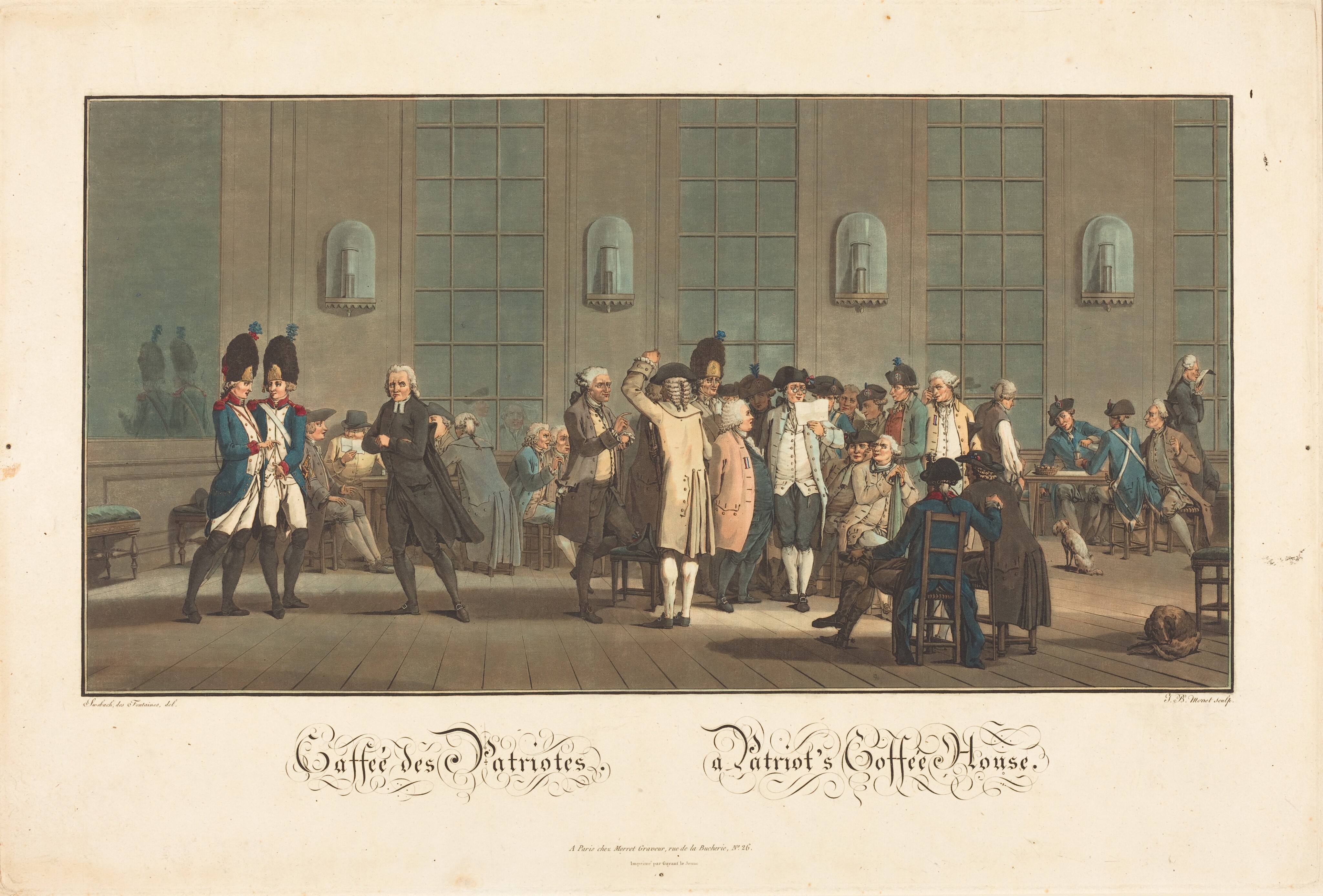
That is different from virality. It is circulation, and perhaps that is the eighteenth-century technology worth recovering.
Artificial intelligence makes the possibility stranger still. The internet dramatically reduced the cost of distributing an argument. AI is now reducing another cost: the labor required to turn thought into communicable form. The interesting possibility is not that artificial intelligence will make thought cheap. We have no shortage of cheap thought. The possibility is that it can make the circulation of expensive thought cheaper.
Knowledge still costs something. Experience costs something. Expertise costs something. Attention costs something. Changing your mind may cost quite a lot. But the machinery required to move the products of those things from one person to another is suddenly becoming extraordinarily inexpensive.
For a disabled person, that possibility has particular force. Disability produces knowledge. You learn where systems fail because your body encounters assumptions other bodies can ignore. You learn which journeys contain no redundancy. You learn the difference between something being theoretically available and actually usable. You learn how much private labor is required to compensate for public systems that nearly work.
Usually this information remains experience. What happens when the person having the experience can also publish? What happens when many more people can?
That question brings me back to Scott-Heron. “The Revolution Will Not Be Televised” was never merely a prediction about whether television networks would cover political upheaval. Scott-Heron was attacking the fantasy that transformation could be consumed like entertainment. You cannot watch your way into participation. At some point the screen ends and the world begins.
That proposition seems stranger now than it did in 1970 because we have spent half a century making the screen larger. Perhaps the exhaustion many of us feel with social media is not really exhaustion with other people. Perhaps it is exhaustion with being continuously connected to people without being asked to think very much with them.
I don’t want another audience. I want somebody to tell me why I am wrong.
Read the argument. Find the weak assumption. Bring evidence I missed. Write an answer. Publish your own pamphlet. Make mine obsolete. That is not hostility. That is a public.
Thomas Paine did not need every colonist to agree with Common Sense. He needed an argument to become available for argument. Other people could read it, reject it, answer it, carry pieces of it elsewhere, or discover that it gave words to something they had not yet been able to articulate. The revolution required circulation, but circulation alone was never enough. It required minds at work.
Perhaps whatever comes after the feed will too: not another enormous audience assembled around attention, but smaller publics assembled around questions; not infinite connectivity, but sustained encounters between people who have done enough work to offer one another something worth considering.
A person brings experience. Another brings knowledge. An argument passes between them, and another mind is willing to answer. After everything we have invented, perhaps that is still enough to begin.
Gil Scott-Heron was right. The revolution will not be televised. And it will not be peer reviewed either.
It may, however, be lightly footnoted from time to time.