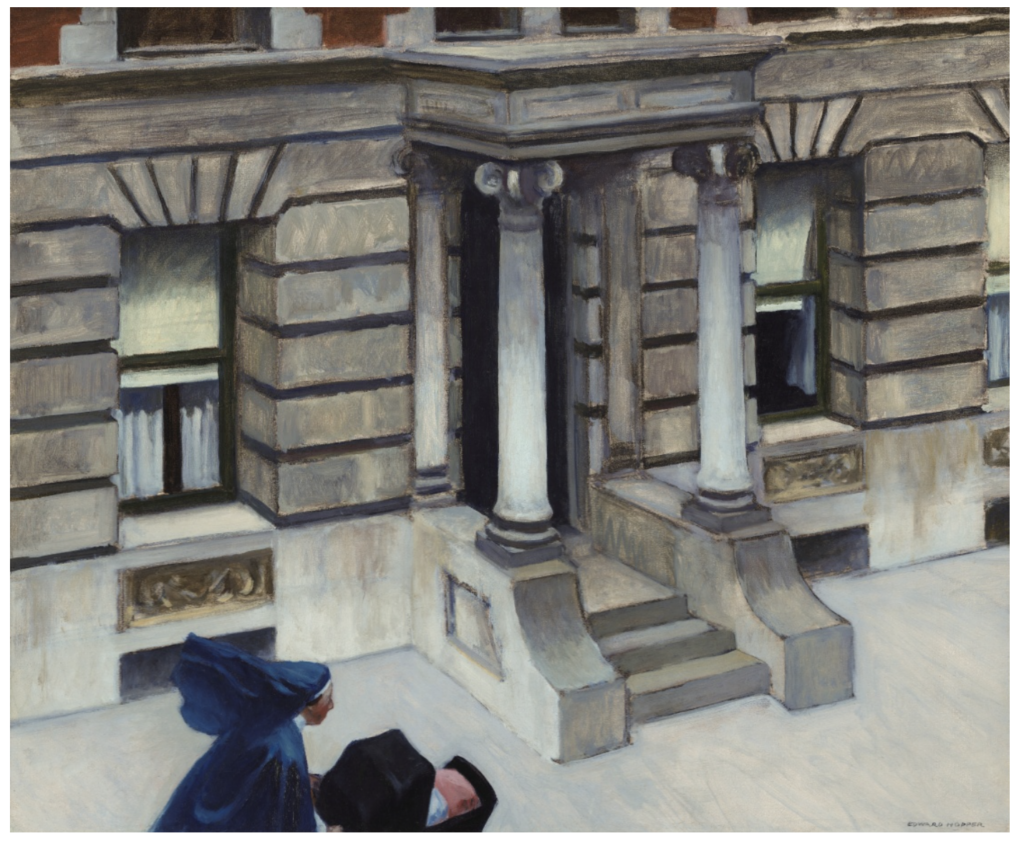
Edward Hopper, New York Pavements, 1924. The building does not prevent the caregiver and child from entering. It simply leaves someone else to solve the stairs. Infrastructure can appear to work because human beings quietly absorb the labor of its failures. Courtesy of the Chrysler Museum of Art, Norfolk, Virginia.
Andrew J Lewis
I began thinking about pedestrian ecology because my town kept trying to solve pedestrian problems one object at a time.
A sidewalk was a sidewalk problem. A path was a parks problem. A tree was a tree problem. Stormwater belonged somewhere else. Accessibility appeared when somebody invoked the ADA. Traffic might belong to the county or state. And the person trying to get from her house to the swimming pool had the irritating habit of experiencing all of these things simultaneously.
I live in Somerset, Maryland, a small incorporated town just outside Washington, D.C. It is leafy, affluent, walkable by many conventional measures, and compact enough that almost anywhere in town looks close to anywhere else. Then I began using a power wheelchair, and the geography changed.
A curb became significant. So did surface material. A narrow passage between a utility pole and a hedge could determine whether a route existed at all. A beautiful wooded path might connect two important places for everyone except me. Tree roots affected pavement; pavement decisions affected trees. Drainage shaped surfaces. Construction redirected travel. A perfectly accessible destination could become inaccessible because of the 200 yards immediately before it.
None of these observations is particularly profound. Taken together, however, they suggest that we may be using the wrong unit of analysis.
The pedestrian experiences an ecology
Pedestrian ecology is the network of physical, institutional, environmental, and social conditions that determines whether a person can move through a place continuously, safely, and with dignity. The key word is ecology.
An ecology is not a collection of independent objects. Change one part and other parts respond. A sidewalk exists alongside trees, driveways, drainage, streets, utilities, property lines, paths, destinations, maintenance practices, weather, budgets, laws, and human bodies.
Municipal governments understandably divide these things into manageable responsibilities. Trees go to one committee or department. Roads go somewhere else. Parks have their own plans. Stormwater has engineers. Accessibility may be treated as compliance. Capital projects live in budgets. Maintenance happens on another schedule.
The pedestrian receives no such organizational chart. She (or he) receives a journey.
HOME → SIDEWALK → CROSSING → PATH → PARK → POOL
The institutions responsible for that journey may instead see:
PRIVATE PROPERTY → TOWN → COUNTY → PARKS → PUBLIC WORKS → TREES → STORMWATER → ADA → CONTRACTOR
That mismatch matters. The pedestrian experiences one trip. Government experiences nine responsibilities.
Somerset as a laboratory
Somerset is an unusually useful place to see this problem because it is so small. The town contains only a few hundred homes. Residents walk to a swimming pool, elementary school, parks, neighboring commercial districts, transit, and one another’s houses. Trees and landscaping are central to the community’s identity. So are quiet streets and pedestrian life.
But even here, pedestrian questions rapidly become systems questions. Should a path be paved? That depends on accessibility, drainage, tree roots, maintenance, environmental conditions, cost, and who owns the land. Should a sidewalk be added? That may implicate trees, rights-of-way, parking, stormwater, neighborhood character, construction costs, regional planning, and the needs of people who cannot safely use the street. Is a wooded trail accessible? That depends not merely on whether someone can enter it, but whether the surfaces, slopes, widths, connections, and destinations create a continuous usable route.
Traditional municipal decision-making tends to separate these questions because institutions need categories. Human movement keeps putting them back together.
Start with the journey
A pedestrian-ecology approach would therefore begin somewhere different. Not with What should we do with this sidewalk? but with What journeys are people trying to make?
Map the journey from home to school, home to park, home to pool, home to transit, home to commercial district. Then identify the discontinuities: Where does the wheelchair stop? Where does the child enter traffic? Where does the older resident avoid walking? Where does stormwater repeatedly damage the route? Where does a tree create a conflict that could have been anticipated twenty years earlier? Where does responsibility pass from one government or department to another? And where does a perfectly reasonable decision about one piece of infrastructure make the whole journey worse?
This doesn’t mean accessibility automatically defeats trees, or sidewalks defeat stormwater, or pedestrians defeat cars. Ecology doesn’t eliminate tradeoffs. It makes the tradeoffs visible before the concrete is poured, the tree is removed, the path deteriorates, or the resident discovers that the supposedly walkable community does not include her.
From accommodation to infrastructure
Disability makes these failures easier to see because disabled bodies encounter system boundaries quickly. But pedestrian ecology isn’t principally a disability framework. Parents pushing strollers experience it. Children experience it. Older adults experience it. Runners experience it. People carrying groceries experience it. Someone temporarily using crutches experiences it. Eventually, almost everyone does.
The wheelchair is useful because it functions almost like diagnostic equipment. It reveals discontinuities that other bodies can sometimes compensate for without noticing. That suggests a different role for accessibility in municipal planning.
Instead of asking near the end of a project whether something is ADA compliant, ask near the beginning whether the pedestrian ecology actually works. Compliance remains necessary. Continuity is the larger goal.
A small-town question with larger implications
Somerset did not create the fragmentation that produced this problem. American government and infrastructure are full of jurisdictional seams. Transportation, land use, environmental regulation, disability policy, utilities, parks, and private property developed through different institutions for understandable reasons. But human beings keep crossing the seams.
That makes small towns potentially useful laboratories. Their scale allows entire journeys to be observed, mapped, changed, and observed again. A town could identify five common journeys, document them with residents using different forms of mobility, map physical and institutional discontinuities, estimate lifecycle costs rather than installation costs alone, test interventions, record what works, and then repeat.
The result would not be a master sidewalk plan. It would be something more useful: a model of how people actually move through the community.
I began thinking about pedestrian ecology because I wanted to get around my town. The more interesting question now is whether looking at the town from a wheelchair revealed something that applies far beyond it.
Perhaps the sidewalk was never the system. The journey was.