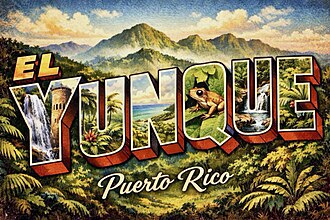
Vintage color postcard of El Yunque, Puerto Rico, published by Tichnor Brothers in 1954. The view shows the densely forested mountains of El Yunque rising above tropical vegetation. Public-domain image via Wikimedia Commons.
Andrew J Lewis
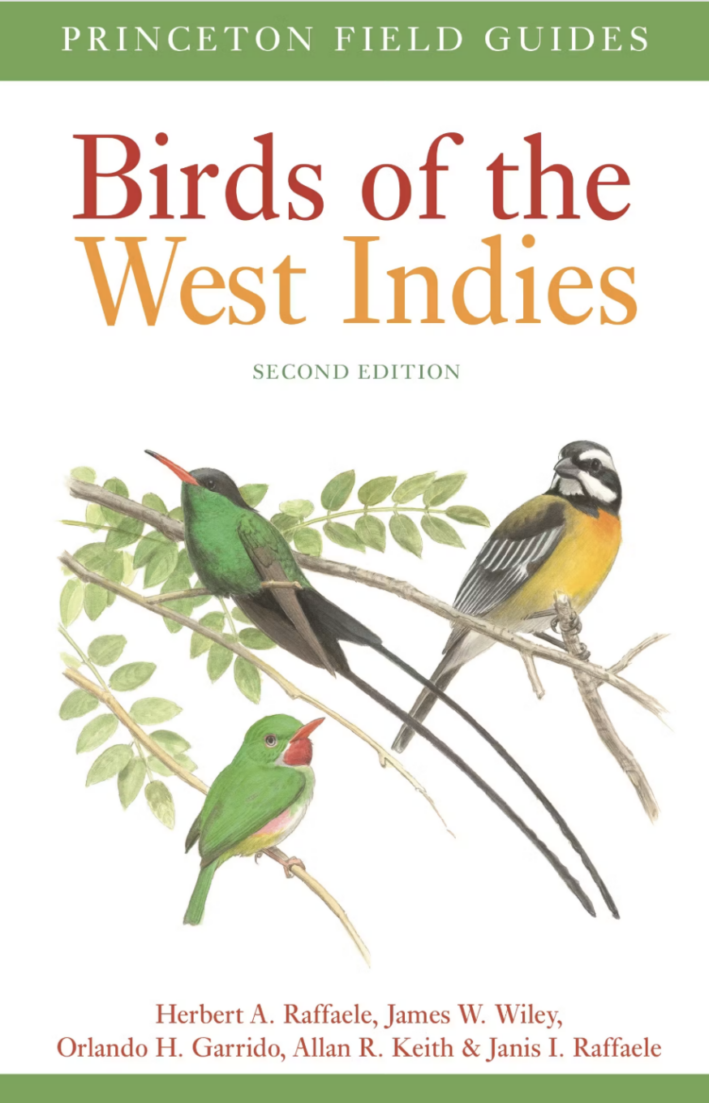
I am not a conspiracy theorist, generally. I do subscribe to one highly specialized conspiracy theory: publishers of bird field guides deliberately put birds on the cover that are difficult enough to see that otherwise sensible people begin planning international travel to locate them.
Sometimes this is unavoidable. The bird lives at the end of a road that becomes a trail that becomes an increasingly optimistic conversation with a local bird guide. Fair enough. Other times the bird isn’t especially rare. It simply lives in one place on Earth.
Take the Puerto Rican Tody. Or at least one of the Caribbean todies, if I’m being honest. Because I still can’t tell you which species adorned the cover of my Princeton Field Guide to the Birds of the West Indies. It hardly mattered. There sat this tiny emerald-green bird with a ridiculous little red throat and bright red bill, staring back at me every time I noticed the book.
At some point, one of us was going to have to make the trip. When my wife suggested a family vacation to Puerto Rico with a few days near El Yunque National Forest, the matter was settled. The tody won.
My relationship with Caribbean birding, however, had not gotten off to an encouraging start. During the pandemic we cashed in a mountain of airline miles and took the kids to the U.S. Virgin Islands, one of the few places Americans could visit without too much fuss. I arrived carrying my brand-new field guide with visions of dazzling tropical birdlife.
I believe I saw approximately eight species. Three lifers.
My birding consisted largely of peering out rental-car windows, standing in parking lots, and walking only as far as my legs would cooperate before quietly pretending they were still cooperating.
The Virgin Islands struck me as beautiful enough but, from a birding perspective, oddly claustrophobic. The best bird was probably a White-tailed Tropicbird soaring over Epstein Island, which remains one of the stranger sentences I’ve ever written.
The field guide came home with me. So did some unfinished business. Did the little green bird beckon me like an insatiable muse? No, silly. Life moved on. But it annoyed me.
By the time we decided on Puerto Rico a few years later, however, the conditions had changed. I knew a little more about Caribbean birds and, more importantly, I had acquired a power wheelchair. Meaning: my odds had improved considerably.
Dad’s Bird Adventure
The day before our round of golf, I dragged the family up El Yunque for an obligatory feature of all Lewis family vacations: Dad’s Bird Adventure.
They should be grateful. The previous winter’s installment involved a successful search for a Great Gray Owl in the Sax-Zim Bog of northern Minnesota, where the rental minivan got stuck in the snow. Do not feel sorry for them, reader. This was a literal trip to the beach.
We drove around the national forest, stopping whenever I shouted, “Bird!” or “There it is!” My wife is a wonderful traveling companion and a terrible birding driver. When I yell, “Stop!” she generally continues another quarter mile before asking, “Where?” By the time we’ve turned around, negotiated several boulders and returned to roughly the correct location, the endemic bird has migrated to the mainland.
Still, it was a pleasant day. We saw Puerto Rican Amazons. Admittedly they were inside an aviary as part of the recovery program, and I remain uncertain how to score that on my life list. They are critically endangered birds. They also look remarkably like seventeen other medium-sized green parrots. I am still thinking that one through.
Late that afternoon, while standing in a parking lot with binoculars around my neck looking hopefully into the forest, a local bird guide wandered over. We started talking. Less than a minute later, my wife and I were scheduled for a bird walk the following morning at seven.
There was one complication. My son and I had an 11:15-ish tee time.
Predictably, my wife and I arrived for birding around 7:45. Travel does this. LGMD2B does this. Nothing involving me occurs quite as quickly as I’d like. And now the clock was already running, so somewhere between the bird guide and the first tee lay the elaborate choreography required to get me from one activity to another on a family vacation.
Our trio started up the road. For a while, nothing particularly interesting happened. Birds, certainly, but ordinary birds. Then we reached the chain.
You could lift it. Beyond it, tall grass and brush obscured the road for a short distance, apparently intended to reinforce the message that people were not supposed to proceed farther. We proceeded farther.
Twenty or thirty seconds later our guide stopped. “Puerto Rican Emerald.” There it was. Well, that was quick.
Twenty feet farther: Green Mango, another Puerto Rican endemic hummingbird. Then, perhaps ninety seconds later, the Emerald returned. For a moment we had both birds in good light, close enough together that even I could compare them without having to remember what somebody had told me three minutes earlier.
How very thoughtful and efficient. I know perfectly well that the birds of El Yunque had not arranged themselves along an abandoned U.S. Army road for my taxonomic convenience. It only felt that way.
We moved another hundred yards or so and apparently reached the tree-topper department: Puerto Rican Bullfinch, Puerto Rican Spindalis, Puerto Rican Tanager. Not all in the same tree. That would have been ridiculous. Instead, they appeared across a moving stretch of perhaps 250 feet, which was somehow funnier.
Can’t distinguish the bullfinch from the tanager? No problem. Move fifty feet. Still uncertain? Try another seventy-five. There’s your answer.
The Puerto Rican Tanager, I should add, may be the least visually ambitious tanager I have ever encountered. A family of birds famous for kaleidoscopic brilliance somehow also produced this perfectly pleasant olive-brown example. The janitor in overalls at the Tanager family reunion.
We kept moving. Every so often our guide would say something like, “The habitat changes a little farther up…” and then, bam!, another bird. Bam is not a word usually associated with birding. That morning it fit.
A Puerto Rican Lizard-Cuckoo shot across the road. I got only the flyby, but there is only one bird in that forest shaped quite like that with a tail quite like that. Our guide confirmed the identification, which makes it gospel as far as I’m concerned. Every so often El Yunque threw in a Magnolia Warbler or an American Redstart for fun.
At one point we encountered an Empidonax flycatcher whose distinguishing feature is a refusal to possess a distinguishing feature. “Which one?” I asked. The guide told me. To my core, I believed him. Licensed-and-bonded-bird-guide rules.
By then this was getting a little ridiculous. We had seen nearly everything I could reasonably have hoped to see and considerably more than I had expected. Except the bird I’d come for. And we really did need to begin rolling downhill.
Lewis Family Birding Rules
This is where Lewis Family Birding Rules become important. Every family birding expedition has a declared destination species. Once that species has been observed to reasonable satisfaction, the objective is complete and the family is released. Incidental birds remain lawful. Scope creep does not.
You may encounter another magnificent bird on the way back to the car. You may look at it. You may marvel at it. You may exclaim loudly enough to embarrass your children. You may not say, “Well, since we’re already here…”
That is how families stop agreeing to go birding.
I had declared the Puerto Rican Tody. I had not yet seen a Puerto Rican Tody. But the tee time was not moving, so I said we probably ought to turn around anyway.
Our guide nodded. Then he pointed quietly into the understory. “There.” The Puerto Rican Tody.
Tiny. Ridiculous. Completely worth crossing an ocean for.
We watched it for several minutes. Then another appeared. And another. That was enough—not spiritually, contractually enough. The destination species had been observed to reasonable satisfaction. No scope creep. We turned downhill.
And because we were no longer bird-questing, what happened next felt even stranger. The morning nearly replayed itself: Emerald, Bullfinch, Spindalis. Not every bird, and not precisely the same order, but enough of them that the whole thing began to resemble a taxonomic exhibit operating in reverse.
Near the bottom, before the road disappeared again behind the tall grass and the chain intended to discourage people from doing exactly what we’d just done, we found one more tody. Not because we were looking for one. Because it was there. My farewell tody.
I took out my phone. The resulting 18 seconds of video will not be troubling the judges at the Macaulay Library. For most of the recording, the camera struggles heroically to establish that a bird is present at all. Eventually the tody comes into something resembling focus. It looks toward me, chirps twice, and poops.
The farewell tody. Twenty-two seconds of enthusiastic field documentation. Video: Andrew J Lewis.
MEDIA RECORD
Species: Puerto Rican Tody (Todus mexicanus)
Location: El Yunque National Forest, Puerto Rico
Observer: Andrew J Lewis
Media: Zapruder-quality video
Duration: 18 seconds
Recording quality: Enthusiastic
Archival value: De minimis
Behavior: Perching; vocalizing; defecating
Observer notes: Fulfilled.
A Different Kind of Birdie
By the time my son and I got onto the golf course, my morning with the todies was receding into the ordinary logistics of vacation. Now we had a different challenge.
The people in front of us were playing golf. Slowly. This is not unusual at a resort course over the winter. Indeed, one might reasonably argue that leisurely golf in tropical sunshine is among the principal reasons resort courses exist.
My son does not subscribe to this theory. Competitive golfers have a somewhat distorted understanding of how long golf should take. They hit drives 300+ yards, usually near the fairway. They hit greens in regulation. They occasionally put one in the water because golf remains golf, but they generally do not spend eleven minutes searching through tropical vegetation for a ball they hit 143 yards off the tee. The rest of golfing humanity does, and so we waited.
Somewhere around the eleventh or twelfth tee, with my son becoming increasingly exasperated, a single caught up with us. He was a Puerto Rican gentleman wearing World Baseball Classic gear. “Mind if I join you?” Of course not. I’ll call him Miguel; I’ve changed a few identifying details.
At first, Miguel was another golfer. Then, over the next few holes, he became increasingly difficult to explain. He had gone to graduate school at Yale. Okay. He had a Ph.D. in something considerably more remunerative than American Studies. Okay. He had gone on to professional success and eventually returned to Puerto Rico, where he now seemed to spend a gratifying amount of time playing golf, watching baseball and following his grandson around. Okay.
Then came Puerto Rican baseball. Miguel hadn’t merely watched it. He had played it seriously, against, alongside, or within one conversational degree of an alarming number of baseball players whose names I knew from childhood.
Another hole, another story. The conversation wandered the way golf conversations do. Baseball. Children. Careers. College. Puerto Rico. Minnesota, somehow. Miguel had been ice fishing there. Of course he had.
Then Yale came around again. I told him I’d studied American Studies.
Miguel looked at me. “Oh, American Studies? Wow. That was a heck of a program when I was there.”
That landed harder than he could possibly have known. For years I had carried Yale American Studies around as evidence in a case against myself: historian, professor, denied tenure, gone. A different career blossomed. Disability advanced.
Miguel knew none of that. He had simply heard American Studies and recognized something I had spent years treating as evidence of failure. “That was a heck of a program.” Then he and my son hit their golf balls.
My son had his own experiment underway. The previous summer I’d watched enough of his putting to notice a pattern. He’s left-handed, and when his attention wandered or he started correcting for the previous stroke, the toe tended to open. The predictable miss was left.
Golf equipment can become absurdly technical very quickly, and I am exactly the sort of person who regards this as an invitation rather than a warning. So, for Christmas/Hanukkah/Winter Commercial American Gift Giving, I bought him a TaylorMade putter with substantially more toe hang. This was perhaps his second or third round with it.
For most of the day, nothing miraculous happened. This is an important feature of golf equipment. If a new putter immediately produced seventeen one-putts, the golf industry would have solved golf sometime around 1974.
Then Miguel joined us. Shortly thereafter, the dang thing caught fire.
My son made an eleven-footer for birdie, then a routine par. Another birdie from about fourteen feet. Another par without the whiff of bogey. Four of the last five holes began to look less like the golf I witness with my son and more like the golf I watch on television: drive, fairway, approach, green, putt, next hole.
Golf is exceptionally difficult right up until someone hits the ball where he or she intends it to rest and then does with the ball what she or he intends to do. At which point golf looks ridiculously easy.
Miguel noticed. His son had been an elite junior golfer and remained one of those infuriating scratch players who can neglect the game for months, rent eight mismatched clubs, buy one sleeve of balls and shoot par without a glove. So Miguel knew what he was watching. And my son knew Miguel knew.
Between shots Miguel offered him some early-career advice about finance. They talked. Then my son would hit another golf shot.
At some point the whole afternoon became faintly ridiculous. A Yale-educated professional who had played serious Puerto Rican baseball, raised an elite golfer, gone ice fishing in Minnesota and wandered onto our tee box kept producing another strangely overlapping piece of biography every few holes.
I had no useful theory of Miguel. Spy seemed unlikely. Some kind of sleeper agent dispatched directly into my subconscious seemed unnecessarily elaborate. Small world remained available. So did: just an interesting guy we met on a golf course.
By the eighteenth tee, Miguel had a scheduling problem. His grandson was at baseball practice. He could probably finish the hole, but it would be close.
“You can be a little late,” he said. “But after a while you start looking like the forgetful grandfather.” He smiled. “I don’t want that reputation.”
Miguel teed off. When we reached his ball, he picked it up. We took off our hats, shook hands and said our goodbyes. He headed toward the clubhouse.
My son and I finished. His approach found the eighteenth green, perhaps twenty-five feet from the hole. I was ready to be done. It had been a long day. Birds. Golf. Wheelchair. Travel. Little negotiations that never disappear, even on holiday.
My son studied the putt and rolled it. The ball started on its line, kept going and disappeared. Birdie. Three of the last five. No bogeys.
He pumped his fist and came toward me, more animated than I’d seen him all afternoon. “I knew I was going to make it.” He wasn’t bragging. He was marveling at himself. “I knew it.”
I didn’t have much to say. I’d watched him work at this game for years. We’d identified the miss, changed the equipment, and he’d kept working. Now we’d seen something click. Not permanently—golf doesn’t offer permanent—but it had happened. I was mostly content, a little in awe by proxy.
At the cart return I transferred into my wheelchair, and we began the usual end-of-round business: clubs, gear, phones, canes, whatever we’d scattered around the cart over four hours. Somewhere in the middle of it, Miguel breezed past us. Another nod goodbye.
Maybe thirty seconds later, I looked up. He was pulling out of the parking lot, the sun low enough now to throw that late-afternoon Puerto Rican gold across everything.
For the first time I got the complete picture: World Baseball Classic gear, beautiful sports car, license plate BEISBOL.
Of course. After everything he’d told me over the previous six holes, what else could it possibly have said?
I watched him start to pull away. Then I remembered. “¡Miguel!” He looked over. “¡Mi hijo también hizo birdie en el dieciocho!”
His eyes went wide. Really wide. He looked toward my son gathering his stuff, then back toward me.
He’d seen the other two. Now he knew how it ended.
We waved, and Miguel drove off toward El Yunque to pick up his grandson from baseball practice.