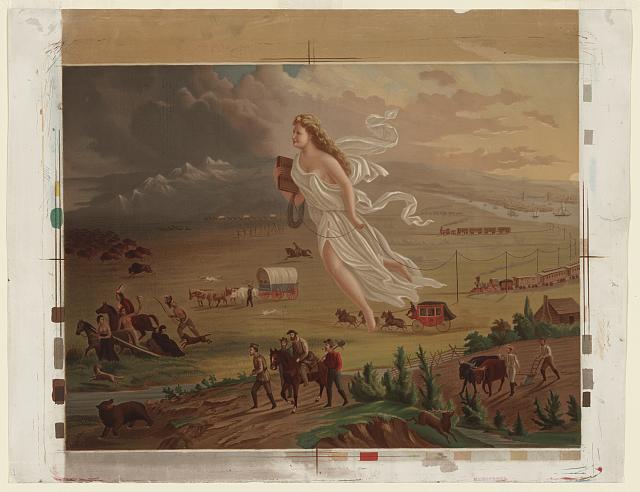
American Progress, ca. 1873, chromolithograph published by George A. Crofutt after John Gast’s 1872 painting. Library of Congress, Prints and Photographs Division.
Andrew J Lewis
I have spent much of the past year entering the world of disability innovation, and I keep hearing enormous numbers.
Here are two I trust. The World Health Organization estimates that 1.3 billion people—about 16 percent of humanity—experience significant disability. The OECD estimates that formal global research and development spending reached approximately $3.8 trillion in 2024. That doesn’t include every dollar we might reasonably describe as innovation, so the true number is larger.
Fine. The numbers are enormous. I am becoming less interested in them.
After enough conversations about the enormous scale of disability, the economic opportunity of inclusion and the capital theoretically available to address enormous problems, I have begun asking an embarrassingly unsophisticated question: Where is the stuff?
The Life Outside the Wheelchair
I don’t mean that nothing is happening. Quite the opposite. We have spent generations developing extraordinary technologies to help disabled people survive, move, communicate, hear, see and function. Medicine has extended lives. Wheelchairs have become sophisticated mobility platforms. Assistive technologies have expanded what human bodies can do.
Those investments matter enormously. But a disabled person’s life does not take place inside a wheelchair. It takes place in the world.
We live in houses. We raise children. We drive—or try to. We go to hotels, restaurants, schools, golf courses, parks, airports, swimming pools and workplaces. We travel with families, friends, caregivers, luggage, equipment, medications and complicated bodies. We want adventure, beauty, independence, spontaneity, privacy, pleasure and occasionally the ability to do something without turning it into a logistical operation.
WHO itself defines disability partly through the interaction between a person’s health condition and environmental and personal factors. It reports that disabled people are up to 15 times more limited by inaccessible and unaffordable transportation than people without disabilities. The United Nations’ Disability and Development Report 2024 finds that progress for disabled people has been insufficient on 30 percent of the Sustainable Development Goal targets it assesses; on another 14 percent, targets have been missed or progress has stalled or gone into reverse.
The world itself remains part of the disabling condition.
And this is where my confusion begins. I have spent enough time around disability innovation to encounter some of the same organizations, funders, advocates, technologists and ideas more than once. Smart people are having serious conversations. Reports are being written. Initiatives launched. Networks built. Money is moving. Good.
But then I leave the conversation, and I still have to figure out whether the bathroom works. I still need to know whether my wheelchair fits. I still encounter paths that become inaccessible when pavement turns to earth. I still need somebody to explain who owns the next step in an adaptive-driving process crossing evaluators, state agencies, equipment manufacturers, vehicle modifiers, insurers and licensing authorities. A few inches can still determine whether something is inconvenient or impossible.
These are not exotic problems. That may be the problem.
The Space Between Capability and Participation
We have become remarkably good at recognizing disability when it appears as a medical problem, technological problem or compliance problem. Those categories have institutions, specialists, funding streams and professional vocabularies attached to them.
But consider a different question: What conditions need to become true for a person to participate more fully in the life they want to live?
Sometimes the answer is a wheelchair. Sometimes it is information. Sometimes transportation, software, hospitality, physical design or community infrastructure. Sometimes nothing new needs to be invented. The necessary pieces already exist, but nobody has connected them around the experience of the person trying to use them.
The problem crosses categories. So does the person. This is increasingly how I understand the missing innovation market. It isn’t simply a market for better disability products. It is the enormous space between human capability and human participation.
We have innovated on the person far more aggressively than we have innovated on the person’s relationship with the world.
Imagine spending billions developing medicine that allows somebody to live longer, technology that allows them to communicate and a power wheelchair that allows them to move independently—and then sending that newly capable person into a hotel room they cannot use. The technologies worked. The life didn’t.
Or consider the wheelchair itself. Extraordinary expertise may go into specifying it correctly: seating, controls, batteries, dimensions, positioning and transportation requirements. Eventually the chair arrives. Success.
Except now it has to enter a house. And a vehicle. And a restaurant. And an airport. And a hotel. And a park. And a bathroom. The wheelchair is finished. The mobility problem isn’t.
This is why I am increasingly skeptical when discussions of disability innovation begin and end with market size. We have established that the problem is large. The more interesting question is why problems this large can remain so ordinary.
Why are disabled people and their families still performing so much systems integration themselves? Why does essential knowledge remain trapped inside individual experiences? Why do apparently solved problems become unsolved again when someone crosses from healthcare to transportation, transportation to hospitality, sidewalk to park? Why does participation so often depend on knowing whom to call, what to ask, what measurement matters or how hard to push?
Those questions interest me more than another market-sizing slide.
Then Build Outward
Disability makes systemic failure expensive enough to see. A missing specification can determine whether a wheelchair works. A broken handoff can delay an adaptive vehicle for months. An inadequately described bathroom can determine whether a family can travel at all. For someone else, the same failures may produce annoyance. Disability can turn them into hard stops.
That makes disabled experience an unusually powerful place from which to design—not because disabled people are inspirational, unusually virtuous or deserving of charitable attention, but because systems reveal themselves clearly when ordinary workarounds stop working.
The opportunity is not to create a nicer collection of accommodations for disabled people. It is to build the infrastructure that allows human capability to become human agency.
Sometimes that infrastructure will be physical. Sometimes digital, commercial or civic. Sometimes it may be nothing more glamorous than preserving the right information across a boundary where it currently disappears.
But the starting point is different. Instead of asking how to insert a disabled person into a system that already exists, start with the life the person is trying to live. Then build outward.
There are 1.3 billion disabled people in the world. Humanity spends roughly $3.8 trillion a year on formal R&D alone. And the United Nations is still documenting substantial gaps in disabled participation in ordinary human life.
There is plenty of capital in the world. There is plenty of innovation. What appears to be missing is sustained attention to the space between what a person can do and what the world allows them to do.
That is where I work.