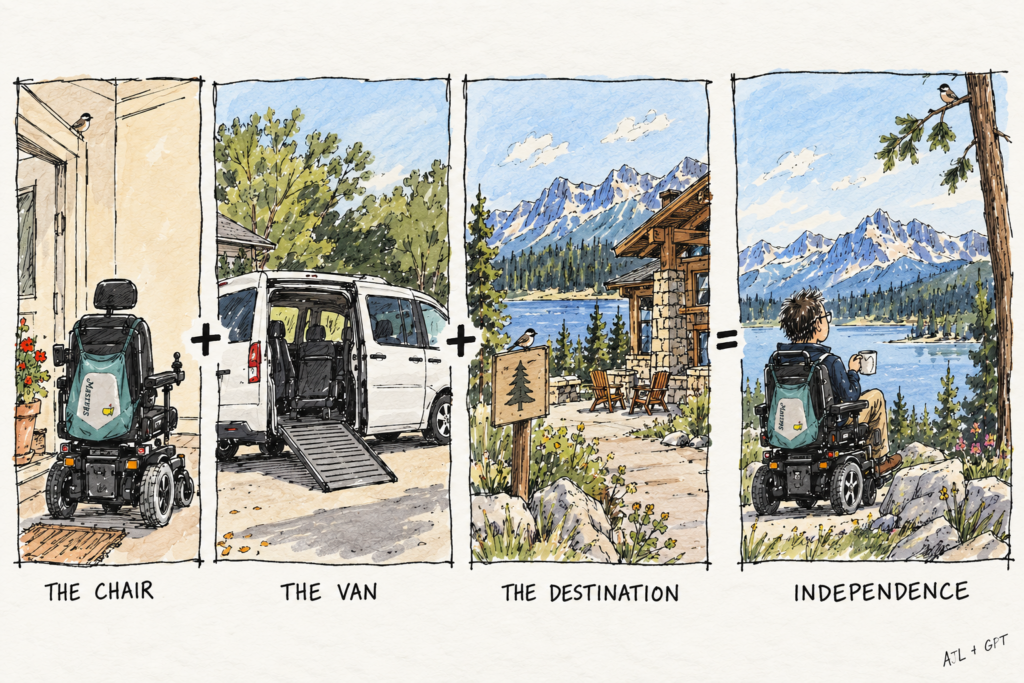
The Mobility Continuum illustrated. The chair + the van + the destination = independence. “Cartoon” by Andrew J Lewis + ChatGPT, 2026. Also, there is a Boreal Chickadee (Poecile hudsonicus) in here, because. The Cornell Lab has a riveting species account, should you wish to wander off before the essay has even begun.
Andrew J Lewis
A single body can move through three enormous systems and become a different person in each one.
When I acquire a wheelchair, I am a patient. My mobility is classified as durable medical equipment and mediated through healthcare: physicians, therapists, insurers, manufacturers and specialized vendors. When I acquire an adaptive vehicle, I become something else. Now I am a driver, consumer, client and occasionally applicant, moving among evaluators, state agencies, vehicle modifiers, equipment manufacturers, insurers and licensing authorities.
Then I arrive at a hotel. Suddenly I am a guest.
Nothing important about my underlying objective has changed. I am still trying to do the same remarkably ordinary thing: move through the world. The institutions have changed around me.
I have spent enough of my life moving among these systems to become fascinated by the discontinuity. Each system has developed its own vocabulary, expertise, records, regulations and assumptions. Each can become quite sophisticated within its boundaries. The problem is that my life does not observe those boundaries.
My wheelchair affects which vehicle I can drive. My vehicle affects where I can travel. Where I travel affects which hotel rooms work. The hotel room affects whether I can use the bathroom, sleep, transfer, charge equipment and get up the next morning prepared to do whatever supposedly brought me there in the first place.
From my perspective, these are not separate industries. They are Tuesday.
This becomes easier to understand if we stop treating mobility as a collection of products. A wheelchair is not mobility. Neither is an adapted van. Neither is an accessible hotel room. Each can contribute to mobility. But mobility itself is the continuing ability to get from where you are to where you want to be, do something there, and continue onward.
That sounds obvious until you encounter the systems responsible for producing it.
Consider the wheelchair. An enormous amount of expertise can go into specifying a power wheelchair correctly: seating, positioning, controls, batteries, dimensions, pressure management, transportation requirements and the particular capabilities of the person using it. Eventually the chair arrives. The healthcare transaction may now be substantially complete.
The person’s mobility problem is not.
The chair has to enter a house. It has to fit through doors. It may need to travel in a vehicle. The person may need to learn or relearn how to drive. The chair has to negotiate sidewalks, restaurants, airports, hotels, parks and bathrooms. Every transition introduces another institution with another definition of the problem.
This is one reason disability can make ordinary systems unusually interesting. A nondisabled traveler can encounter a broken handoff and compensate without necessarily noticing that compensation occurred. A hotel room isn’t quite what the photographs suggested. A path becomes unexpectedly narrow. A piece of furniture sits somewhere inconvenient. The rental car is different from the one expected. Annoying, perhaps, but often recoverable.
Disability can remove that margin.
A missing measurement can determine whether a wheelchair fits. A poorly described bathroom can determine whether a hotel stay works. A broken administrative handoff can delay someone’s ability to drive for weeks or months. A few inches of clearance can separate inconvenient from impossible.
Disability therefore has a useful way of exposing something that was already true: human experience is continuous even when institutions are not.
We tend to organize the world by industry, agency, profession and transaction. Healthcare does healthcare. Transportation does transportation. Hospitality does hospitality. Municipal government maintains streets. Parks departments manage parks.
People do not live that way. We wake up. We get dressed. We leave the house. We go somewhere. We work, eat, visit, swim, travel, shop, worship, play golf, walk the dog, pick up children and come home.
The continuity resides in us.
That distinction has changed how I think about accessibility. Accessibility is often treated as a property of individual things. Is this entrance accessible? Is this bathroom accessible? Is this vehicle accessible? Is this path accessible? Those are necessary questions. But they can miss the larger one:
Accessible to what end?
The objective is rarely to enter the building. The objective is to attend the meeting. It is rarely to occupy the hotel room. It is to take the vacation. It is rarely to possess a wheelchair. It is to move.
Once you start looking from that direction, apparently unrelated failures begin to resemble one another. The problem may not be that every institution is doing its own job badly. Sometimes each institution can be performing reasonably well according to its own definition of success.
The failure appears in the spaces between them. Nobody owns the whole journey because the whole journey belongs to the person taking it.
I call this the mobility continuum.
I don’t mean that mobility should become another giant system administered from somewhere above all the existing ones. That sounds horrifying. I mean something simpler: start with the person moving through the world. Then look outward.
What information has to travel with them? Where are the handoffs? Which assumptions change from one system to another? Where does uncertainty accumulate? Which problems repeatedly require the person or family to reconstruct context that already existed somewhere else?
And perhaps most importantly: where does somebody else’s finished transaction leave the human being with an unfinished problem?
These questions matter especially in disability because the consequences of fragmentation can be so high. But the underlying phenomenon is not peculiar to disabled people. Human lives routinely cross boundaries that institutions cannot see. Disability simply makes some of those boundaries harder to ignore.
A wheelchair user can be a patient at breakfast, a driver before lunch and a hotel guest that evening. Three industries may encounter three different customers.
There was only ever one person.
And he was trying to get somewhere.