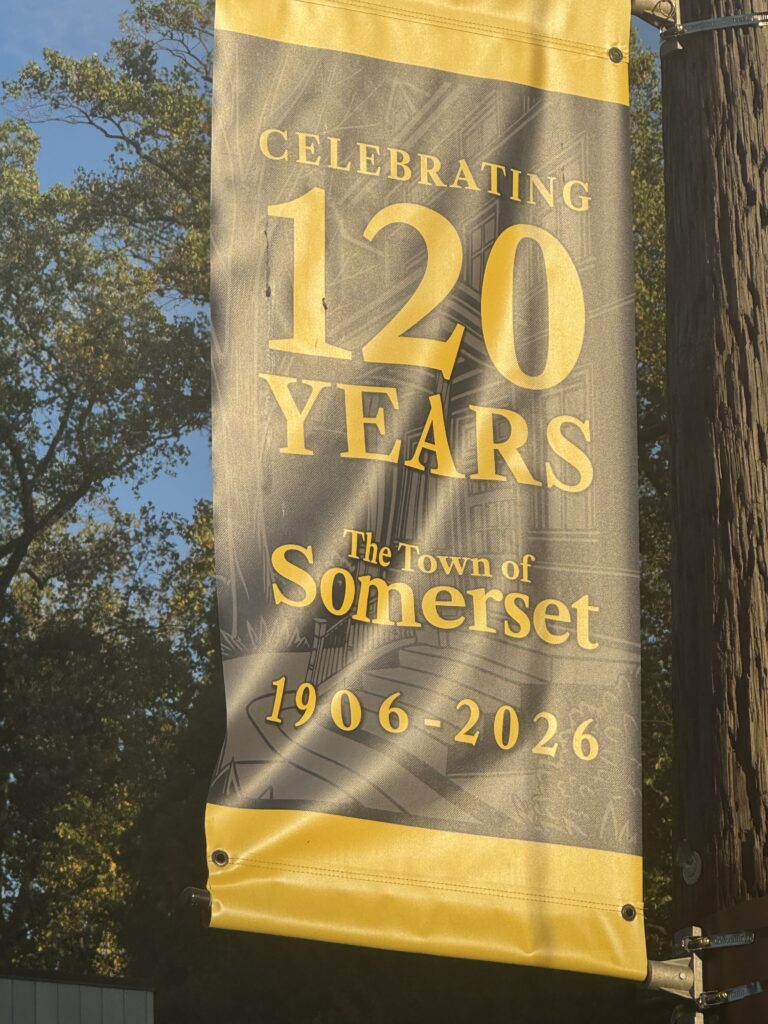
A street banner marking the Town of Somerset’s 120th anniversary, photographed in Somerset, Maryland, in 2026. Photograph by the author.
Andrew J Lewis
A municipal budget tells us how much a government spends. It also tells us what the government has learned to recognize.
The Town of Somerset’s FY2027 budget contains approximately $2.07 million in operating expenses and another $740,000 in capital spending. This is a small town, but it operates a real municipal government: professional staff, consultants, streets, sanitation, public facilities, recreation programs, trees, technology, insurance and substantial reserves.
The interesting thing is how clearly many of those responsibilities appear in the budget.
Somerset knows what it costs to operate Somerset. Personnel costs $588,241, including salaries for the Town Manager, Deputy Town Manager, Town Clerk, Public Works and Mayor, along with benefits and professional development. Another $358,757 purchases outside professional services: attorneys, accountants, permit administration, technology, consultants, landscaping support and an arborist.
The physical systems are equally legible. Sanitation receives $280,591. Streets and sidewalks receive $90,500 for operations and another $344,569 in capital spending for maintenance and replacement, consultants, traffic calming and lighting. Snow falls; Somerset has a category for removing it. A street deteriorates; there is money for repairing it.
Trees may be the clearest example. Somerset has an entire budget category called simply Trees: $55,500 in operating spending and another $15,000 for planting. Elsewhere sits a separately identified $25,000 arborist. That is at least $95,500 explicitly devoted to tree stewardship before considering any portion of the Town’s separate $30,000 landscaping and grounds-support budget.
Somerset can certainly see swimming. The pool receives $302,560 in operating spending and another $265,000 in capital improvements this year: filter system, shade structure, audio system, comfort furniture, bridge and parking-lot work. That’s $567,560 before the swim team enters the water.
The Dolphins are separately visible: $68,375 for coaches, team expenses, MCSL fees and the fiftieth-anniversary celebration. This isn’t a criticism. I spent much of the summer working on that anniversary. Somerset has decided that the pool and swim team are important parts of community life, and its budget reflects that decision with impressive clarity.
Then look for accessibility.
There is no corresponding budget category. No accessibility professional appears alongside the arborist, attorney, accountant or permit administrator. No recurring appropriation is labeled ‘accessibility.’ No capital category gathers accessibility improvements together.
That does not mean the Town of Somerset spends nothing on accessibility. It almost certainly does. A curb ramp may be a Streets and Sidewalks expenditure. An automatic door opener may be Town Hall maintenance. Accessibility work at the pool may be Recreation Facilities. A consultant may address accessibility through Professional Services.
Accessibility can therefore be present throughout the budget while remaining difficult to see within it.
And that distinction—between being funded somewhere and being institutionally legible—may explain more than the dollar totals do.
When a tree needs attention, Somerset already has a system capable of noticing it: a budget category, recurring funding, professional expertise, maintenance and planting. The same is true for streets, sanitation and the pool. These needs do not have to introduce themselves anew every time something goes wrong.
Accessibility appears differently. An inaccessible sidewalk is a street problem. An inaccessible forest path becomes a parks problem. An inaccessible entrance becomes a Town Hall problem. Each may have an institutional home, but the relationship among them can disappear.
Which brings me, somewhat uncomfortably, to myself.
I use a power wheelchair. During the past year I have encountered sidewalks I cannot use, paths I cannot enter, routes that disappear when pavement becomes earth, and an automatic door opener at Town Hall that did not open the door. Each incident belongs somewhere in Somerset’s existing organizational structure.
But I do not.
Or, more precisely: the recurring condition those experiences reveal does not appear to have an obvious institutional category of its own.
You cannot see me because I am not a budget category.
I don’t mean that Somerset should reorganize its finances around one resident or create an “Andrew J Lewis” line item. Nor do I think money spent on trees, swimming or anything else should be taken away. Those systems demonstrate something useful: when a community decides that something requires sustained stewardship, it creates ways to notice, maintain and improve it over time.
The FY2027 budget therefore raises a simple question.
What would it look like for accessibility to become equally legible?
Maybe the answer is a budget line. Maybe it is a responsible staff member, a recurring accessibility review, outside expertise, or some mechanism connecting accessibility failures across streets, parks, buildings and recreation. The organizational answer is not obvious from the budget.
The underlying problem is.
Somerset has developed sophisticated systems for caring for the things it recognizes.
I would like to become recognizable to the system.