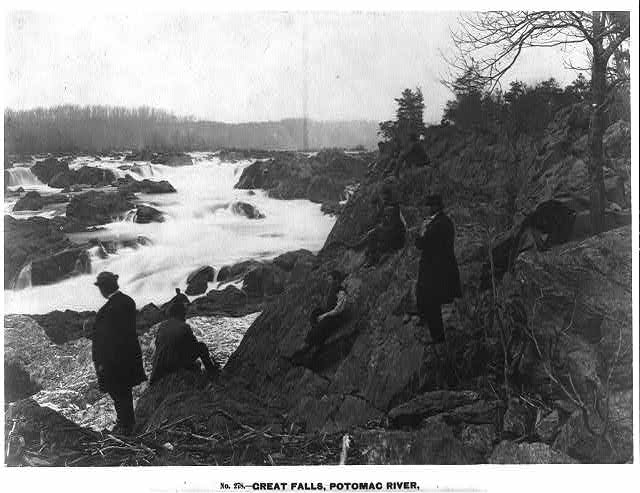
FIG. 1. GREAT FALLS, POTOMAC RIVER, 1864. For scale: this is a Great Falls. The Somerset Healing Bubbler is not this. Photograph by Andrew J. Russell, March 1864. Library of Congress Prints and Photographs Division. Great Falls of the Potomac River rushing through a rocky gorge, with several people standing on the rocks above the water.
Andrew J. Lewis
The Town of Somerset, Maryland contains a lovely little forest. And inside that forest is a small stretch of moving water that is not quite a cascade and certainly not a waterfall. Water passes over enough rock and grade, however, to produce a remarkably consistent and soothing sound.
This is the Somerset Healing Bubbler.
The name is ridiculous. The destination is not. Because it is exactly the sort of small public amenity that makes Vinton Woods valuable: moving water, mature trees, birds, shade and a place where someone might stop for ten minutes and simply listen.
I would like to go there. At present, I cannot. I use a power wheelchair, and the existing path through this portion of Vinton Woods is not usable by me. That recently led me toward a much larger question: How do we make Vinton Woods accessible?
That’s the wrong place to start, I realize now. Making “the forest accessible” is an abstraction. It immediately raises questions about paving, bridges, stream crossings, engineering, tree roots, drainage, environmental impact and cost. Those are legitimate questions. They are also an excellent way to make a small problem enormous before anybody establishes what we are trying to accomplish.
So, let’s try something smaller: Can Andrew J Lewis, resident of Somerset, get to the Somerset Healing Bubbler?
The human requirement is straightforward: a resident using a power wheelchair would like to enter Vinton Woods, travel to a pleasant place beside moving water, stop there, listen, watch birds and return independently.
Perhaps that requires modest path engineering. Perhaps an initial experiment uses wood chips, compacted material or some other natural-looking treatment. Perhaps a bench creates a destination useful to many people. Perhaps a forester, engineer or wheelchair user will explain why one of these ideas won’t work.
Excellent. That is what experiments are for. The objective isn’t to prove that Andrew’s solution is correct. Andrew doesn’t have one yet. The objective is to identify a worthwhile destination. Then study the user journey.
Why the Healing Bubbler?
There is a serious reason to choose this ridiculous destination. Research increasingly suggests that natural sounds can contribute to psychological restoration and well-being. A major 2021 review found that exposure to natural sounds was associated overall with improved mood and other positive health outcomes and with reduced stress and annoyance. Particularly relevant here, water sounds showed the strongest average results for positive health and mood outcomes, while bird sounds performed especially well for reducing stress and annoyance.
A newer review reached a broadly similar conclusion, finding evidence that natural-sound exposure can reduce anxiety and affect measures including heart rate, blood pressure and breathing rate, while cautioning that the underlying studies vary considerably.
And, rather wonderfully, the Summer 2026 issue of the Cornell Lab of Ornithology’s Living Bird includes Emily Nichols’s “Birding Influences Brain Health and Mental Health,” exploring emerging research connecting birding with brain health and well-being. (My own article, “The Great Swallow Debate at the Birth of America,” appears in the same issue. This proves nothing scientifically but does provide an amusing excuse to approach the Cornell Lab.)
None of this turns the Somerset Healing Bubbler into a medical treatment. It suggests something simpler: Access to nature means more than reaching a place. It means being able to experience what the nature offers.
For residents who can already walk into Vinton Woods, the creek moves, birds call, trees rustle and someone can stop and listen. For a resident who cannot get onto the path, the same public amenity might as well not exist.
Start with One Journey
So don’t begin by asking how to make all of Vinton Woods accessible. Start at the Healing Bubbler.
Where does the usable route end now? What prevents the wheelchair from continuing? Which portions of the existing path already work? Could modest improvements connect them? What surfaces, grades, drainage conditions and roots need attention? Where could someone stop without obstructing the path? What would maintaining the route require over time?
Then bring in the people who know things I don’t: foresters, engineers, accessibility expertise, park managers, neighbors who use the forest and other people using mobility devices.
Maybe the first experiment works. Maybe it fails. Maybe another destination proves easier, more valuable or less environmentally disruptive. All those outcomes produce useful information. And the Town of Somerset need not necessarily solve or finance the entire problem alone. Montgomery County and M-NCPPC/Montgomery Parks may have relevant expertise or adjacent infrastructure. Maryland already has funding mechanisms supporting local parks, trails and inclusive recreation. Outside funding or other partnerships may eventually make sense.
Cornell might even enjoy thinking with us about birds and accessible nature. Those possibilities can wait.
First, let’s see whether we can get one guy to one nice place beside the creek. No moonshot. No heroic bridge. No paving the wilderness. Just a resident using a power wheelchair who would like to enter his town forest, listen to moving water, look for birds and come home.
That is a sufficiently serious reason to experiment. It is also a sufficiently modest place to begin. Start with where someone wants to go. Then figure out how to get them there.
Sources
Natural sounds. Rachel T. Buxton et al., “A Synthesis of Health Benefits of Natural Sounds,” Proceedings of the National Academy of Sciences (2021). Review finding benefits associated with natural sounds, including water and birdsong. Buxton study.
Health recovery. Ruirui Zhu et al., “Effects of Natural Sound Exposure on Health Recovery” (2024). Meta-analysis finding reduced anxiety and some physiological effects, with variation across studies. Zhu study.
Birding and well-being. Emily Nichols, “Birding Influences Brain Health and Mental Health,” Living Bird (Summer 2026). Nichols article.
And, just for fun. Andrew Lewis and Frederic J. Frommer, “The Great Swallow Debate at the Birth of America,” Living Bird (Summer 2026). Same issue; considerably less therapeutic. Swallow article.