Andrew J Lewis
Most forgotten bird stories begin with a sighting. This one begins with a disappearance.
On a spring morning in 1785, a Massachusetts judge named Samuel Dexter wrote an unusual letter to the newly-formed American Academy of Arts and Sciences in Boston. His neighbor, he explained, had seen something strange when a pond was drained that spring: dozens of swallows, coated in mud, struggling up from the ooze “as if returning to life.”
Dexter himself had never witnessed such a thing. But his neighbor was insistent. Swallows, he claimed, did not migrate. They spent the winter underwater, buried in mud. Dexter trusted the man. More importantly, he trusted the observation enough to pass it along. So Dexter sent the account to people he considered better equipped to decide what it meant. Naturally, those people were naturalists.
If this story sounds unbelievable to modern birders, it sounded only slightly less so to Americans in the late eighteenth century. And yet for nearly half a century, the young United States carried on a vigorous, public debate about where swallows went each winter: flying south, sleeping underground, hibernating in trees, or lying submerged in muddy ponds in a state of suspended animation.
The debate became one of the first major scientific controversies of the new republic—and an early test of something Americans had not yet figured out: What should you do with an observation that appears to be real when nobody knows what it means?
A New Nation, Watching Closely
In the decades after Independence, Americans were determined to build not only a new government, but a new way of knowing. European naturalists—Georges-Louis Leclerc, Comte de Buffon chief among them—had long portrayed North American nature as inferior, unhealthy, even… degenerate. (Yes, it is acceptable to hiss.) Early republic Americans were eager to prove the Frenchman otherwise.
And nature, at least as Americans encountered and argued about it, became unusually participatory. People from across society contributed observations to newspapers and magazines—some printed directly, others filtered through neighbors, editors, ministers, physicians, and other intermediaries. Disabled people, enslaved people, Native Americans, women, farmers, millers, physicians, ministers, and judges all participated, although certainly not with equal authority or access.
Science had not yet hardened into a profession. There were no field guides, no binoculars, no satellite tags. If you saw something strange with your own eyes, you might write it down and send it in. The swallow question quickly became one of the era’s most popular puzzles. Everyone had a theory. Everyone had a story. And the stories were wonderful.
The Case for the Mud
In Pennsylvania, villagers watched swallows gather by the thousands on willows along the Lehigh River. One evening, entire flocks seemed to drop straight down and vanish. By morning, not a single bird remained.
In New York, a man named Peter Cole carried a spyglass to a local pond. He claimed to have seen two hundred swallows plunge into the water “in the twinkling of an eye.” Another eyewitness described what looked like moving mud lifted to a fire, from which stiff, silent birds slowly revived. In Vermont, farmers reported finding mud-stained swallows early in spring, barely able to fly, as if newly awakened.
Readers loved these accounts. They were dramatic, seasonal, and participatory. Anyone, anywhere, could potentially contribute another piece of evidence. And the new nation—still small, still largely rural—seemed full of places no one had properly studied yet. If America was a land of possibility, why not this?
There was another reason the stories survived: some of what people were reporting was real. Swallows really did gather in enormous numbers. They really did disappear suddenly at the end of the season. They really did skim across water, crowd into roosts, appear sluggish in cold weather, and sometimes turn up mud-stained in spring. The mistake was not necessarily in seeing something. It was in deciding what the seeing meant.
The Skeptics Strike Back
In 1796, a Philadelphia physician named Charles Caldwell decided to settle the matter by experiment. He captured two swallows just before their annual disappearance and submerged them in the Schuylkill River, one weighted head-first, the other tail-first, to mimic what believers described as “natural submersion.”
They drowned.
Caldwell published his results triumphantly. Swallow submersion, he concluded, was physiologically impossible. Americans needed to stop trusting stories and start trusting science. But many readers were unconvinced, partly because Caldwell’s birds had not chosen to enter the water, partly because an experiment designed by a physician did not necessarily reproduce whatever people believed they had witnessed in a pond, and partly because eyewitness testimony still carried enormous weight in a culture trying to determine the proper relationship among experience, expertise, experiment, and authority.
That disagreement is more interesting than deciding which side looks foolish from two centuries away. Caldwell was right about the birds. The eyewitnesses were wrong about the mud. But that did not make everything the eyewitnesses had observed imaginary. The problem was figuring out which part of the story was signal and which part was explanation.
What the Swallows Revealed
Migration itself remained mysterious. No one had tracked a swallow across continents. No one knew precisely where these birds spent the winter. And plenty of familiar animals—frogs, turtles, snakes—really did overwinter buried in mud. The people standing beside those ponds were reasoning by analogy from a natural world they knew. And they were trying to explain a genuine phenomenon: the birds were there, and then they weren’t.
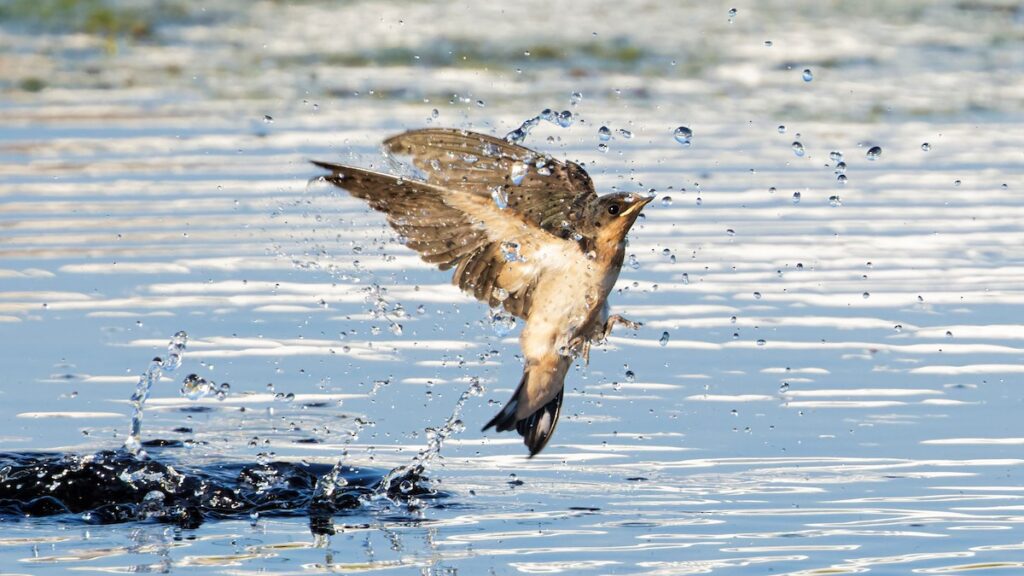
Modern ornithology gives us several reasons their stories could have seemed persuasive. Some swallows can enter torpor, a temporary low-energy state that can resemble lifelessness. Swallows skim water to drink and bathe. They roost in dense flocks. At dusk, enormous groups can descend rapidly into vegetation and disappear from sight. And then, seasonally, they leave.
A person could therefore watch something real, describe something real, and nevertheless be completely wrong about what had happened. That is not an unusual failure of human knowledge. It may be one of its fundamental conditions. We encounter the world first through signals: observations, experiences, patterns, anomalies, stories. Only afterward do we build explanations around them.
Sometimes the explanation is right. Sometimes the swallows are sleeping underwater.
What This Story Means Now
Eventually, migration won. Mud lost. But something important happened along the way.
For decades, Americans had to decide what to do with observations they could neither verify nor fully explain. Ordinary people noticed patterns. Naturalists proposed mechanisms. Physicians designed experiments. Editors published arguments. Readers compared accounts. Understanding advanced unevenly—through observation, error, disagreement, correction, and time.
That process did not require treating every observation as true. It required something harder: distinguishing between an observation and the explanation attached to it.
The swallows never rose from the mud. But people really did stand at the edges of ponds and watch them disappear. And for a while, observation outran explanation. Participation preceded permission. People noticed things before institutions possessed reliable systems for interpreting what they noticed. Some observations were mistaken. Some were distorted in transmission. Some were probably nonsense. Others contained signals whose meanings had not yet been understood.
That distinction matters because uncertainty presents two symmetrical temptations. We can believe an extraordinary explanation because someone sincerely reports an extraordinary experience. Or we can discover that the explanation is wrong and conclude that the experience therefore contained nothing worth hearing.
The swallow story suggests another possibility: listen to the signal. Interrogate the explanation. Keep them separate long enough to learn something.
Samuel Dexter’s neighbor was wrong. The swallows had not spent the winter underwater. But something happened beside that pond that was strange enough for one person to notice, another person to remember, and a third person to send onward into the machinery of American knowledge.
More than two centuries later, the explanation has vanished.
The observation remains.
More Swallows
If you would like more swallows—and, for reasons I cannot entirely explain, there are now several ways to have them—this story exists in three earlier versions, with varying quantities of academic machinery attached. It first appeared in 2005 as an article in the William and Mary Quarterly, then became the opening chapter of my 2011 academic monograph, A Democracy of Facts. This summer, it returned (this time with Fred Frommer, co-pilot) in Living Bird as “The Great Swallow Debate at the Birth of America.” Each tells essentially the same story for a different audience, with different questions, evidence, and tolerances for footnotes. And now there is this version, which appears to be what happens when the historian returns twenty-one years later, retrieves the swallows from the archives, and discovers that nobody is around anymore to make him behave.
2005 — “A Democracy of Facts, an Empire of Reason: Swallow Submersion and Natural History in the Early American Republic,” William and Mary Quarterly 62, no. 4 (October 2005): 663–696.
Read the article on JSTOR
2011 — A Democracy of Facts: Natural History in the Early Republic, Chapter 1, “The Revolution in Natural History Practice: Democratic Science and the Case of Submerging Swallows.” University of Pennsylvania Press.
A Democracy of Facts — Penn Press
2026 — “The Great Swallow Debate at the Birth of America,” with Frederic J. Frommer, Living Bird.
Read the Living Bird article