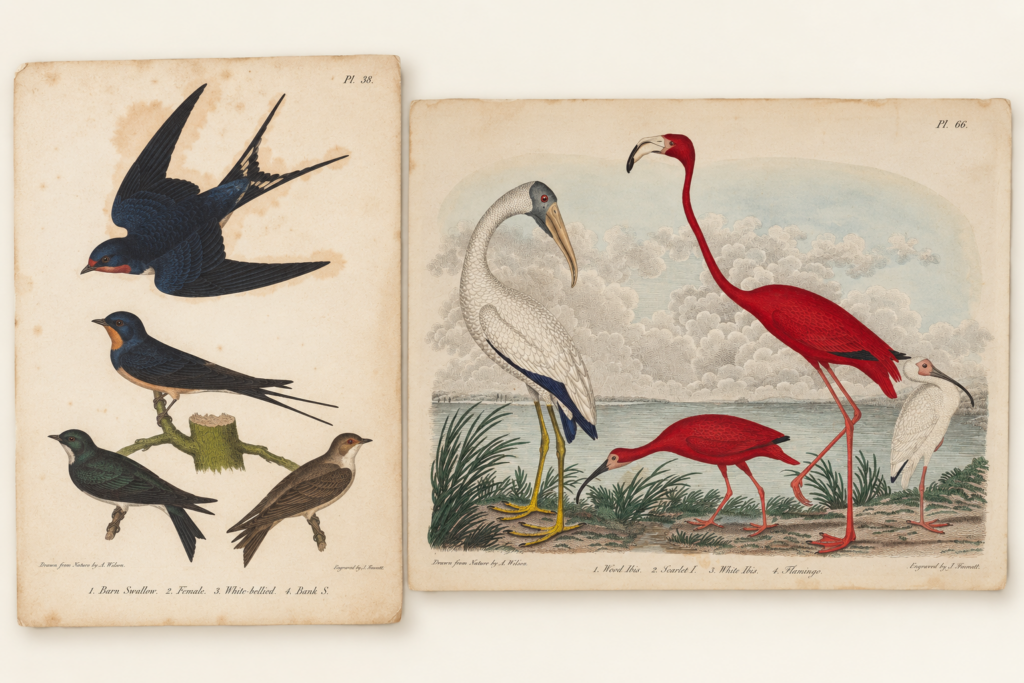
A modern composite based on two hand-colored plates from Alexander Wilson’s American Ornithology (1808–1814). At left, Plate 38 (1812): Barn Swallows, White-bellied Swallow (now Tree Swallow), and Bank Swallow; at right, Plate 66 (1814): Wood Ibis, Scarlet Ibis, Flamingo, and White Ibis. The original Plate 38 is held by Smithsonian Libraries and Archives and digitized by the Biodiversity Heritage Library; Plate 66 is in the National Gallery of Art. The historical plates are public domain.
Composite artwork: Andrew J Lewis + ChatGPT, October 2026.
Andrew J Lewis
I have a complicated relationship with Yale University.
To Yale I owe an enormous amount. It trained me as a scholar and writer. It introduced me to teachers who changed how I understood the past and, eventually, how I understood myself. It gave me access to libraries, archives, arguments, people, buildings with extremely impressive stonework, and an institutional confidence that I have spent much of the rest of my life alternately benefiting from and avoiding.
Yale also diagnosed me with two chronic conditions.
The first diagnosis began in 1997. I was twenty-five years old and something was wrong with my muscles. The initial diagnosis did not explain very much, and it would take another six years before the condition was finally isolated as LGMD2B, a rare form of degenerative muscular dystrophy. There is a much longer story about that diagnosis, what it meant, and what eventually happened to my body.
But Yale diagnosed the other condition much more quickly. That diagnosis did not come from a physician. It came from a humanist.
Her name is Dr. Joanne B. Freeman.
Freeman was particularly well prepared for a case like mine because, in retrospect, she had experienced something not entirely dissimilar herself. Her condition presented somewhat differently. It involved early national politics, Alexander Hamilton, honor, gossip, reputation, dueling, and the elaborate rituals by which extremely educated eighteenth-century gentlemen occasionally decided that the most sensible response to an insult was to stand in a field and shoot at one another.
Excellent planning on her part, as it turned out. Alexander Hamilton would have quite a future.
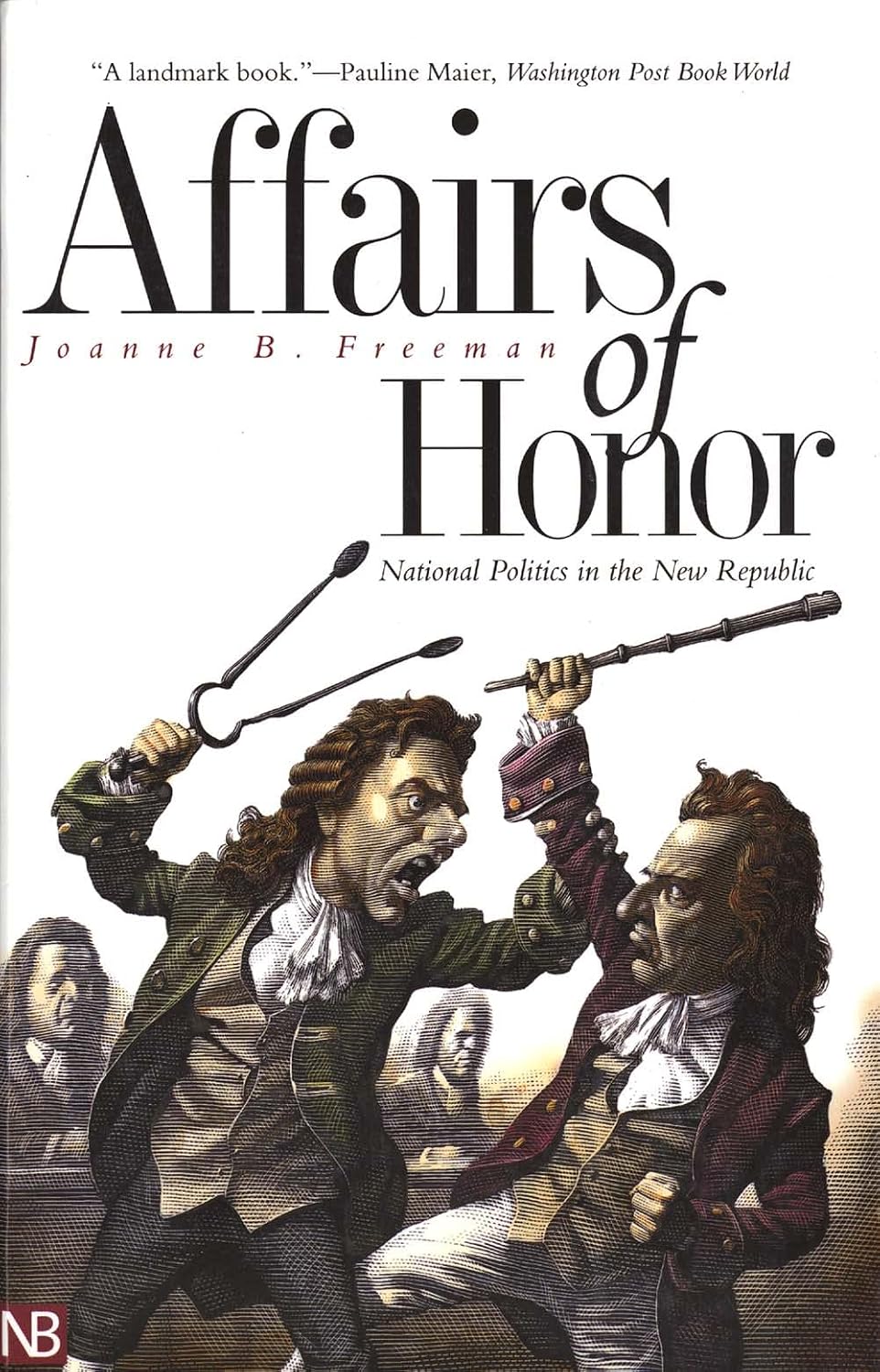
Freeman had done her doctoral work at the University of Virginia, studying the political culture of the early republic. Somewhere along the way, she realized that the politicians she studied inhabited a world with its own largely unspoken rules about reputation and honor, insult and response, gossip and print, challenge and duel.
Eventually she gave this system a name: a “grammar of political combat.”
Once Freeman could hear that grammar, the early republic sounded different. Behavior that might look irrational, melodramatic, or merely personal acquired structure. Gossip meant something. An insult meant something. A duel meant something. This insight became central to her scholarship and eventually to Affairs of Honor: National Politics in the New Republic.
Some years later, Freeman found herself looking across a table at a young graduate student who was having a somewhat different problem. Me.
I don’t remember the exact setting anymore, and I certainly don’t remember the conversation word for word. Memory has had thirty years to improve the staging. But I remember the diagnosis.
Freeman essentially said, “Andrew, have a seat.” So, I sat.
Over the next fifteen or twenty minutes, she explained how she had gradually learned to recognize the grammar operating beneath early American political life. Once she understood it, seemingly disconnected evidence began relating to other evidence. The archive started talking differently.
I remember being mesmerized. This was fascinating. But I was also beginning to wonder why she was telling me.
Then came the diagnosis.
“Andrew,” she explained, “I think something similar is happening to you.”
There are conditions like this that occasionally present among historians. Political historians seem particularly susceptible. Cultural historians probably carry it asymptomatically. In the natural sciences, of course, related conditions are everywhere.
But my presentation was unusual. She had looked at my work. She had listened to the questions I asked. She had watched the evidence I noticed and the strange connections I kept making among things that did not, to everyone else, necessarily appear connected.
And then Freeman told me something about myself that I have never forgotten.
“Andrew,” she said, “you speak a grammar of birds.”
I don’t remember what I said. I suspect I laughed. I also suspect that I had absolutely no idea what she meant.
Nearly thirty years later, the prognosis is becoming clearer.
The Symptoms
The strange thing is that Freeman didn’t make this diagnosis because I was a birder. I was. I am, but I’m not very good at it. She made it because birds kept appearing in my work.
One of the first substantial pieces of scholarship I wrote concerned an argument that now sounds wonderfully ridiculous: whether swallows migrated south for the winter or disappeared beneath ponds and spent the cold months submerged in mud.
This was once a serious scientific question.
Americans reported seeing enormous flocks of swallows descend toward ponds and vanish. Others claimed to have found birds buried in mud, apparently lifeless, only to watch them revive when warmed. Naturalists, physicians, farmers, ministers, newspaper correspondents, and assorted other observers argued about the phenomenon for decades. I loved the story.
But what interested me was never whether the swallows were in the mud. They weren’t. I wanted to know why people thought they were there, whose observations counted, how testimony moved through networks, how ordinary people participated in making knowledge, and how a new nation argued about a natural world it did not yet fully understand.
The swallows became my first article in the William and Mary Quarterly. Then they became the first chapter of my book.
This should probably have been considered diagnostic evidence.
But careers have a way of making their own evidence look ordinary. I became a historian. I wrote and taught history. Birds appeared when they were useful and disappeared when they weren’t. Freeman’s observation remained somewhere in my head, memorable enough that I never forgot it but not important enough that I thought I needed to do anything about it.
For years, I didn’t. Then, much later, birds became useful to me in a different way. I had begun writing little stories.
They weren’t quite scholarship, although they often contained scholarship. They weren’t memoir, although I sometimes wandered into them. They weren’t nature writing exactly. They were shorter, more voiced, occasionally ridiculous things in which history and observation and family and place kept colliding.
I liked them. This created a problem.
I had been trained to evaluate historical scholarship. I knew what a scholarly article was supposed to do. I knew how footnotes worked. I knew what happened when you submitted something to a journal and three anonymous people were invited to explain why you had misunderstood your own subject.
I had considerably less confidence that I knew when one of these new stories was good. Birds gave me a way to find out.
I wrote a story about using Merlin Bird ID, the Cornell Lab of Ornithology’s remarkable little application that can listen to the world around you and begin suggesting which birds are making the sounds.
Then I did something that felt surprisingly vulnerable. I sent the story to Cornell.
This was useful because the people at the Cornell Lab did not need anything from me. They had not trained me. They were not my colleagues. They had no reason to encourage an aging historian who had begun writing strange little stories about birds.
Weirdly, they published it.
Listening with Merlin Bird ID appeared in Living Bird in 2025.
So, I tried again.
This time I went back to an old historical argument I knew well: the early American fight over birds, migration, European claims of American degeneracy, and the astonishing amount of national meaning people once managed to extract from swallows. Cornell published that one too.
The Great Swallow Debate at the Birth of America appeared in Living Bird the following year.
Two stories do not constitute a literary movement. But they were enough. Enough, at least, to make me wonder whether Freeman’s diagnosis had been more consequential than I understood.
The Other Diagnosis
There is a peculiar symmetry here. My muscular disease worked one way. The symptoms came first. Something was happening to my body, but nobody could tell me precisely what it was. Years passed before the symptoms acquired a sufficiently precise name.
The birds worked in the opposite direction. Freeman gave me the name first. Then I spent nearly thirty years discovering the symptoms. I understand more now about what she saw.
A grammar of birds is not ornithology. I am not an ornithologist. It isn’t even birding, exactly, although I remain strangely compelled to find the little hobgoblins and they remain equally committed to almost being found. It is closer to a way of noticing.
Birds have an almost unreasonable ability to move between categories humans prefer to keep separate. They cross national borders without passports. They inhabit cities and forests, golf courses and battlefields, backyards and islands. They turn up in scientific arguments and political symbols, paintings and poems, technologies and family stories. They can carry histories of empire, migration, extinction, naming, belonging, observation, and home.
And once I notice one, something tends to happen.
A swallow disappears into a Massachusetts pond, and I end up wondering who gets to decide what counts as knowledge. A phone identifies a bird singing in the trees and I begin thinking about whether technology diminishes attention or can teach us to listen. A Puerto Rican Tody appears in a rainforest and somehow, I find myself thinking about Alexander Hamilton, American empire, disability, fatherhood, and what it means to arrive somewhere believing you understand the place.
And then there is the Eastern Phoebe. Sayornis phoebe.
That bird presents a particular problem because Phoebe is also the name of my daughter. At which point ornithology becomes almost completely useless.
Nearly thirty years after Freeman diagnosed me, I have decided to stop treating this condition as incidental.
I am calling the experiment BirdQuest.
It is not a birding project, exactly. It is not a history project, exactly. I don’t yet know what kinds of stories will belong here, which is part of the reason for doing it. There will be birds. There will be history. Family seems likely to intrude. So do disability, technology, travel, landscape, science, and whatever else the birds drag in with them.
The earlier Cornell stories helped me discover that I wanted to write this way. BirdQuest begins with the decision to follow the grammar deliberately and see where it leads.
Fortunately, I already know which bird goes first. A small gray flycatcher. Genus Sayornis. Species phoebe.
The luckiest one on Earth.