
Andrew J Lewis
A neglected consideration for prospective graduate students: choose the architectural language in which you would eventually prefer to experience ruminative shame.
This matters particularly in the humanities, where pursuing an advanced degree increasingly resembles knowledge-work YOLO BASE jumping. You may spend five to seven of your most energetic adult years becoming exquisitely qualified in a field whose labor market was already questionable before artificial intelligence arrived and began asking awkward questions about what, precisely, knowledge is.
Faculty fit matters. Funding matters. Placement matters. Libraries matter. But applicants should give considerably more attention to the physical environment in which they may someday conclude that they have squandered their talents and disappointed everyone who ever believed in them. Let me offer my experience to kick things off.
Choose Your Architecture
My undergraduate education at St. Olaf College in Northfield, Minnesota provided a sturdy foundation in what I would describe as Lutheran Limestone Shame. St. Olaf is a lovely place, and I remain enormously grateful for my education there. But Minnesota limestone communicates moral seriousness unusually well. It does not accuse. It simply stands there, pale and sturdy, suggesting that perhaps you have not been an adequate steward of the gifts entrusted to you.

Geologists classify limestone as a relatively soft sedimentary rock. Learned this at St. Olaf in Geophysics! This information is of little comfort when you hit the ground, however.
Graduate school offered varied choices. I was admitted to Yale, UCLA, Brown and Columbia. Princeton and Cornell rejected me and are therefore excluded from consideration. Cornell has recently undertaken meaningful reparative work, and its status may eventually be reconsidered. Also, within the Ivy League: Dartmouth is ineligible, despite my never having applied, because it later rejected my daughter. Cow college.
The consequential choice, in retrospect, was UCLA versus Yale. UCLA offered more money, which should have been a clue. Young prospective graduate students should understand that when an institution in Southern California offers you additional funding to study history beneath blue skies and palm trees, the universe may be attempting to communicate useful information.
Imagine my counter-narrative. My dissertation stalls in Westwood. I emerge from the library burdened by professional inadequacy and encounter… sunlight?! This isn’t going particularly well, Andrew. That’s unfortunate. On the other hand, it’s 74 degrees. Perhaps get a taco. Even complete professional collapse would eventually have had to compete with bougainvillea. (I know, I was also a Fellow at the Huntington Library in San Marino.)
Brown offered a different possibility. Providence was old enough and serious enough, but the brick seemed less judgmental. I can imagine arriving years later at the conclusion that my academic career had failed only to discover that failure was merely one among several legitimate interpretations of an unconventional professional trajectory. Someone would organize a seminar.
Columbia presented the opposite problem. You can fail spectacularly in Manhattan, but New York City will not notice. While you are contemplating your professional disappointment over coffee, three people younger than you will publish important books, somebody will sell a company, and the person at the next table will receive a MacArthur fellowship. The city does not judge you. It simply continues without you.
I chose Yale. Of course I chose Yale.
I was going there to study Puritan New England. Apparently, I looked at a future devoted to covenant, declension, impossible standards, anxious communities and people wondering whether they had adequately fulfilled the purposes assigned to them by history and God, then decided I should conduct this work surrounded by gargoyles as thought partners.

Yale offers magnificent Gothic shame. Its great twentieth-century buildings perform the remarkable trick of making a relatively young American university appear to have been evaluating inadequate scholars since the Middle Ages. Sterling Memorial Library is a cathedral to books. Courtyards close around you. Leaded windows imply judgment. Past scholars and mythical creatures occupy the stonework. If UCLA says, Bummer, man, Yale architecture says: You have failed the dead.
And here is the embarrassing part. Years later, after I had left academic life and spent a very long time feeling ashamed about how things had turned out, I began writing to some of my old professors again.
(This is not therapeutic advice. If you are experiencing profound post-academic shame, do not begin randomly contacting retired humanities professors. These poor people already carried an unreasonable share of the late-twentieth-century humanities burden and deserve peaceful retirements.)
But I did. And, coolest dang thing, some of them started talking back.
Nobody appeared particularly disappointed in me. Some seemed downright pleased that I was writing ‘history’ again. This was moving, reassuring and deeply inconvenient for a theory of professional failure I had spent years constructing and polishing.
Apparently, Yale had not imposed Gothic Shame upon me. I had simply selected an unusually beautiful place in which to manufacture it myself.
Go Elis! Beat Harvard!
The Theater Remains
Graduate schools don’t merely sell education. They sell an imagined future self, and the campus becomes the physical theater in which you rehearse becoming that person. Seminar rooms, libraries, pathways and buildings become attached to an expectation about who you will someday be.
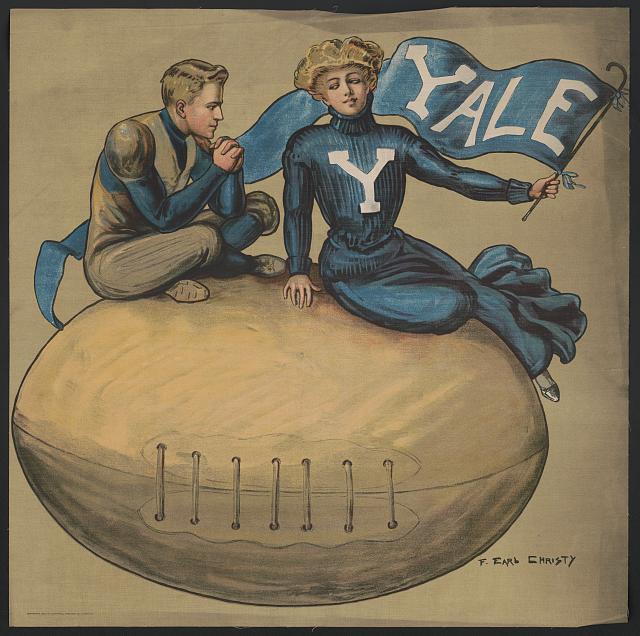
If that future arrives, wonderful. If it doesn’t, at least the theater remains.
I later held a postdoctoral fellowship at The McNeil Center and have only lovely things to say about Penn and Philadelphia, which is inconvenient for purposes of this essay. So, I offer this advice to the next generation of humanities graduate students, who are contemplating a professional future even less predictable than mine was.
Study the placement statistics. Compare stipends. Talk to faculty. Investigate health insurance.
Then walk around campus. Look carefully. Ask yourself: If everything goes spectacularly wrong, is this where I want to feel bad about it?
Choose your shame carefully.